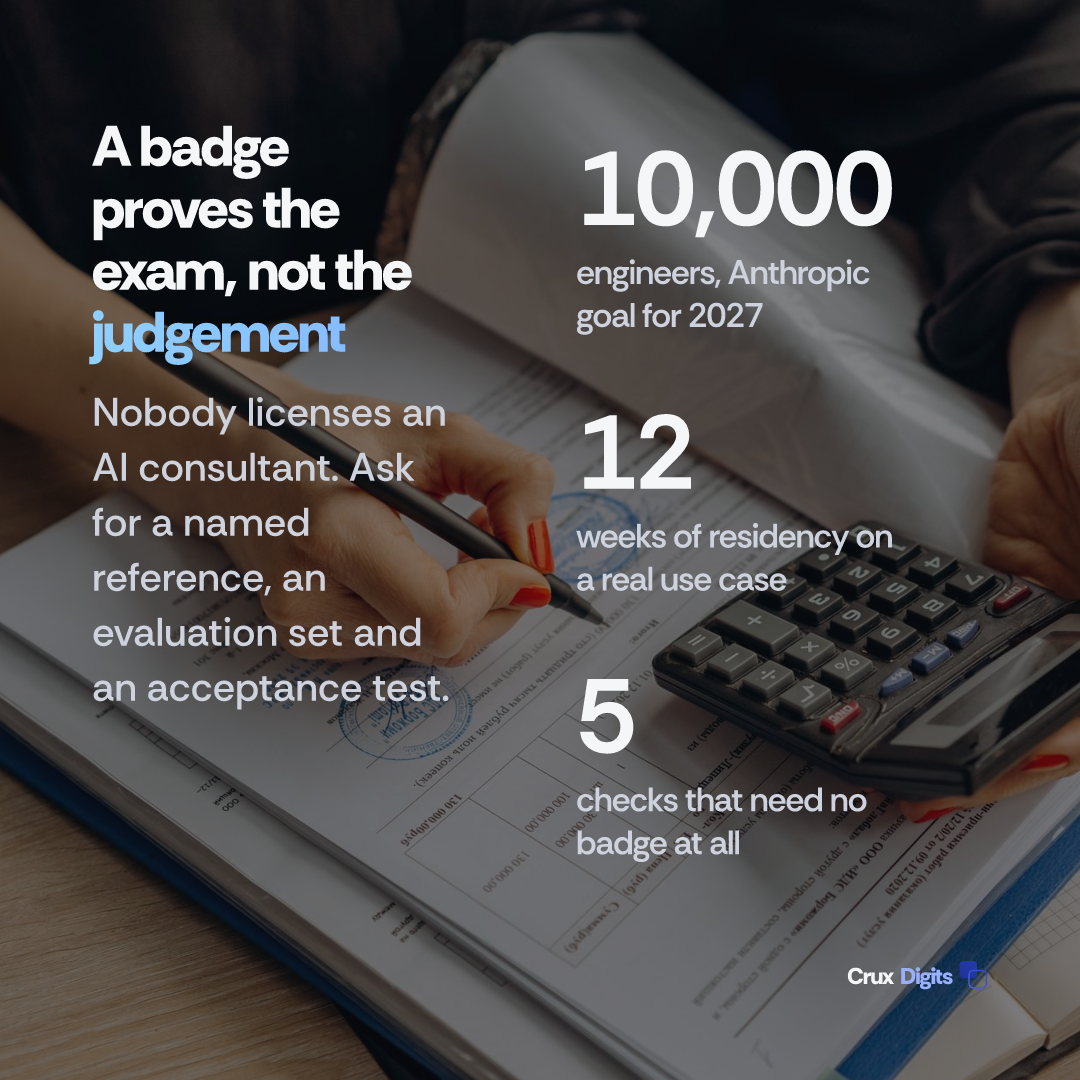
There is no licence, register or protected title for an AI consultant in the Netherlands, so the credential a consultant shows you is a badge, not a guarantee. A badge proves that someone passed an assessment. It does not prove that their judgement holds inside your company. What does: a named reference, an evaluation set from a past project, and an acceptance test written into the contract.
Can anyone call themselves an AI consultant?
Yes. As far as I know, nothing in Dutch law reserves the title, and I am not a lawyer, so check that with one before you build a contract on it. A business card, a LinkedIn headline and a website are enough. I think this is worth saying out loud, because buyers tend to assume that somewhere there is a body that has looked at the person across the table. For AI consulting there is not.
The contrast with other professions is useful. Take accountants. Only people registered in the accountants register may call themselves an accountant, and the professional body NBA can enforce that, as accountant.nl reported at the time. In December 2016 the Hoge Raad upheld the conviction of a man who had used the title accountant-administratieconsulent without being registered, and rejected the argument that the compulsory registration behind it breached the freedom of association (ECLI:NL:HR:2016:2910, 20 December 2016).
Why does the Dutch state go that far for accountants? Because an accountant signs a statement that people who never hired them rely on. A bank, a shareholder or the tax authority reads an audit opinion and acts on it. The protected title is a protection for third parties.
That is also where the analogy stops working. An AI consultant signs nothing that outsiders rely on. The person harmed by a bad one is almost always the client who hired them, and that client can read a contract. It is a weaker case for a statutory register, and one reason I do not expect one. Belgium, and so Flanders, may treat professional titles differently, and I will not pretend to know how. The point travels across the border, the statute may not.
What is a Frontier Deployed Engineer, and what is Anthropic's Frontier Academy?
On 2 October 2026 Anthropic announced the Claude Frontier Academy: a commitment of $100 million to train 10,000 "Frontier Deployed Engineers" by the end of 2027. It is modelled on medical training. Engineers learn from practitioners, practise on realistic cases and are assessed before they earn a credential.
The structure is in two steps. First a multi-day in-person programme with Anthropic engineers, ending in a graded practical, which earns a Claude Resident Engineer badge. Then a 12-week residency in which the engineer leads a real Claude use case at their own organisation, followed by a final assessment and a Claude Frontier Deployed Engineer badge. The first of those are expected in early 2027. Cohorts run in San Francisco, New York and London, participation is by nomination from the employer, and the partners named for the first cohorts include Accenture, Bain, Capgemini, Commonwealth Bank of Australia, Deloitte, McKinsey, Morgan Stanley and Novo Nordisk.
Anthropic says the programme builds on its Claude Partner Network, where professionals across 46,000 firms have earned more than 175,000 Claude certifications. Steve Corfield, who leads business development and partnerships there, puts the reason this way: "The hard part is building that depth of talent".
I find that more informative than most benchmarks. A lab that can make its model better every quarter says the scarce thing is the person who deploys it. That matches what I see in practice, and it is the context in which every AI consultant you meet this year will start showing you badges.
What does an AI consultant certification prove, and what does it leave out?
Start with what it does prove, because it is not nothing. Someone passed a graded practical against a standard written by the people who build the product. That is a floor, and a floor is worth having. Accenture's Ram Ramalingam describes the aim as testing judgement against a simulated enterprise deployment rather than technical skills in isolation. Judgement is the right thing to test. The word to notice is "simulated": that belongs to the first, in-person step. I like the design choice that follows it, because the residency moves the test out of the exam room and into a real organisation.
Here is what a certificate of this kind leaves out, and I would hold any badge, from any vendor, to the same list.
It has no track record yet
The first Frontier Deployed Engineer badges are expected in early 2027. Today nobody holds one. The shorter Resident Engineer badge is a different thing, and so are the 175,000 certifications Anthropic mentions: they tell you someone learned the material, not that anything they built is still running.
The standard is set by a model vendor
A programme run by a lab teaches you to deploy that lab's models well. That is what it is for, and it is not a flaw. But it cannot tell you whether that lab's model is the right choice for your task, because that question is outside the curriculum. I wrote about the same effect in a different setting when I looked at what a partner badge from an ICT supplier actually attests to: a badge tells you what the programme measured, which is rarely what you need to know.
It was built for large organisations
The named partners are consultancies, banks and a pharmaceutical company. A logistics firm with twenty people has no change board, no data team and an owner who answers the phone in the warehouse. The skill that matters there is judging what is worth automating at all, and sometimes talking an owner out of the project. I have not seen a curriculum that certifies that. It is the skill behind what I tell people in a first call, and it is learned by being wrong a few times.
A badge is a snapshot
Models, prices and tooling change by the quarter. A residency finished in spring tells you how someone worked then. It does not tell you how they will react when the model underneath your workflow is retired and the answers shift by a few percent in exactly the cases you care about.
Should an AI consultant hold a certification at all?
My answer is that it helps and that it is not the thing you hire on. I would expect any serious consultancy to send people through programmes like this, because that is how a craft passes on what a vendor knows. I would be wary of a consultant who has none and also cannot show work. I would be more wary of the one for whom the badge is the whole pitch.
The same goes for us. If you want to know what credentials anyone at Crux Digits holds, ask, and expect a straight answer. Then ask the five questions below, because they work on us as well as on everyone else, and they work with no credential at all.
How do you recognise a good AI consultant without a register?
These are the checks I would use if I were on your side of the table. None of them needs a certificate. All of them need the consultant to show something rather than say something.
Can they tell you what not to build?
In most first conversations the interesting answer is the one that makes the project smaller. A consultant who cannot name something in your wish list that should wait, or should not be built, is selling. Ask directly: "What would you take off this list?" A good answer is specific and slightly uncomfortable.
Can they show how correct will be measured?
Every AI system needs a definition of correct that someone other than the builder can run. In practice that is an evaluation set: real examples with the right answers, scored on every change. Ask whether they will build it with you, who keeps it, and what it looked like on a previous project, anonymised. If the answer is vibes and a demo, you have your answer. The practical guide to evaluating LLM applications shows what good looks like.
Who owns it after go-live, by name?
Not a role, a person at your company. Projects that work have an owner on the client side who can say yes and no and who stays after the consultant leaves. I have described why an AI implementation needs an owner and not a sponsor. If the proposal does not name one, the consultant is planning around a gap that will later be yours.
What happens on the day the model changes?
A model will change under your system. Ask what the consultant does on that day: who notices, what is re-tested, who decides. The answer shows whether they think of the system as a delivery or as something that runs.
Can you speak to the person who runs it today?
Ask for a reference conversation with the person who uses the system daily, not the executive who signed. Then ask them one thing: what broke after go-live, and how fast did it get fixed? A consultant who is confident about their work has no trouble arranging that call.
If you are still deciding whether you need a consultant at all, AI consultant: when the vendor's agent is enough is the place to start.
Do we need a Dutch register for AI consultants?
I do not think so, and I say that as someone who would probably benefit from the signal. A register works when there is a stable body of knowledge that members can be examined on and that changes slowly. Accountancy has that. AI practice is rewritten every few months, so an exam would certify a version of the craft that is already ageing by the time anyone sits it.
Registers also solve a problem I mostly do not see: harm to people who are not party to the contract. What I see is clients who bought a polished pitch and a thin delivery, and the remedy for that is on the page they sign. A buyer's best credential is an acceptance test that the buyer can run without the consultant in the room.
So here is what I would put in the contract instead of asking for a certificate. An acceptance test built on an evaluation set that you hold a copy of. A named person on each side. Handover documentation that lets you or someone else maintain the system. An exit route that does not depend on goodwill. Those four things protect you whoever the consultant is, and the person who is serious about the work will accept them without a fight. If you need a starting point for scoping the job itself, the AI consultant for SMEs page lays out how we frame an engagement.
What changes when the labs start training the implementers?
Until recently the labs sold models and left implementation to everyone else. Now they are paying to train implementers, and "Frontier Deployed Engineer" is a new title. For a Dutch or Flemish mkb I see two consequences.
The first is about supply. The lab itself says the hard part is depth of talent. That does not point towards cheap, abundant implementation capacity in the next year or two. Expect competent people to stay expensive, and expect the badge to become a price signal before it becomes a quality signal.
The second is about independence. If the engineer who builds your system was trained and certified by the vendor whose model they deploy, ask what they would recommend when your task fits a different model better, or when a cheaper open-weight option is good enough. Plenty of consultants will give you an honest answer. The point is to ask, and to notice how long they take to answer.
What should you do this quarter?
If you are about to hire an AI consultant or renew a contract, do three things. Ask what credentials they hold and treat the answer as a conversation starter. Run the five checks above and notice which ones produce something concrete. Then write the acceptance test into the contract before the first invoice, not after the first disappointment.
And if you are an owner of a small company reading headlines about a 10,000-engineer academy, you do not need to wait for those engineers. You need one person on your side who owns the outcome, and a consultant who can show you what correct looks like. A badge may be on that consultant's wall. It should not be the reason you picked them.
A consultant tells you where AI pays off; Crux Digits also builds it. A fixed price per step, one named expert, from Utrecht.
AI consultancy in the Netherlands →