Sometimes they can, and sometimes you should let them. The question is not whether your ICT partner is capable. It is which of three different things "we do AI too" means, because licence resale, a low-code build and a process rebuilt around a model are different risks with different margins and different people behind them. Two published sources let you tell them apart before the next steering committee, and neither of them is my opinion.
This is written for the IT manager, IT director, informatiemanager or CIO at an organisation of 250 to 5,000 people whose incumbent ICT partner has just added an AI line to a renewal or a framework agreement. I run a specialist AI firm that works alongside those partners, so I have an obvious interest in the answer. That is exactly why what follows leans on the managed-services industry’s own survey data and on Microsoft’s own partner documentation rather than on my characterisation of competitors. Both are things you can check in an afternoon.
Why did your ICT partner add an AI offer this year?
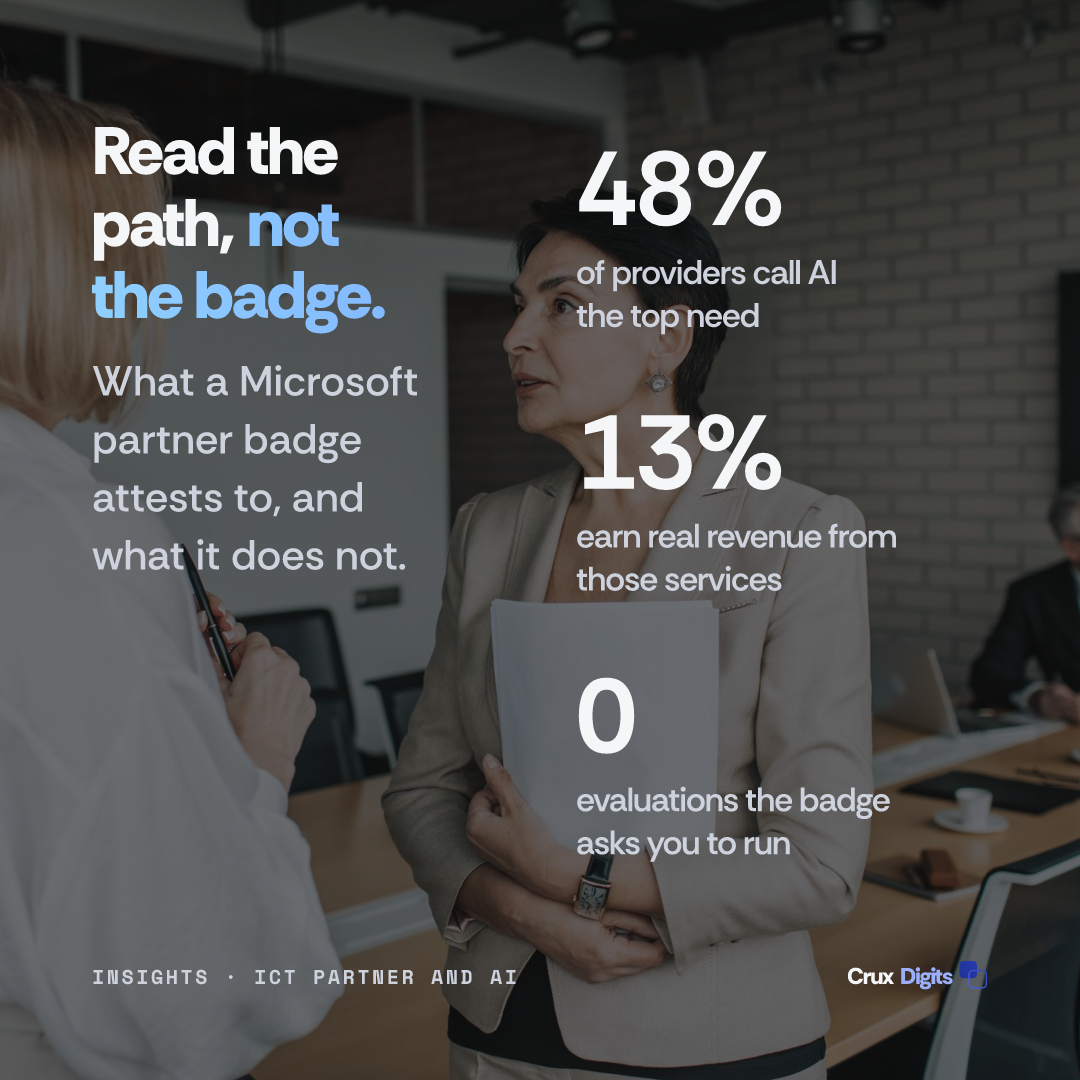
Because the business underneath them got harder, and the evidence for that is theirs rather than mine. Kaseya’s 2026 State of the MSP Report, published on 14 April 2026 from a survey of more than 1,000 managed service providers worldwide, found that 48 per cent of MSPs rank AI and automation as the top client need for 2026, ahead of security and backup. In the same survey, just 13 per cent are generating meaningful revenue from those services.
That 35 point gap is the most useful number in this entire conversation. It says the AI line on your renewal is, on the industry’s own figures, far more likely to be a response to what clients are asking for than a service with delivery history behind it. That is not dishonesty. It is what every supplier does when demand arrives before capability, and it is what your own organisation does too.
The rest of the survey explains the pressure. Seventy-one per cent say acquiring new customers is their top challenge, and the share of providers reporting typical customer spend above 25,000 dollars a year fell to 41 per cent, down from 75 per cent the year before. Meanwhile the old model still pays: 71 per cent reported year-on-year revenue growth in cybersecurity, the highest of any service category.
One caveat that matters at your size. Kaseya’s respondents skew towards providers serving small and mid-sized businesses, so if your incumbent is a Dutch systems integrator rather than an MSP of that shape, the deal-size figures will not map onto them. The 48 against 13 gap is the part that travels, because it is about how young the capability is rather than how big the contracts are.
What does a Microsoft "AI Business Solutions" badge actually attest to?
Less about AI than the name suggests, and this is documented rather than alleged. Microsoft announced at MCAPS Start for Partners on 22 July 2026, and published in its Partner Center announcements of 5 and 13 August 2026, that the names of the customer-facing Solutions Partner badges now align to three commercial solution areas: AI Business Solutions, Cloud & AI Platforms, and Security.
Read the mapping, because the mapping is the point. Business Applications and Modern Work both now present as Solutions Partner for AI Business Solutions, while the three Azure paths present as Solutions Partner for Cloud & AI Platforms. Microsoft is explicit that nothing underneath moved: the six solution paths remain the foundation for requirements, scoring and specializations, and partners were told no action is required on their side.
So a badge reading AI Business Solutions can be held on the strength of the Modern Work path, which is Microsoft 365 work. That is a genuine attainment and displaying it is not a false claim. It simply does not mean what an IT manager hearing the word AI assumes it means, and the rename landed in the middle of the year your renewal did.
What does the Agentic Business Solutions specialization certify?
Specializations sit above designations and are the closest thing to a checkable AI credential the programme offers, so this is the one worth reading properly. On 31 July 2026 Microsoft merged two existing specializations, Low Code Application Development and Intelligent Automation, into a new one called Agentic Business Solutions. Partners already enrolled in either of the two were enrolled in the new one automatically.
That lineage tells you what it certifies: Power Apps, Power Automate and Copilot Studio delivery. The published attainment criteria confirm the scale. One pathway asks for two unique customer deployments, one with a Power Automate flow in production and one with a Power Apps app with a minimum of five users in production. The alternative pathway asks for two new customer deployments of Copilot Studio at a minimum of 10,000 dollars trailing twelve months each, non-recurring. There is a skilling bar on top of that, nine certified individuals across Power Platform and Copilot Studio roles, plus a published Microsoft Marketplace consulting offer, and an active Solutions Partner designation in Digital & App Innovation, Business Applications or Modern Work.
None of that is a criticism of the credential, and the skilling bar is a real one. Low-code delivery at that scale is useful work and a great many organisations need precisely it. But read what the certifications are in: Power Platform and Copilot Studio delivery, start to finish. If your programme involves retrieval over your own documents, an evaluation set that defines what a correct answer is, a measured before-state and acceptance criteria that are statistical rather than pass or fail, this specialization attests to none of it. A partner can hold it, entirely truthfully, and never have run an evaluation.
Which of the three offers are you actually being shown?
Take the word AI out of the proposal and three distinct products are left underneath it.
- Licences and rollout. Copilot seats, assignment, a training session, adoption reporting. Real work, low risk, and your incumbent is usually the right party for it because they already hold the tenant.
- A low-code build on a platform they already manage. A Power Automate flow, a Copilot Studio agent over a SharePoint library, a Power Apps front end. Governable, inexpensive to reverse, and with a ceiling you will meet.
- A process rebuilt around a model. Retrieval over your own content, an evaluation set, a measured before-state, and behaviour that drifts without anyone shipping a release.
Ask which one is being quoted, and notice that the quote usually answers for itself. The first two price per seat, per flow or per day. The third has to price per process and has to name a before-state, because there is no other way to say what finished looks like. If a proposal promises the third kind of outcome on the first kind of pricing, that is the gap to ask about. We have written separately about what separates a demo from production if you want the longer version.
When is your incumbent the right choice anyway?
More often than a post written by a specialist usually admits, so let me be plain about it.
- The work is the first or second kind above. Then estate access is the hard part, and they have it.
- The data never leaves Microsoft 365 and the value sits in permissions, labelling and identity rather than in modelling. Our page on Microsoft Copilot implementation covers that half of the problem.
- Integration risk dominates model risk. If the difficulty is four line-of-business systems and an identity model, the party that knows your estate beats the party that knows transformers.
- Change capacity is your binding constraint. A saturated change process can make one supplier doing an adequate job beat two doing a better job on paper.
What does not justify it, in my experience, is that they are already on the framework agreement and adding a service line is administratively easier than running a selection. That is a procurement convenience rather than a capability judgement, and it is the single most common reason I see this question never get asked at all.
Which risk stays with you whoever builds it?
Essentially all of the ones that matter. You are the deployer of a system used inside your own organisation, and the deployer’s duties do not transfer to whoever wrote the code. Article 4 of the AI Act, as amended by Regulation (EU) 2026/1744 and in force since 27 July 2026, now requires providers and deployers to take measures to support the development of AI literacy among staff and others operating the system on their behalf. The earlier reference to guaranteeing a particular level was removed, but the duty sits with you and no supplier discharges it for you.
The operational version is sharper than the legal one. When the system returns a wrong answer, a ticket has to open somewhere, and usually it cannot: a wrong answer is not an incident under ITIL, not an error under the Dutch standard IT terms, and not a warranty breach for the model provider. We set that out in full in who gets paged when the AI breaks. Choosing the familiar supplier does not close that gap. It makes it feel closed, which is worse, because the relationship is comfortable enough that nobody writes the definition down.
The same applies to change. A model version bump, a prompt edit and a supplier’s silent upgrade all change production behaviour with no release to approve, which is why we argue for sorting AI changes by what they can break rather than by which file they touched. Your incumbent’s familiarity with your CAB does not help if the change never reaches it.
What should you ask before the next steering committee?
Four questions. None of them is a vendor-selection exercise, and all four have factual answers.
- Which of the three offers is this, and what is the unit of pricing?
- Which Solutions Partner designation and which specializations do you hold, and through which solution path did you attain them? The path is the informative half of that answer.
- Show me an evaluation set from a system you run in production today, and tell me who maintains it. Not a demo.
- When the model provider changes behaviour without a release, who notices, who tells us, and within how long?
The second question is the one that changes the room, because the answer is a matter of record rather than a pitch. The third is the one that separates the three offers faster than anything else, and it is also the thing we argue you should never hand over entirely, whoever builds the system.
Where we sit in this
We are the AI partner that works alongside your ICT partner. We do not sell ICT beheer, infrastructure, hosting, systeembeheer or a service desk, and we do not want to: your incumbent is better at those than we would be, and an AI supplier that starts quoting for the estate has stopped being a specialist. What we do is the third kind of work above, next to whoever holds the contract, which is the shape of applied AI for mid-sized organisations as we practise it.
Which means the honest version of this post costs us something. If your programme is the first or second kind of offer, your incumbent should do it and we should not be in the room. We would rather be in the room for the work where the distinction actually matters. And you should put the second and third questions to us as well. We would think less of you if you did not.
A consultant tells you where AI pays off; Crux Digits also builds it. A fixed price per step, one named expert, from Utrecht.
AI consultancy in the Netherlands →