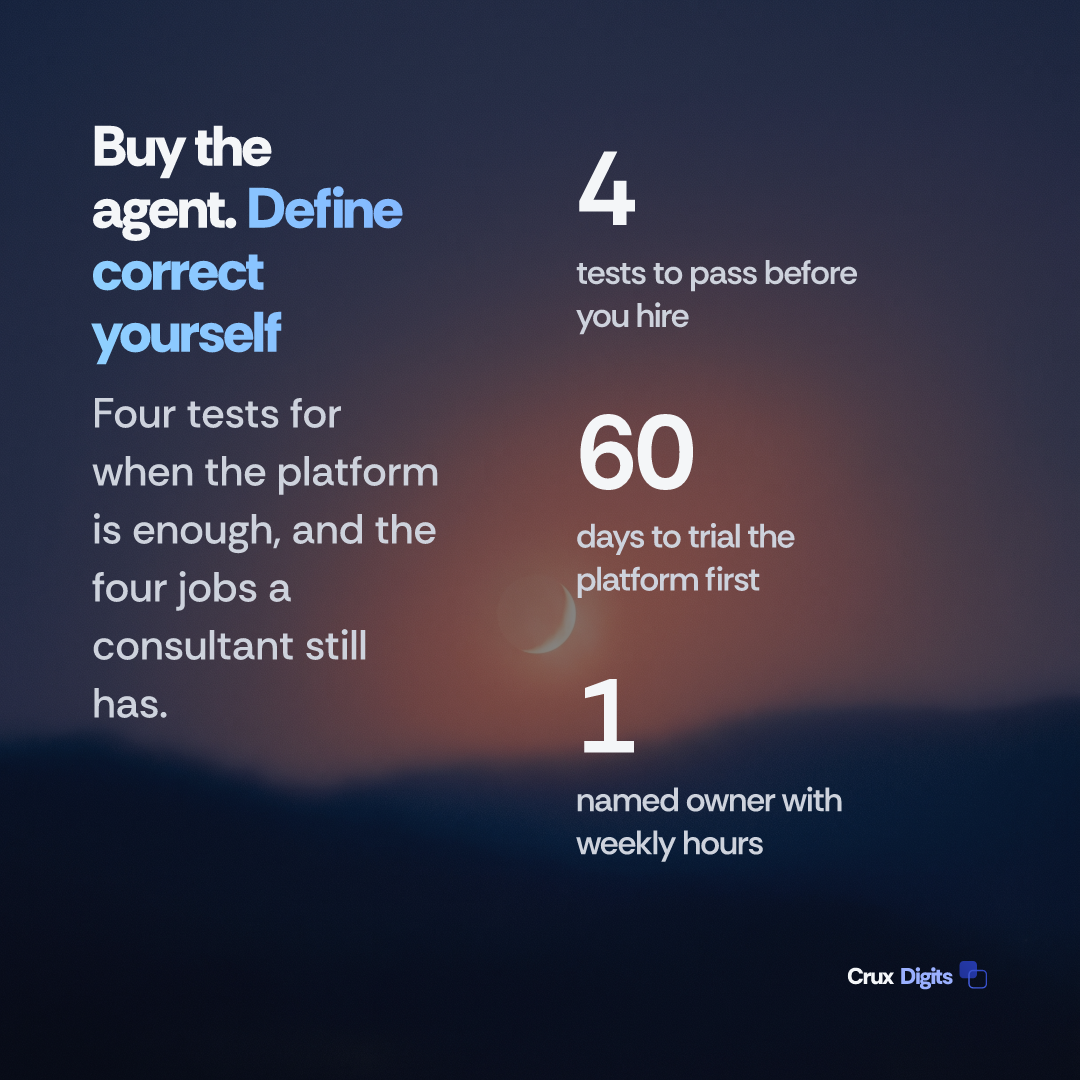
You do not need an AI consultant to switch on an assistant inside the suite you already pay for. You need one when the work crosses systems that suite does not own, when "correct" has to be defined for your business, or when somebody must run the thing after go-live. The vendor's agent is meant to cover the first case better every quarter. The other three stay yours.
Do you still need an AI consultant when Google and Microsoft ship the agent?
On 8 October 2026, at its Gemini at Work event, Google Cloud introduced the Gemini agent, which it describes as a universal agent for work: one prompt box that plans tasks, uses tools and skills, connects to business systems and hands back finished work in the documents, email and developer tools people already use. Futurum's analysis adds the parts that matter for a company of thirty people. The agent works inside Google Workspace, Microsoft 365 and Slack. Persistent "coworker" agents get their own Workspace identity, with an email address, a calendar and a Drive. It can call any MCP server, it orchestrates Claude models alongside Gemini, and per-project spend caps pause an agent when they trigger.
If you sell consulting, the temptation is to feel threatened. If you buy it, the temptation is to feel finished. Both reactions are too fast. Futurum also reports that Google did not disclose pricing or general availability dates for most of what it announced, and that the customer figures mostly describe earlier Gemini Enterprise deployments, not this agent. Announced is not deployed, and deployed is not working. I am writing this in the week of the announcement, so read every statement about availability as dated.
The direction is still clear. Futurum notes that Microsoft is moving the same way with Entra agent identities. The agent is becoming something that arrives with the platform, the way spell check arrived with the word processor. My honest answer to the question in the heading is: less often than consultancy marketing, mine included, would have you believe, and in more specific places than most buyers expect.
What does a platform agent do well enough that you can skip the consultant?
Let me be fair to the platform, because a founder who strawmans the option you already pay for is not worth hiring. Drafting and summarising, searching across mail, documents and meetings, a first pass at a spreadsheet, notes from a call, a reply to a customer who has asked the same question for the fortieth time. The common shape is work that lives inside the suite, is done by one person, and costs minutes when it goes wrong, with the person who asked there to catch it.
For that work the right project is not a project. It is a licence, a short internal guideline and two months of honest use. I tell people so in the first conversation. If the use case fits in one sentence that starts with "everyone in the office could", I will point at the platform before I point at myself.
When don't you need an AI consultant at all?
I use four tests, and I use them as a filter, not as a sales funnel. First, the work lives inside one suite. Second, a mistake is cheap and visible to the person who made the request. Third, it is one person's time, not a process with a handover between people. Fourth, somebody has the hours to try it for two months and report back without flattering the result.
Pass all four and you should save the money. A team of five with no real volume of repeated work usually passes all four, and for those companies the AI consultant page is more likely to tell you what to try on your own than what to buy from us. Fail one and you are in the grey zone where, in my experience, a few hours of advice pay for themselves. Fail two and you have a process, not a task, and that is where I become useful.
What does an AI consultant still do when the vendor ships the agent?
Four jobs. None of them is "choose a model": Google says the agent now picks the most suitable model per task, and that decision is moving into the platform where it belongs.
First, choosing which process deserves an agent. In my experience the projects that fail usually pick the process by enthusiasm. The projects that work pick it by looking at the exception list: the cases a person currently fixes by phone, by memory or by walking over to the other desk. I wrote about that test in a post on the exception list. A platform agent cannot choose for you, because it has no opinion about which of your processes is worth the risk.
Second, connecting the agent to where your truth lives. In most Dutch and Flemish SMEs the truth is not in Workspace or Microsoft 365. It sits in Exact, AFAS or e-Boekhouden, in a work-order app, in a warehouse system, in a spreadsheet that one person maintains. The tools registry Futurum describes names Salesforce, ServiceNow, Jira, Snowflake and Databricks, plus any MCP server. None of those names is the package your bookkeeper uses. For those systems the socket is MCP, and somebody still has to build the plug, decide what it may read, and decide what it may write. That is integration work, and it is the least glamorous part and often the most valuable one of connecting AI to Exact and AFAS.
Third, defining what correct means. Futurum describes Google's Knowledge Catalog as mapping business definitions to ground the agent's answers. Futurum says that value still has to be demonstrated, and I agree with the caution. A catalogue can store your definition of "overdue invoice" only after somebody has decided there is exactly one. Most companies discover in that conversation that sales, finance and the warehouse each have their own. Writing down the definition, and then a set of real cases the agent must get right, is the work. How you test those cases is covered in how to evaluate LLM applications.
Fourth, the first ninety days after go-live. An agent with its own email address is a new colleague with no manager. Somebody has to decide what it may see, who reads its mistakes, and who gets the call when it does something strange. That person is an owner, not a sponsor, as I argued in AI implementation needs an owner. The identity and permission side is more technical, and a post on AI agent identity goes through it.
Where do platform agents break inside a company of thirty people?
I have not run Google's new agent in production, as far as I know nobody outside Google has run it for long, and I will not pretend otherwise. What follows is what I expect from watching other agents arrive, flagged as expectation and not as observation.
The first break is permissions inherited from people. An assistant that acts on behalf of a user can read what that user can read, which is the mode I expect most small companies to start in. In a small company the shared drive has grown for ten years without anyone pruning it, and the agent is the first reader that actually opens everything. The second break is metering. Futurum reports a Google representative saying there is no plan for a per-seat licence when the agent acts as a coworker in Workspace, with pricing to follow closer to wider availability. That removes one barrier and leaves a larger question: what does an hour of agent activity cost, and what stops it from costing more next month? Without a number you cannot write a business case, and FinOps for AI is the discipline of getting one. The third break is the exception. A demo handles the normal invoice. The business lives in the abnormal one, which is why demo versus production is a gap measured in months and not in features.
The fourth break is quieter and I would bet on it most. Nobody changes how they work because an agent exists. People change how they work because a colleague they trust shows them it saves an evening, and because their manager stops asking for the old report. A licence buys the capability. It does not buy the habit, and the habit is where most of the value sits. That is why adoption belongs on the plan from the first week, and why AI adoption fails in the org chart, not the code.
AI consultant or do it yourself: how do you decide?
Start with the platform, and give it sixty days. Before you start, write down what you would count as success, as a number you could check: hours saved on a named task, or the share of replies sent without edits. Then, at day sixty, one of three things has happened.
It worked, and you stop. Congratulations, you saved a consultancy fee, and I mean that. It worked for individuals but not for the process: people got faster at their own tasks and nothing changed in how work moves between them. You have found a process worth a project, and you now arrive with a sharper brief than most of my first calls start with. Or it did not work because the agent could not reach the data, or could not be trusted with the system that holds it. You need plumbing and guardrails, not a smarter assistant, and no licence upgrade will fix that.
Only the last two outcomes need someone like me, and in both you arrive having spent a small amount of money to learn which one you are in. If you are weighing external help against hiring, in-house AI team versus AI consultancy covers that choice, and what to ask before you hire an AI consultant covers how to test whoever you meet.
What do I tell a client who asks this in the first call?
First a disclosure: I sell consulting, so weigh everything above accordingly. What I say is close to this. Buy the seats, run them for sixty days with one owner and one number, and call me if the result is one of the two outcomes that need a project. In most first conversations the person has already tried a chat assistant. They found it good for themselves and useless for the team, and they are slightly embarrassed about that, as if the failure were theirs. It is not. The gap between a tool that helps one person and a system that changes how six people work is the project, and it was never a technology gap.
A consultant who cannot say "you don't need me yet" is selling the wrong thing. I have a longer account of that instinct in sometimes the right answer is do nothing, and it applies here without change. The platform agent does not make that advice obsolete. It makes it easier to follow, because the option you already pay for has become better.
What should you watch over the next six months?
Five things. How coworker agents are metered and priced, since that decides whether they leave pilot status. When the unified agent, the agent gateway and the spend caps reach general availability, as opposed to announcement. How well it performs inside Microsoft 365 organisations, where Google is competing on Microsoft's own surface. Whether the audit trail holds up in practice, in a form you could show an auditor. And whether grounding is proven in practice and not in a keynote.
Meanwhile, three jobs cost almost nothing and are needed under either answer. Write down your definitions, starting with the three words your departments use differently. Name one owner with hours in their week. And list where your data actually lives, including the spreadsheet nobody mentions. Do those and you will make a better buying decision, whether you buy from a platform, from me, or from nobody.
We build custom AI and LLM systems that run in production: a clickable MVP by the second call, fixed steps, and you own the code.
AI development agency in the Netherlands →