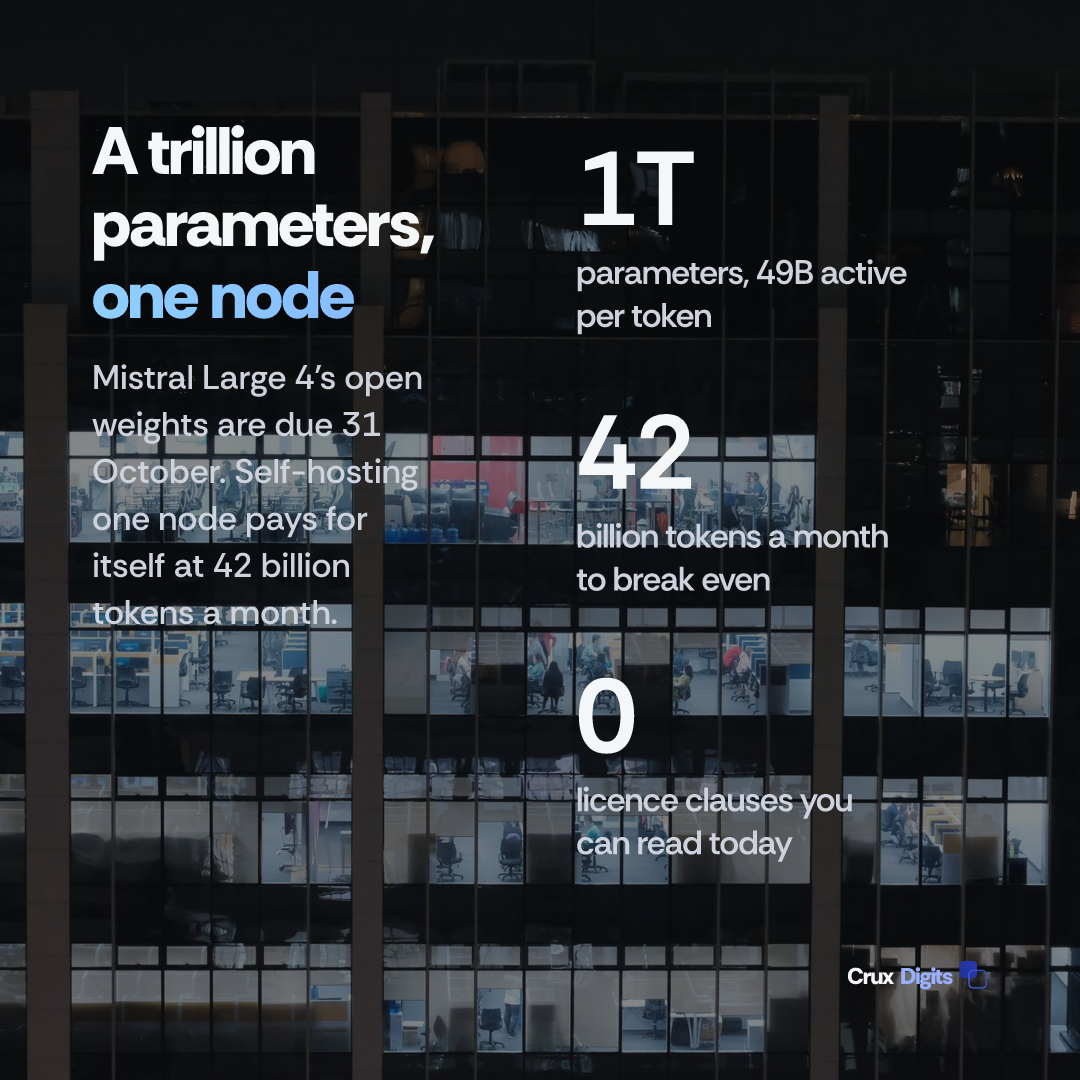
Mistral announced Large 4 on 6 October 2026: a trillion parameters in total, 49 billion active per token, trained in its own European datacentres, with open weights promised by the end of the month. The model page now carries an ETA of 31 October. The licence text does not exist yet. For an IT organisation of 250 to 5,000 staff, neither fact is the one that decides anything. The arithmetic underneath them is.
What did Mistral actually announce on 6 October 2026?
Mistral's own announcement describes Large 4, publicly nicknamed "Le Chonk", as an open-weight hybrid instruct-and-reasoning mixture-of-experts model with a trillion total parameters and 49 billion active per token, multimodal input, and more than 160 languages including every official EU language. It was trained from scratch on 3,800 NVIDIA Grace Blackwell GPUs in Mistral's own European datacentres. Mistral's rate card is $1.36 per million input tokens and $4.18 per million output; the preview API on Mistral Studio currently bills half that, $0.68 and $2.09, with the list prices struck through on Mistral's own pricing page. Note the parameter count already needs reading twice: the launch post says 52 billion active parameters, while the model card says 49 billion active per token and 52 billion counting embeddings and output layers.
The benchmark list is genuinely strong in the places that matter for engineering work: DeepSWE v1.1 at 61.7 percent, Terminal-Bench 4 at 28.3 percent, a Coding Agent Index of 49.8, AutomationBench at 59.9 percent, Cybench at 93 percent and a reproduce-and-patch score of 82 percent, which Mistral reports as the highest of the models it compares. On the Surge AI human coding evaluation it scores 3.74 out of 5, second of five, behind Claude Opus 5 at 4.22. On the Dense 200 vision test it reports 42 percent against 41 percent for GPT-6-Astra.
The weights are a separate matter. The Hugging Face repository mistralai/Mistral-Large-4-1T-A52B exists today as an upcoming release carrying one line, "open weights drop at the end of the month", and an ETA of 31 October 2026. No files. No licence field. One note on price before anything else: the sale has no published end date, so budget against the rate card and treat $0.68 and $2.09 as a condition of the preview, not a tariff. Qovery's October sizing write-up reports the same split.
Why does the missing licence outrank the benchmarks?
Because "open weight" is a distribution claim, not a permission. And within Mistral's own Large line, the permission has gone both ways. The Mistral Large 3 model card states Apache 2.0 outright, for a 675-billion-parameter model with 41 billion active, shipped in December 2025. Qovery's write-up notes that the Large 2 generation arrived under a research licence that required a separate paid commercial agreement, and that Codestral 22B v0.1 carries a non-production licence. So the question an IT organisation actually has to answer (may we run this in production, on infrastructure we choose) has precedent on both sides within one product family.
That matters because of what the licence feeds. A supplier assessment has a field for the model licence. A data protection impact assessment needs a named processor chain. An ISMS control for third-party software needs terms you can attach to a change record. None of those close on an ETA. An IT manager can run a pilot on an unpublished licence; they cannot sign a renewal on one, and they cannot tell an auditor in January what they were permitted to do in October. At 250 to 5,000 staff that renewal has a procurement calendar attached to it, which is the difference between an inconvenience and a blocked quarter.
What does a trillion parameters cost to run yourself?
A mixture-of-experts model splits the two numbers that matter. The 49 billion active parameters set your throughput and your cost per token. The roughly 1.05 trillion total, as the sizing analyses that did the memory maths put it, set your memory, because every expert has to be resident even though only a fraction fires per token. Qovery puts the weights at roughly 2.1 TB at bf16, 1.05 TB at FP8 and 525 GB at 4-bit, plus 10 to 20 percent for activations and fragmentation and tens of gigabytes of KV cache at long context. An H100 SXM carries 80 GB, an H200 SXM 141 GB, so eight H200s give 1,128 GB, which Qovery calls tight at FP8. YottaLabs' hardware note lands in the same order of magnitude. The practical unit of self-hosting is therefore one full eight-GPU node, not a card.
Now the arithmetic those posts do not finish. Assume one dedicated node at the on-demand price Qovery quotes for an AWS p5.48xlarge, about $55.04 per hour, which is roughly $40,000 a month running continuously. Assume list API pricing and a four-to-one input-to-output token mix, which blends to about $1.92 per million tokens. Break-even is then about 20.8 billion tokens a month, or roughly 7,900 tokens per second sustained across a 730-hour month. And that is the generous case: at the $0.68 and $2.09 the preview actually bills, the same node has to serve about 41.8 billion tokens a month, close to 15,900 tokens per second, every hour, including nights and the week between Christmas and New Year. Change the token mix and the number moves a little; change the price assumption and it doubles. Neither moves it by an order of magnitude. Qovery reaches the same conclusion from the other direction, putting the self-hosting crossover above roughly 20 to 40 percent sustained utilisation. No organisation of 250 to 5,000 staff is near either figure on its AI workload today.
Who already spotted the missing licence, and what did they leave out?
The contract-over-flag argument is not mine. On 8 September 2026, writing about Mistral's €3 billion Series D led by Samsung, beri.net argued that nationality is a weak sovereignty control because a financing round can change it without a single customer contract changing, and proposed scoring four contractual controls instead. Its second control is the one that matters here: controllable models should be tested through the model licence, not through whether the weights can be downloaded.
That piece was written about the Mistral 3 generation, where every model in the line carried a named licence (Apache 2.0 on Large 3, a modified MIT with a revenue threshold on others), so the control could at least be answered. The same authors applied it to Large 4 on 6 October and hit the dead end, and the missing licence is by now the consensus reading of this release: orcarouter notes that the Licence cell in Mistral's own model selection guide is simply empty, and that Artificial Analysis records the licence as null, marks the model as not open-weight and files it as proprietary. So spotting the gap is not this post's contribution, and anyone telling you it is has not read the week's coverage. The licence posts have the legal gap covered and the sizing posts have the hardware answer covered. What nobody has done is price the alternative, which is the only thing that tells an organisation with no GPU estate what the gap actually costs it.
If the weights are not a deployment plan, what are they?
Two things worth having, neither of which needs hardware. The first is an exit route. If the API's terms, price or regional availability change, a licensed checkpoint means some third party can serve the same weights for you: your prompts, your tool definitions and your evaluation set move, and the model underneath them does not have to be rebuilt. That is the same argument as keeping your evals in-house while outsourcing the build, applied one layer down.
The second is a price ceiling. A published checkpoint that competing European hosts can serve puts an upper bound on what the first-party API can charge, which is the structural reason open weights matter to buyers who will never run them. Our earlier read on open-weight versus paid models made the general case; With Large 4 that ceiling sits considerably further up the capability curve. Both benefits depend entirely on the licence permitting commercial use and third-party hosting. That is the clause nobody can read yet.
Which sovereignty question does the contract answer, and which does the checkpoint?
Split them, because they are bought differently. The contract answers where processing happens, who the sub-processors are, which law governs, and what the audit and deletion rights are. Mistral states that its European deployment is operated end to end by Mistral, independently of other digital service providers and under European law. That is a contractual claim, and a contractual claim is testable in a contract, which is where an informatiemanager should test it.
The checkpoint answers one narrower question: can this model run with no network path to the vendor at all. That is a real requirement for a small set of workloads, and Mistral names security operations as the self-deploy case. For the ordinary mid-market workload (document search, a service-desk assistant, a quoting helper, a private assistant on internal data), the contract is the instrument and the checkpoint is beside the point. The failure mode to avoid is buying the checkpoint story for a workload that needed the contract, and ending the year with GPU budget and no answer for the auditor.
What should a Dutch IT organisation decide before 31 October?
Four decisions, and it is worth naming who owns each, because in a Dutch mid-market estate they sit with different parties. Two are yours. First: whether a pilot may start on a preview API with no published licence. Usually yes, if the data in it is non-sensitive and the exit is written into the pilot rather than deferred to the renewal. Second: which of your workloads genuinely cannot have a network path to a vendor. Write that list now, before the weights land and the conversation gets exciting; it is almost always shorter than the room expects.
The third belongs to your ICT partner, and the honest answer is that they are not hosting this. A node holding 1.1 TB of GPU memory is not in a Dutch managed-services catalogue, and asking for one converts a model decision into a datacentre project. Their real question is narrower and worth asking: egress, identity and logging for whatever endpoint you do end up calling. The fourth belongs to whoever builds the application: keeping prompts, tool definitions and the evaluation set in your own repository, so the model stays the replaceable part. That is the whole argument behind how we approach AI implementation in the Netherlands and the reason applied AI for mid-sized organisations starts with your existing supplier landscape rather than a model choice.
Then, on 31 October, read three things in the licence before anything else: whether commercial use is permitted, whether third-party hosting is permitted, and whether fine-tuned derivatives may be redistributed. If all three are open, the exit route and the price ceiling are both real. If any of them is conditional on revenue or on a separate agreement, you have the Large 2 pattern again, and the ceiling goes with it. How we choose models for a workload does not change either way: one score is not evidence, and one licence is not a strategy.
Last updated 16 October 2026.
We build custom AI and LLM systems that run in production: a clickable MVP by the second call, fixed steps, and you own the code.
AI development agency in the Netherlands →