"AI agent" has become the industry's most overloaded phrase. Vendors slap it on everything from a scripted FAQ bot to a full autonomous system. For a Dutch MKB owner deciding where to spend real money, that vagueness is expensive. This piece cuts through it: what an agent actually is, how it plugs into the software you already run, six processes it can take over today, and what it honestly costs to build and govern one.
What are AI agents, in one paragraph
AI agents are systems that carry out a task end to end rather than answering a question about it: they read the input, use your systems as tools, take the decisions the task requires, and produce the result a person would otherwise have produced by hand. The distinction that matters in practice is not intelligence but permission — an agent needs access to your data and the right to act in your systems, which is why agent projects are integration projects wearing an AI hat.
An agent is not a chatbot
A chatbot answers. It takes your text, generates a reply, and stops. An agent acts. The difference comes down to four capabilities working together:
- Tools — the agent can call your systems: query your CRM, create an invoice, send an email, look up a shipment. It doesn't just talk about the task; it does it.
- Memory — it retains context across steps and sessions, so it knows this quote belongs to that customer and this reply continues yesterday's thread.
- Planning — given a goal ("chase every overdue order"), it breaks the goal into steps and decides the order to run them, rather than following one hard-coded script.
- Acting in a loop — it observes the result of each step, checks whether it worked, and adapts. Failed API call? It retries or escalates.
That loop — plan, act, observe, correct — is what makes agentic AI genuinely different from the automation you may already have. It handles the messy middle of a process, not just a single trigger.
How agents connect to your existing systems
An agent is only as useful as the systems it can reach. There are three connection patterns, and most real deployments blend them:
- APIs — the clean path. If your accounting package, CRM, or webshop has an API (most modern Dutch tools do — Exact, Moneybird, Teamleader, Shopify), the agent calls it directly. Reliable and auditable.
- RPA (robotic process automation) — for legacy software with no API, the agent drives the user interface like a person would: clicking, typing, copying between screens. Slower and more brittle, but it unlocks systems that would otherwise be walled off.
- Human-in-the-loop — the agent prepares the work and a person approves the consequential step. It drafts the reply, stages the payment, proposes the quote; a human clicks "send". This is not a limitation to grow out of — for many processes it is the correct permanent design.
Six processes an agent can run today
These are not future promises. Each is a bounded, high-frequency process where an agent delivers value now — and you can see more of them on our use-case overview.
- Quote generation. The agent reads an inbound request, pulls pricing and stock from your system, applies your rules and margins, and produces a draft quote for a human to approve. Faster turnaround on the deals you'd otherwise answer late.
- Invoice and AP processing. It extracts data from incoming invoices, matches them to purchase orders, flags mismatches, and queues clean ones for payment. The exceptions — the 10% that need judgment — go to a person.
- Inbox triage and replies. It classifies incoming email, routes it, and drafts answers to routine questions. Zendesk's 2025 research finds AI can resolve around 75% of routine customer questions — for an MKB that is a large share of a support inbox handled without a person touching it.
- Order and logistics follow-up. It tracks shipments, chases suppliers on late deliveries, and proactively updates customers — the persistent chasing work that quietly eats hours.
- Lead qualification. It enriches inbound leads, scores them against your ideal-customer criteria, and books the qualified ones straight into a calendar, so your sales time goes to real prospects.
- Internal knowledge assistant. It answers staff questions from your own documents — contracts, procedures, product specs — grounded in your files rather than the open internet, so the answers are yours and citable.
What the numbers actually say
The credible evidence points the same way, without the hype. Studies of knowledge workers using production AI agents — not demos — find they recover a median of roughly 6.4 hours per week. PwC reports that 66% of organisations using AI agents see increased productivity, and notably they often maintain or grow headcount rather than cut it: agents absorb the grind, people move up the value chain.
The ceiling is large. McKinsey estimates 60–70% of work hours go to tasks that current AI can at least partly automate — yet only about 1% of firms describe themselves as "AI-mature". The gap between what's possible and what's deployed is the whole opportunity.
Dutch adoption is still early. CBS data shows 29.8% of Dutch SMEs use AI, dropping to 13.8% among micro-firms, and 74.6% of non-adopters cite a lack of experience as the reason. That last number matters: the barrier is know-how, not the technology. It's why a named expert who has done this before is worth more to an MKB than a platform licence.
The honest cost and build path
Agents fail when teams skip discipline. Most enterprise AI pilots underdeliver — not because the models are weak, but because there's no evaluation, no monitoring, and no clear owner. The way to avoid that is to build in stages.
A sensible path: start with a fixed-price AI audit (€2,500) to find the one or two processes worth automating and confirm the data and systems support it. Move to a proof of concept (€20,000) that proves the agent works on your real data with humans in the loop. Then go to production (from €50,000) with monitoring, evaluation, and guardrails in place. Throughout, you own the code — no lock-in to a black box you can never inspect or move. Fixed prices mean you know the cost before you commit, not after. This is exactly how we approach AI agent development in the Netherlands.
Risks and guardrails: AVG and the EU AI Act
Agents act, so their mistakes have consequences. Governing them is not optional.
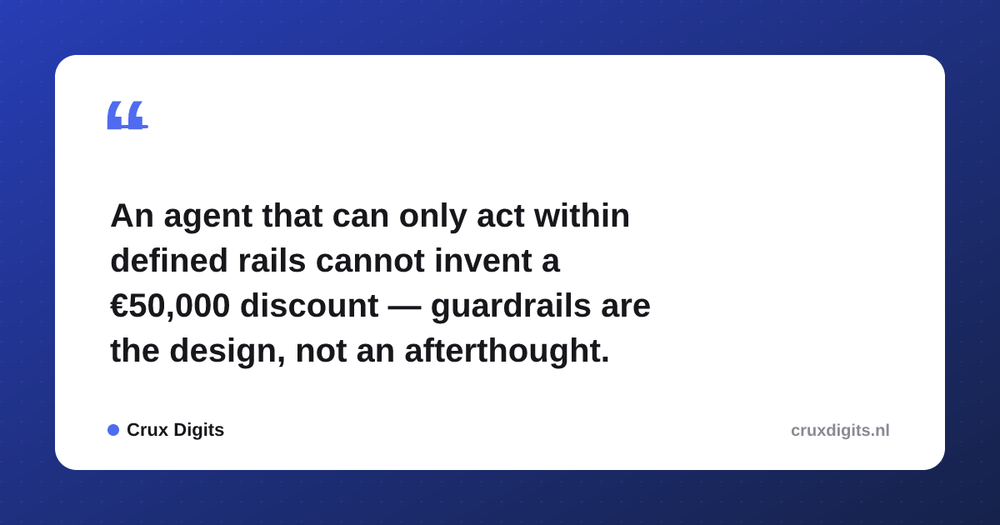
Hallucination control. Ground the agent in your data (retrieval from your documents), constrain what tools it can call, and evaluate its outputs against known-good answers before and during production. An agent that can only act within defined rails cannot invent a €50,000 discount.
Human oversight. For consequential actions — payments, contracts, external communications — keep a person on the approval step. This is your primary safety control and the EU AI Act often expects it.
The EU AI Act classifies AI by risk tier. Most MKB agents (drafting quotes, triaging email) fall into limited-risk, where the core obligation is transparency — people must know they're dealing with AI. Some uses (anything touching hiring, credit, or similar) climb into higher-risk tiers with real requirements. Knowing your tier before you build is the point of our AI Act MKB checklist.
AVG (GDPR). The moment an agent touches customer data, data protection applies: process only what's needed, keep it in the EU where you can, log what the agent did, and be able to explain its decisions. Build this in from day one — retrofitting compliance is expensive.
How to start small
Don't attempt an autonomous everything-agent. Pick one bounded, high-volume, low-risk process from the six above — inbox triage or quote drafting are common first wins. Keep a human on the approval step. Measure the hours it actually saves against a baseline. Then expand to the next process once the first is stable and trusted.
The technology is ready for the MKB. The gap CBS measures is experience, not capability — and that's precisely what closes fastest with the right partner and a first, small, well-governed step. Start with a pilot scan, see it work on your data, then scale.
We build custom AI and LLM systems that run in production: a clickable MVP by the second call, fixed steps, and you own the code.
AI development agency in the Netherlands →