A quote has four layers: the scope you promise, the calculation underneath it, the terms attached to it, and the number the customer signs. AI drafts the first and the third well. It has no business owning the second. The reason is not technical. Under Dutch contract law the number binds you the moment the customer accepts, and a wrong-but-plausible number is not an error you can walk back.
That gap between what AI speeds up and what actually costs you money is the whole subject of this article. It is written for a Dutch firm of roughly twenty to fifty people: large enough to send a few dozen quotes a month, small enough that one person still checks most of them. Everything below was checked on 9 September 2026.
Why is 2026 the wrong year to guess at a price?
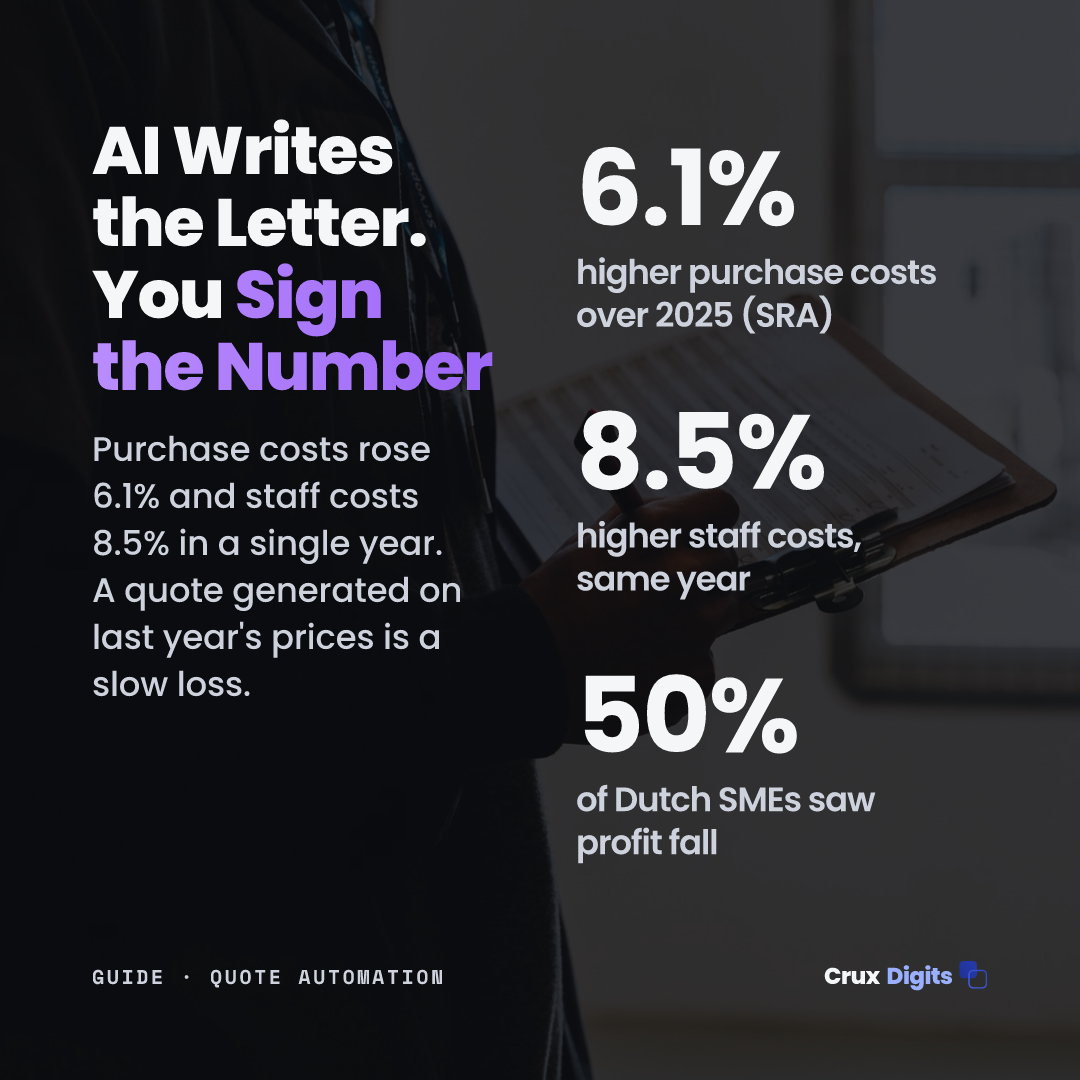
Because the cost base under your quotes moved. SRA published its Branches in Zicht 2026 analysis on 12 July 2026, built on 7,061 sets of Dutch SME annual accounts for 2025. Revenue rose 6.4 percent while profit rose only 3.4 percent, and inflation of 3.3 percent sits inside that revenue figure. Half of all firms saw profit fall, 24 percent of them by half or more. The pressure came from the cost side: purchase costs up 6.1 percent, staff costs up 8.5 percent. Construction was hit hardest, with average profit down 11.2 percent.
Read those two numbers again next to each other. Purchase prices 6.1 percent higher, staff costs 8.5 percent higher, in one year. A quote is a promise about costs you have not yet incurred. A quote generated from last year's price list is not a fast quote. It is a slow loss, and you will not notice it until the job is finished and the margin is not there.
The same SRA report found firms putting investment on hold while equity and cash balances rose. Careful and automated are not opposites, but they imply an order of operations: fix what the quote says about money before you speed up how fast it says it.
Which part of a quote can AI actually write?
Split the document into four layers and the answer becomes obvious.
- Scope. Turning a messy intake into a structured description of the work: an email thread, a site visit note, a voicemail, three photos. This is reading and rewriting, which is exactly what language models are good at, and it is usually the slowest manual part. Give it away.
- Calculation. Hours, materials, purchase prices, margin, risk surcharge. This is arithmetic over data that has to be current. A model is a terrible place to keep prices, because it will produce a confident number whether or not it has one. Use AI to look a price up from your own list. Never to remember it.
- Terms. Payment terms, validity period, exclusions, warranty text. AI assembles these well from your own clause library. The hazard is silent variation: a model that paraphrases a clause has changed your contract. Insert clauses whole, by reference, or not at all.
- The number. Nobody signs this except a person with authority to sign it.
One sentence carries the whole design: AI may compose the quote, your system must compute it. If you cannot draw a line in your own setup showing where composition stops and computation starts, you have not built quote automation. You have built a plausible-document generator pointed at your customers.
Why does a generated price bind you under Dutch law?
A contract comes into being through offer and acceptance, article 6:217 of the Dutch Civil Code. Article 3:33 adds that intention and declaration must match, so a price you never meant to offer was, strictly, never offered. Article 3:35 takes most of that back: if the other party could justifiably rely on your declaration, you are bound anyway. That last article is where automated quoting gets expensive.
The familiar escape route is the obvious mistake. In the OTTO case, decided by the Court of Appeal in 's-Hertogenbosch on 22 January 2008, a mail-order company had offered Philips LCD televisions at 99 euro when the court found the going price for that type of set ran from about 700 to about 1,300 euro. Nobody, it held, could seriously have believed the offer. ICTRecht's explainer on typing errors and price mistakes, written in June 2016, sets out the same test in general terms and is still the clearest short treatment in Dutch.
Now apply that threshold to an AI mistake. A model that returns 41,800 euro where your cost base says 44,600 has not produced an absurdity. It has produced a number your customer has no reason to question, from a supplier who looks organised. Justified reliance holds. You deliver at that price. The defence that saves a 99-euro television does nothing for a quote that is wrong by six percent, and an error of a few percent is exactly the size a generated quote is capable of producing.
There is one control that does work, and it is specific to business customers. ICTRecht's analysis notes that against a business counterparty a reservation covering all typing errors is permitted in your general terms, where against consumers only obvious errors may be reserved. It works indirectly: a stated reservation removes the ground for justified reliance in the first place. So if you are moving to generated quotes, two lines in your algemene voorwaarden are worth more than any prompt engineering: a typing-error reservation and a validity period. Make sure the terms are genuinely supplied with the quote rather than merely mentioned. This is general information about Dutch law and not legal advice; have your own lawyer confirm the wording for your sector.
What does one bad quote actually cost against the time saved?
Numbers with stated assumptions, so you can substitute your own. Take a thirty-person firm sending 40 quotes a month at an average value of 18,000 euro, winning roughly 30 percent of them.
The saving. Assume drafting takes 55 minutes today and a good setup removes 25 of those, while adding a 5-minute review. Net saving is 20 minutes per quote, so 13.3 hours a month. At a loaded internal cost of 55 euro an hour that is about 730 euro a month, or 8,800 euro a year. Real, and worth having.
The loss. Now assume one won job a month is priced 4 percent under its true cost. On an 18,000 euro job that is 720 euro of margin gone. One such quote a month cancels the entire saving. Two a year on jobs of 60,000 euro and the automation is net negative for the year.
The assumptions are illustrative, but the structure is not. Your saving scales with the number of quotes. Your loss scales with the value of the ones you win. Dutch SMEs typically quote a few dozen times a month and win work worth tens of thousands, which puts the larger lever on the loss side. That is the conclusion vendors will not lead with: in quote automation, accuracy is worth more than speed, and it is not close. For the cost of building this properly, our page on what an AI project costs sets out the fixed prices rather than hiding them.
Where does the draft have to land: Exact, AFAS or a Word file?
In the Dutch SME stack the quote is not a document. It is a record with a status. AFAS runs a chain from quote to order to invoice, and its own documentation is explicit that only a quote with status Definitief or Akkoord verkooprelatie can be converted into an order. Exact Online is built on the same idea: the quote is raised from an opportunity record and moved on once the customer accepts, so status and history travel with it.
A quote drafted in a chat window and pasted into Word leaves that chain. You lose the version the customer accepted, the link from quote to order, the margin per job, and any later ability to ask which quotes you lost and why. Six months on you have a faster process and no data about it.
So the integration target is not "AI writes our quotes". It is narrower and more useful: intake arrives, a structured draft is written into your quote record with status concept, and a named person sets it final. The automation never touches the status field. Getting a model to read and write against Exact or AFAS is the part most teams underestimate, and we wrote separately about connecting AI to Exact, AFAS and e-Boekhouden.
What does a workable setup look like for 20 to 50 people?
Six components, in the order they matter.
- One source of truth for prices. The article list in your ERP. Not a spreadsheet on a laptop, and never the model's memory.
- A structured intake step. Email, notes and voice into a fixed request format. This is where a language model earns its licence fee.
- A deterministic calculation. The model selects line items; your system multiplies and totals them. If a line has no price in the list, the run fails loudly instead of estimating. A quote that stops costs you nothing. A quote that guesses does. We set out the wider version of that trade-off in how wrong an automation is allowed to be.
- A draft in the quote record, status concept. Never a PDF that exists only in someone's inbox.
- A named reviewer. One person, by name, who sets the quote final. Shared responsibility here means no responsibility.
- A change log. Record what the reviewer altered between draft and final. After two months that log tells you where the model is systematically wrong, which is worth more than the hours it saved.
None of that requires a new platform. Most of it is process work with a thin layer of automation on top, the same pattern we describe on our process automation page. If you are unsure which process should go first, a short readiness scan answers that faster than a pilot does.
Does answering faster actually win more work?
Probably, but the evidence is weaker and older than the marketing suggests. The study behind almost every "respond within five minutes" claim is Oldroyd, McElheran and Elkington in Harvard Business Review, March 2011, which audited 2,241 US companies and found most responded to online enquiries far too slowly. The 21-times and 60-times multipliers circulating in 2026 copy trace back to that period of InsideSales and MIT work, in a US online-lead context. They are not a measurement of a Dutch installation firm quoting a 40,000 euro job after a site visit.
What survives is modest and still useful: being first with a complete, correct quote helps, most of all when the customer is comparing three suppliers on similar work. What does not survive is the idea that removing days from your turnaround is worth getting the price wrong. Speed only compounds on work you would have won anyway.
So measure your own baseline before you buy anything: median working days from request to quote sent, and win rate split by how quickly you answered. If your median is six days, there is real ground to make up. If it is one day, the remaining gain is small and your effort belongs on the calculation instead.
Automating quotes is worth doing. Just be clear about what you are automating. The letter is the easy half and the low-cost half. The number is the half your customer can hold you to, and Dutch law does not care that a model wrote it.
AI automation for SMEs: the audit prices the saving and payback per process, then we build the first process as a Production-ready MVP.
AI automation for business →