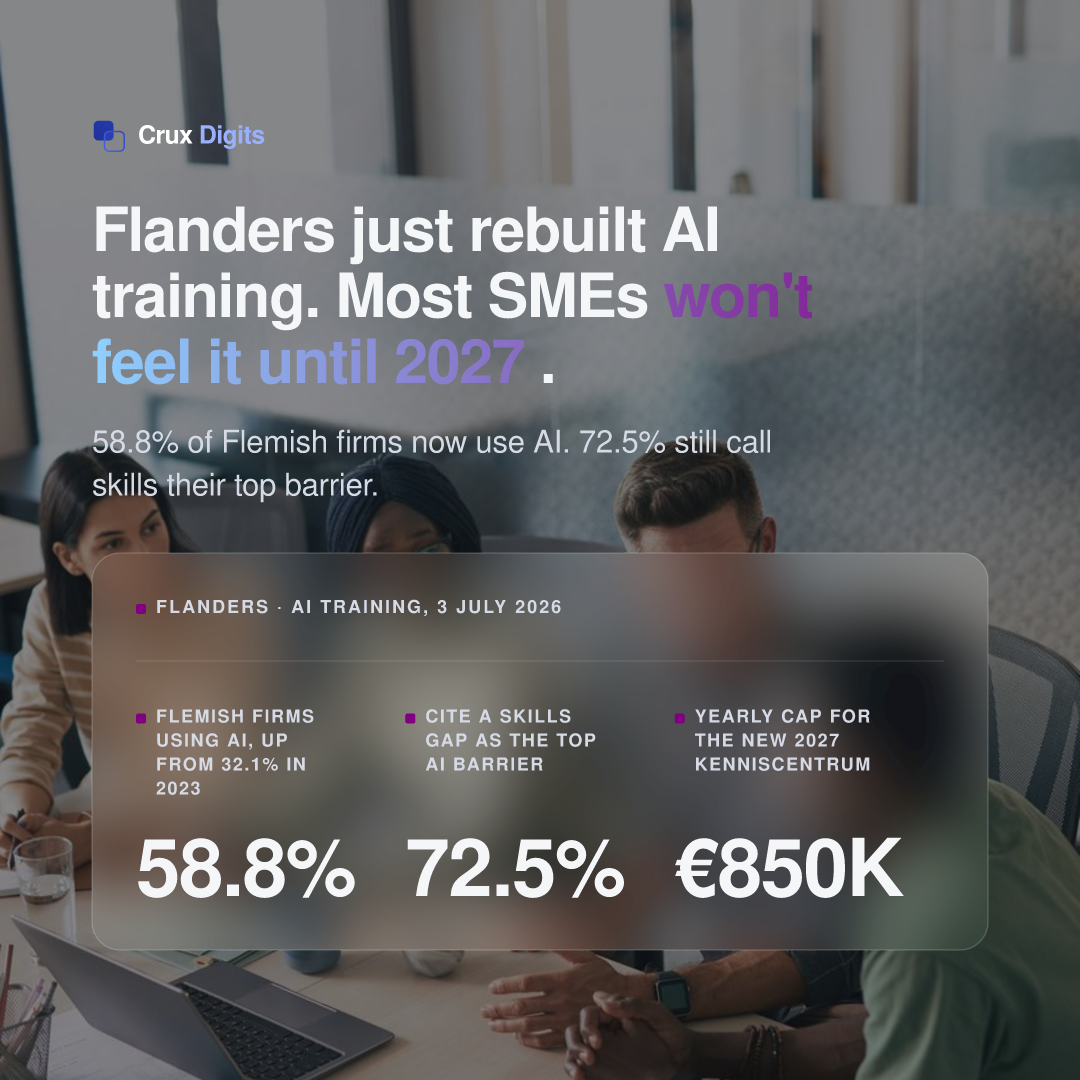
On 3 July 2026, the Flemish government approved the call document to select a renewed Vlaams Kenniscentrum AI-Opleidingen for 2027–2030, with up to €850,000 a year in funding and an explicit mandate to bring in non-academic training providers. It's a direct response to the 2025 AI-Barometer: Flemish business AI use nearly doubled to 58.8%, yet 72.5% of companies still name a lack of relevant skills as their single biggest barrier. Here's what the decision actually changes, what stays exactly as it is, and what a Flemish business with 1–50 FTE should do before 2027 rather than after.
What the Flemish government actually decided on 3 July
The decision sits inside the Vlaams Beleidsplan Artificiële Intelligentie, the policy track Flanders has run since 2019 covering AI research, innovation, adoption and accompanying regulation. Its training arm, the Vlaamse AI Academie (VAIA), was set up in 2020–21 with strong academic backing — universities, hogescholen, Agoria, Voka and UNIZO — and a focus on lifelong learning about AI. A 2025 evaluation of VAIA confirmed the central function still matters, but flagged three gaps: the organisational form needs updating, the offering needs to become more demand-driven, and non-academic training providers — sector federations, private trainers, consultancies — need a real seat at the table.
The 3 July call document is the mechanism to fix that. From 2027, VAIA's current operation is reoriented into a renewed Kenniscentrum, selected through this open call, funded at a maximum annual subsidy of €850,000, with a multi-year agreement to follow once a body or consortium is chosen. That's infrastructure money for the organisation running the training ecosystem — not a new grant that lands directly in an individual SME's bank account.
Why now: the AI-Barometer numbers behind the decision
The timing isn't arbitrary. The Flemish AI-Barometer 2025, published in March 2026, is the clearest read yet on how fast — and how unevenly — AI has spread through Flemish organisations:
- At least one AI technology is now used by 58.8% of Flemish businesses, up from 32.1% in 2023 — close to a doubling in two years.
- Generative AI (47.6%) and text-analysis software (41.2%) are the fastest-growing categories.
- 48.9% of companies say adoption is bottom-up — started by individual employees, not rolled out by IT or management.
- 21.4% of companies report higher productivity specifically among lower-skilled workers because of AI.
- Inside the Flemish government itself, Microsoft Copilot saves staff 16–17 minutes a day — one full working week per 140 civil servants — across 72 separate AI initiatives currently running.
The barometer's flip side is the reason the Kenniscentrum is being rebuilt: 72.5% of Flemish companies name a lack of relevant knowledge, skills or experience as their top AI barrier, ahead of 63.7% who struggle simply to work out which AI applications apply to their business, and concerns over legal aspects and data quality further down the list. Flanders is spending over €150 million a year across government on responsible AI adoption — the skills gap, not appetite, is what that money is increasingly aimed at closing.
What changes, what doesn't: 2026 versus 2027
Nothing about VAIA's current catalogue disappears on 1 January 2027 by default — today, VAIA still lists 1,500+ AI trainings and courses from 500+ organisers, free and paid, live and online, aimed at everyone from complete beginners to specialists. That catalogue is the thing a Flemish business should be using right now, while the renewed Kenniscentrum is still being selected.
What changes from 2027 is the steering, not the shelf: the new Kenniscentrum's mandate explicitly requires a more demand-driven programme and wider involvement from non-academic trainers. In practice, that should mean fewer generic "introduction to AI" university modules and more courses built around what an accountancy office, a transport planner or a wholesale warehouse actually does — assuming the selected operator delivers on the mandate.
A related but separate track: the Kenniscentrum Data & Maatschappij (KDM) is evolving its own convenant into a practical advisory point for legal and ethical AI questions, including EU AI Act and Data Act compliance. That's a compliance-support function, distinct from training capacity — useful context if you're also working through the AI-literacy duty under Article 4 of the EU AI Act.
There's no published start date for the renewed Kenniscentrum beyond "from 2027" — the call document only opens the selection procedure. Expect a period of proposal submission, evaluation and contracting before an operator or consortium is confirmed, followed by the multi-year agreement going back to the Flemish government for sign-off. Realistically, that puts a functioning renewed Kenniscentrum somewhere around late 2026 to early 2027 at the earliest, which is exactly why waiting for it before starting any AI training is the wrong call for a business that needs skills this quarter, not next year.
The funding reality check: kmo-portefeuille hasn't moved for AI training
It's worth being precise here, because subsidy stories get inflated fast. The kmo-portefeuille training pillar was untouched by the February 2026 reform that scrapped the advies (consultancy) pillar: support still sits at 30% for small enterprises and 20% for medium-sized ones, capped at €7,500 a year, across eight forward-looking themes including digitalisation and innovation.
One nuance worth checking before you assume the best rate applies: the enhanced 45%/35% rate is reserved for two named themes — sustainability/energy-efficiency and digitalisation/cybersecurity — not for AI skills training in general. Whether a specific AI course qualifies at the standard or enhanced rate depends on how the training provider has tagged it in the kmo-portefeuille registry, so check that tag before budgeting on the higher percentage.
And to repeat the point from the 3 July decision: the €850,000 annual ceiling funds the Kenniscentrum's operations, not a new company-level grant. If your business is after direct AI-adoption funding rather than training support, that route currently runs through kmo-portefeuille and the wider Flemish subsidy landscape, not through this specific decision.
A practical framework for 1–50 FTE Flemish businesses
This lands hardest on the businesses without an L&D department to sort through 1,500 course listings — which, per the barometer, is most Flemish SMEs. Two starting points, by size:
Micro (1–10 FTE, zzp/eenmanszaak): don't wait for 2027. Pick VAIA's free or low-cost offerings now, and choose 1–2 courses tied to a specific daily task — invoicing, customer email, quote drafting — rather than a general "AI strategy" module. The bottom-up pattern the barometer found (48.9%) works in your favour here: one motivated person trying one tool beats a formal rollout you don't have the headcount for.
Small (20–50 FTE): this is usually the first moment a business has both a real process to automate and a training budget line. Check whether the specific course qualifies for kmo-portefeuille's digitalisation theme, and pair it with a short internal AI-policy document covering the Article 4 literacy duty before, not after, employees start using tools independently.
What we'd flag before you invest
The barometer's own bottom-up finding is being read by some as validation for formal, top-down training programmes. In practice, we see the opposite failure mode more often: a company buys a structured AI course, sends two or three people through it, and nothing about how the business actually works changes afterward. Training only pays off if it's tied to one named task with a 30-day check-in — not if it's bought as a box to tick for the Article 4 duty. Treat the renewed Kenniscentrum as a better menu arriving in 2027, and treat this month's task list as the thing that actually determines whether training changes anything.
Related reading: our guides to AI Act 2026 obligations for Flemish SMEs, the 2026 Vlaio subsidy landscape for Flemish SMEs, and why we think most companies don't actually have an AI skills gap in the way they assume.
If you'd rather have a vendor-agnostic partner scope the training and the process change together, our AI training for businesses page and our short guide on drafting an AI policy for your SME cover both sides of that combination — and our AI subsidy guide for Dutch and Flemish SMEs lays out the wider funding picture beyond kmo-portefeuille.
Once the training has produced a shortlist of processes, AI consultancy for Flemish SMEs explains how we take one of them from audit to a working system, at fixed prices.
A consultant tells you where AI pays off; Crux Digits also builds it. A fixed price per step, one named expert, and the Belgian rules and funding built in.
AI consultant in Belgium →