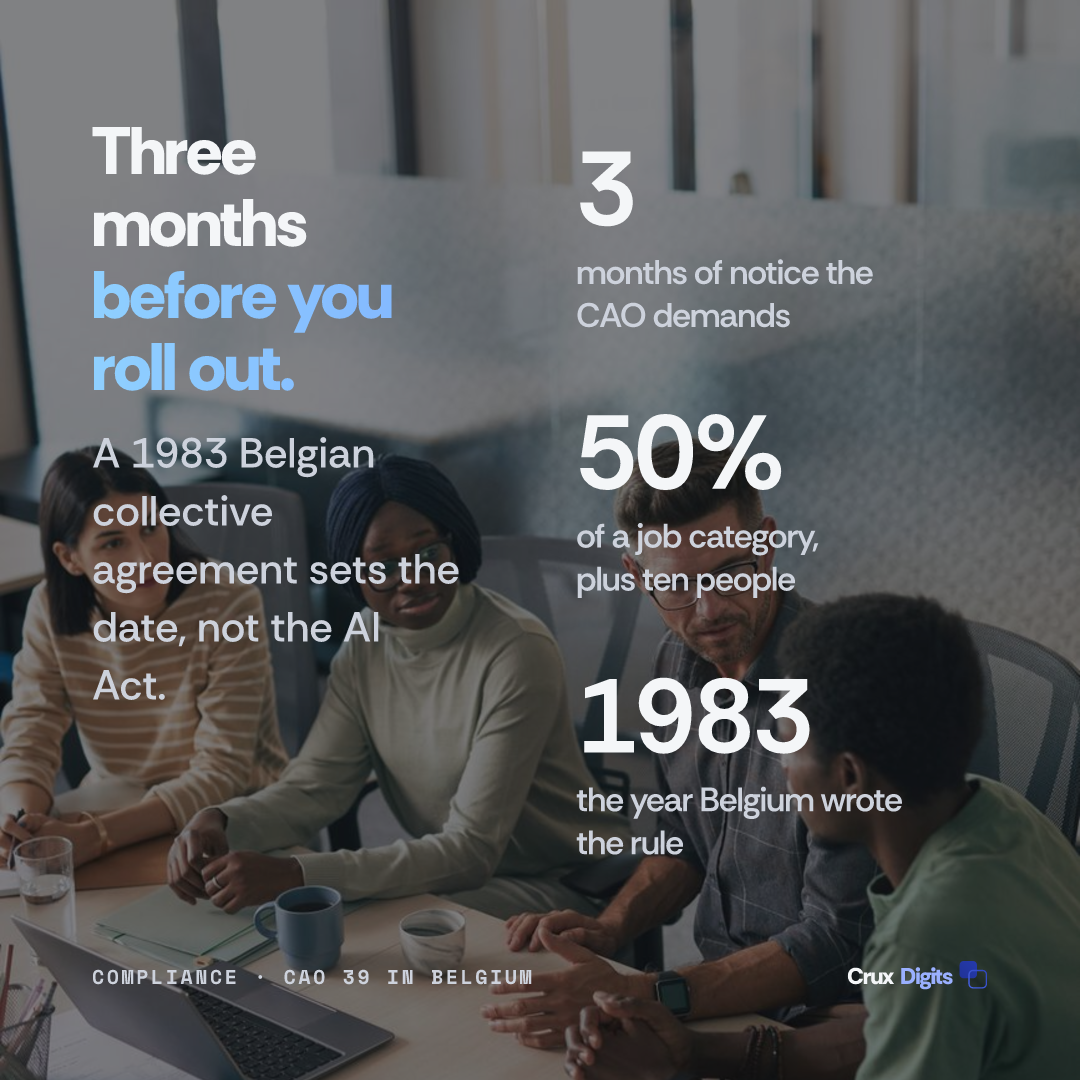
If you employ 50 or more people in Belgium and you are about to put an AI tool in front of your staff, CAO nr. 39 of 13 December 1983 can require written information and consultation with your worker representatives at least three months before rollout begins. It applies regardless of what the AI Act currently defers, it does not care whether the system is high-risk, and in practice it is the date your project plan turns on.
This is for the IT manager, IT director, CIO or security officer at a Belgian organisation of roughly 250 to 5,000 employees, where a single occupational category can clear the threshold on its own.
Which Belgian rule actually sets your AI rollout date?
CAO nr. 39 was concluded in the Nationale Arbeidsraad on 13 December 1983 and took effect on 1 February 1984. It is cross-industry in scope, so in principle it reaches the whole Belgian private sector. Article 1 §1 sets the scope: employers who normally employ an average of at least 50 workers in the calendar year before the information falls due.
Article 2 §1 is the operative sentence. Where the employer has decided to invest in a new technology with important collective consequences for employment, work organisation or working conditions, information and consultation must begin at the latest three months before implementation of that technology starts. Article 3 §1 says the information must be written, and sets out four things it must cover. We come back to those below.
Belgium wrote its new-technology consultation rule four decades before anyone drafted an AI regulation, during the automation wave. It was never repealed, and it was written broadly enough to reach a language model unamended. Belgian employment counsel have said so for a while: Crowell set CAO 39 beside the AI Act in February 2026, and Ghent firm commit worked through the mechanics in March. They are right. What is missing is the arithmetic on a real rollout and the date line.
When does an AI rollout cross CAO 39's threshold?
Article 2 §2 defines "important and collective": the consequences count when they affect 50% and at least ten workers of a given occupational category. Affected workers, says the commentary, are those who must use the new technology under changed working conditions or a changed work organisation, and those facing job loss or transfer. If the affected categories together hold fewer than 100 workers, the 50% and ten-worker thresholds are measured across those categories combined rather than separately.
Run that against a real organisation. Take an 800-FTE organisation with a 60-agent customer-service department. Put an assistant in the workflow of 38 agents and change how they work: 63% of the category and well over ten people, so you are in scope. Now the case that catches people out: a pilot across five departments, eight users each. Five teams of 30 hold 150 workers between them, so each category is measured on its own and eight of thirty is 27%, below the line. Five teams of 16 hold 80, which is under 100, so Article 2 §2 measures them combined — 40 of 80 is half the base and well over ten workers. The same pilot, both sides of the threshold.
That is the part worth taking away, because it is counter-intuitive for anyone used to licence maths. The threshold is computed per occupational category on changed working conditions, not on seats bought. A tenant-wide purchase for 2,000 people can sit below the line while a 40-seat rollout inside one department sits above it. Which groups form an "occupational category" is contested and not IT's call. But you are the only person who knows whose work changes, which is why the arithmetic stalls without HR and you in the same room.
Did the AI Act's duty to inform workers move, and does that help you?
Article 26(7) of the AI Act says that before putting a high-risk AI system into service or using it at the workplace, deployers who are employers shall inform workers' representatives and the affected workers that they will be subject to it. That duty was due on 2 August 2026. Then Regulation (EU) 2026/1744, the Digital Omnibus on AI, published on 24 July 2026 and in force since 27 July, moved the Annex III high-risk obligations to 2 December 2027, and Annex I systems to 2 August 2028.
Article 26 sits in Chapter III, Section 3, and the amended Article 113 defers Sections 1 to 3 of that chapter, Article 6(5) aside — so on the operative text Article 26(7) moved with the rest, and ActuIA's October 2026 dossier reads it that way. Crowell's EU overview of AI and HR, written in February while the Omnibus was still a proposal, took the view that the duty applies regardless of any postponement; that reading predates the adopted text. Ask your counsel if your calendar turns on it, but do not plan on the earlier date.
For a Belgian employer this is close to academic, and it is the practical point of the whole post. CAO 39 does not depend on a risk class: an assistant nobody would call high-risk still triggers it if working conditions change for half a category and at least ten people. The amended Article 4 AI-literacy duty, meanwhile, has applied since 2 February 2025 and was not deferred at all. The deferral bought you documentation time. It bought you no consultation time.
What do the French rulings tell a Belgian IT manager?
France is the leading indicator here, because its Article L. 2312-8 "new technologies" ground is close kin to CAO 39 and French unions have litigated it. ActuIA's dossier of 7 October 2026 counts nine decisions across six cases between February 2025 and September 2026 — including ChatGPT and an internal assistant suspended at two subsidiaries by the Créteil court in July 2025, upheld on appeal in Paris in May 2026.
The one to read runs the other way. The Tribunal judiciaire de Paris, in référé on 10 February 2026 (no. 25/57412), held that a Copilot 365 deployment was not an "important project" requiring consultation: a four-month voluntary test, no decision taken on full deployment, no specific tasks or workstations targeted, training provided. Higher productivity on its own, the court added, does not create a health and safety risk.
So the pilot's design decides whether the clock starts. A time-boxed, genuinely voluntary pilot with no task reassignment can sit outside the duty; one that runs long enough to present the works council with a fait accompli does not. CMS draws the conclusion we would reach anyway: inform the representatives before the test begins, and the demand for formal consultation during it tends to subside.
These are French decisions under French procedural law, and we found no equivalent line of Belgian cases. They tell you where the argument lands, not what an Antwerp or Brussels judge will hold.
What goes in the written information, and who receives it?
Article 3 §1's four elements, written the way an IT organisation can actually fill them in:
- Nature of the technology. Which system, which data it reaches, which model provider sits behind it, and whether it decides or only suggests.
- Reasons. The business case, in its own language. Article 3 §2 lets you leave the economic, financial or technical reasons out where disclosing them would seriously harm the undertaking — the social consequences stay in regardless.
- Nature of the social consequences. Which tasks change, which do not, and whether any role is reduced. If there is no job-loss plan, write that there is no job-loss plan.
- Timeline. Pilot dates, go-live, and the scaling steps after it.
Article 5 sets the recipients: the information goes to the ondernemingsraad, or where none exists, to the union delegation. Consultation then happens in the works council, the CPBW, or the union delegation depending on the subject. This is where a threshold trips people up. A Belgian works council is only required from an average of 100 employees, while the CPBW threshold is 50 — so a site below 100 people can be squarely in scope for CAO 39 with no works council at all.
Article 4 lists what consultation must cover: employment prospects and structure, planned employment measures, work organisation and working conditions, health and safety, and vocational skills with training or retraining. That last item is where your AI-literacy and training plan belongs. It is the same meeting. Bring one document, not two.
What does CAO 39 do to your project plan, and what does skipping it cost?
Article 6 §1 is the sanction, and it is sharper than the procedure suggests. An employer that has not run the procedure may not act to terminate employment contracts unilaterally except for reasons unrelated to the new technology — and carries the burden of proving those reasons from the day the information was due until three months after the technology takes effect. Outside that window the employee carries it. Article 6 §2 adds a flat three months' gross wages on top of ordinary dismissal compensation.
Read that as a project risk and it changes shape. The window is open for at least six months around go-live, longer when implementation runs ahead of it, and what opens it is a missed information date, not the AI. Any reorganisation inside it inherits a reversed burden of proof. If HR is planning a restructuring in the same year as your rollout, those two plans need one date line between them, not two.
The sequence we run, with the three months as the anchor: scope the affected occupational categories first, get the per-category arithmetic from HR, then set the information date three months before implementation starts — not before go-live. Implementation starts earlier than the change window your CAB sees, and that gap is where the date gets missed.
One line on the comparison, because many groups here run both countries. In the Netherlands, Article 27 of the WOR gives the works council a consent right over certain regulations, with no fixed notice period attached. In Belgium, CAO 39 gives information and consultation with a hard three-month lead and no veto. Dutch route: you may need a yes. Belgian route: you need three months. A group that runs the Dutch playbook at a Flemish site will have the conversation and still miss the date.
Who owns the sentence in Article 3 §1?
You have an ICT partner, or an internal team, or both. CAO 39 is not their work and not their liability, and no vendor's sales engineer will raise it. We work alongside your existing ICT partner rather than replacing them — we do not manage, host or support your estate — and this is the seam we keep landing in. The AI supplier knows what the system changes about the work; HR knows what the law needs; nobody owns the sentence that joins them, and that sentence is Article 3 §1. Write it with both in the room, and the Belgian route costs a meeting instead of a quarter. If the arithmetic needs a second pair of eyes, that is what we do in Belgium.
Last updated: 8 October 2026. Legal thresholds and AI Act dates verified against the sources linked above on that date. This is an informational piece, not legal advice — your social-law adviser decides what your occupational categories are.
A consultant tells you where AI pays off; Crux Digits also builds it. A fixed price per step, one named expert, and the Belgian rules and funding built in.
AI consultant in Belgium →