A transport company is sold software in the order suppliers happen to call, not in the order its problems appear. This page maps the five systems a Dutch transport business actually runs, what each one is genuinely for, which to buy first, and where the money leaks between them. It is deliberately not a product comparison — it is the decision that comes before one.
By Tom Joseph · Last updated: 18 August 2026
Most transport companies run five systems: a TMS, a planning tool, telematics or a board computer, a financial and invoicing package, and — if they hold stock — a WMS. The costly mistake is buying them in the wrong order, because each one assumes the data of the one before it. The practical rule: buy the system that owns the decision currently losing you the most money, and make sure it can hand data to the next two before you sign. We start with a €2,500 audit that establishes which decision is actually leaking — planning, invoicing, or the gap between them — before anything is purchased.
The five systems
Transport companies run five systems. The costly mistake is buying them in the wrong order.

The backbone: the shipment, the tariff, the carrier. It owns what may be billed.

Which vehicle takes which load, within driving hours and time windows. Sometimes a TMS module, sometimes separate.

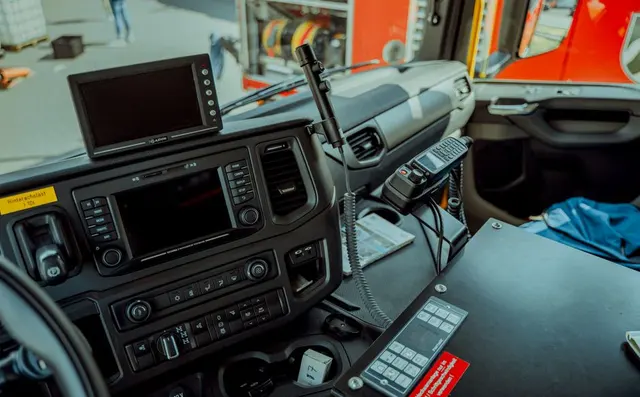
The board computer reports reality. It decides nothing — and prices nothing.

Receives what the TMS calls billable, with no view on whether that was correct.

Warehouse work on a transport system is the most common cause of a stock position nobody trusts.
The vocabulary overlaps badly. Suppliers use "transport software" for all five, which is how a company ends up with two systems that half-do planning and none that does it well.
Because all five functions get called "transport software", the fastest way to place a supplier is to ask what their system refuses to do. Honest vendors answer this quickly; the answer tells you which of the five you are being sold.
The order is not universal — it follows your constraint. Three patterns cover most Dutch operators:
The honest answer depends on how unusual your operation is, and the question is not which is better but which failure you would rather have.
All-in-one means one supplier, one dataset and no integration project. You pay for it in fit: when your tariff structure or planning constraints are unusual, you adapt to the package or pay for development. For a straightforward general-cargo operation this is usually the right trade.
Best-of-breed means each system is genuinely good at its job, and you own the integration for the life of the stack. That is a permanent cost, not a project. It is worth it where one function is your competitive edge — specialised planning, or a tariff model competitors cannot copy.
What decides it in practice: how many exceptions your operation runs on. Few exceptions favour all-in-one. Many favour best-of-breed, because packaged software handles the common case well and the exception badly.
Telematics suppliers have added trip registration, order screens and messaging, so it reasonably looks as though you already have transport software. You have an excellent record of what happened and no system that decides what should happen.
The distinction shows up in three places. A board computer cannot price a shipment against a customer tariff, so invoicing stays manual. It has no view of unaccepted orders, so it cannot help you decide what to take on. And its data model is the vehicle, not the shipment — which means a load moving across two vehicles is two records that nobody reconciles.
What it is genuinely good for is feeding everything else: actual times against planned, real driving hours, fuel per lane. Any TMS worth buying takes that feed. Ask how, and how often, before you sign.
Each handover is a place where reality and record diverge. Four leaks show up in almost every audit we run:
Worth stating plainly, because these get sold as software problems:
Licences are quoted per user or per vehicle and are the predictable part. What surprises people is the annual change budget: tariff structures shift, customers demand new file formats, a carrier changes its API. Budget for that deliberately rather than treating each change as an incident.
The second recurring cost is the integration layer, if you chose best-of-breed. Someone maintains it. If nobody is named, it decays quietly until an invoicing run breaks, and the diagnosis takes days because no one owns both ends.
A TMS is one system within the transport software stack — the order-to-invoice backbone. "Transport software" is the whole set, including planning, telematics and invoicing.
Usually not at first. TMS planning modules handle straightforward vehicle allocation well; a separate optimiser earns its cost when the combinatorics genuinely exceed a person.
For a handful of pallets in a buffer, yes. For picking customer orders from stock, it produces a stock position you cannot trust.
Licences are usually priced per user or per vehicle per month, which makes the licence the predictable part and everything else the variable.
It can be, for a small operation on simple tariffs. Test it against three specific things before accepting it.
The €2,500 audit establishes where money actually leaks in your stack — planning, invoicing, or the handover between them — before anything is purchased.
Book a conversation