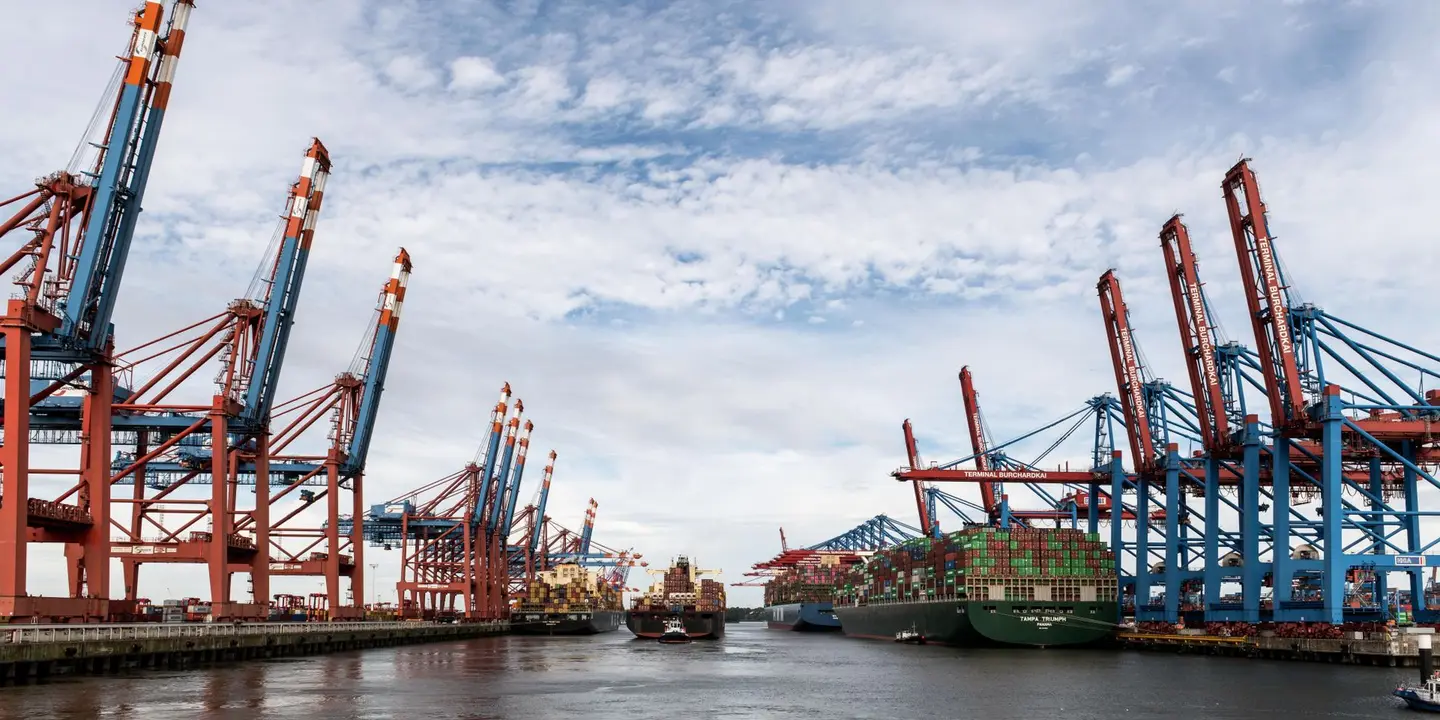
The minutes that decide a terminal's day
A box that sits one extra day on the stack is not a rounding error — it is demurrage billed, a slot lost, a re-handle nobody booked. In a Rotterdam terminal the whole P&L turns on a few operational variables: how long a container dwells before it leaves, how many moves a quay crane makes per hour, how accurately you knew the vessel's real arrival, and how much of the gate and document flow runs without a human keying data twice. Those are the numbers AI for port logistics actually moves, and they are the numbers most port software only reports instead of improving.
Rotterdam is Europe's largest seaport, the deep-sea gateway feeding the whole northwest-European hinterland by barge, rail and road. That scale is the opportunity and the trap: a small percentage gain on dwell time or crane productivity is large in absolute terms, but the planning surface — deep-sea calls, feeders, barge windows, rail paths, empties, reefers, hazardous cargo — is far too complex for spreadsheets and gut feel. This is exactly where applied AI earns its place, and it sits under our broader AI for logistics and transport work.
We size the euro before we model anything
Before a line of code, we ask which decision is leaking money — the yard plan, the ETA, the gate, the berth allocation — and what a 5% or 10% improvement is worth to your operation in real terms. If the number is small, we say so. That is the difference between a senior-led AI consulting partner in the Netherlands and a vendor selling you a platform you have to justify afterwards.
Almost every downstream plan at a terminal hangs on one number — when the ship will actually be alongside. Carrier-declared ETAs drift; weather, congestion at the previous call, pilotage and tide windows all move the real arrival. When the berth plan is built on a wrong ETA, the consequences cascade: gangs rostered for a ship that is six hours late, a berth held empty, a barge connection missed, reefers waiting for power.
A vessel ETA prediction model learns from AIS tracks, historical call patterns, weather and the terminal's own berth history to produce an arrival window you can plan against, refreshed as the vessel approaches. The outcome is not "better accuracy" in the abstract — it is tighter berth scheduling, gangs called at the right hour instead of paid to wait, fewer missed barge and rail connections, and a believable promise you can pass to the next link in the chain. The same forecasting machinery predicts inbound volumes so the yard and the gate can be staffed to the actual peak, not last month's average. This is core machine learning applied to a problem dispatchers cannot compute by hand.
Yard optimisation and dwell time: stop re-handling the same box
Inside the stack, the enemy is the unproductive move. Every time a crane lifts one container only to reach the one underneath it, you have paid for a shuffle that adds nothing. Poor stacking decisions, made under pressure without knowing when each box will leave, are what drive re-handle ratios up and slow the whole yard down.
Smarter stacking decisions, fewer shuffles
Yard optimisation uses the ETA and pickup forecasts to decide where each container should sit — grouping by departure window, mode and customer so the boxes leaving first sit on top, and the deep-sea export pile is built in load sequence. The measurable wins are a lower re-handle ratio, shorter dwell time, more predictable equipment utilisation, fewer empty crane moves, and quay and rail transfers that flow instead of waiting on a buried box. Pair that with reefer-slot planning so conditioned containers land near power, hazardous cargo segregation that the model enforces by rule rather than by memory, and yard-density balancing so no single block becomes the bottleneck during a peak call. The same engine improves quay-crane and straddle-carrier sequencing, lifting effective moves per hour without buying a single new piece of equipment — pure throughput from better decisions.
Where computer vision pulls its weight
Much of the yard's friction is data that should be captured automatically and isn't. Computer vision reads container numbers and IMO/ISO markings at the gate and on the crane, verifies seal integrity, detects damage on arrival so a claim is photographed before the box ever enters the stack, and confirms what is actually on the chassis. Those accuracy gains show up directly: fewer mis-stows, fewer disputed damage claims, and a digital twin of the yard that the planning model can trust because the inventory underneath it is correct.
Gate and document automation: where the back office actually bleeds hours
Quay and yard get the attention, but a large share of a port-logistics operation's cost is paperwork. A single import box can carry a bill of lading, a customs declaration, a CMR for the onward leg, a delivery order, dangerous-goods documentation and a release code — and at most terminals and forwarders that data is keyed by hand, more than once, across systems that don't talk.
This is where generative AI and NLP do quiet, compounding work. Document-extraction models read the bill of lading, the commercial invoice and the customs declaration, pull out the fields, cross-check them against the booking, and flag a mismatch before it becomes a hold at the border. The outcomes are concrete: fewer manual touches per shipment, fewer customs corrections, faster release at the gate, and lower demurrage and detention because the paperwork is ready when the box is, not after. Layer on the higher-value patterns and the back office changes shape:
- AI copilots for planners and clerks. A copilot sitting on top of your TOS, customs status and booking data answers "where is this box, what's blocking its release, what's the next free barge slot" in one query instead of five screens — so a planner spends the shift deciding, not hunting.
- Customer-support and shipment-visibility automation. A track-and-trace assistant grounded in your live container and vessel data deflects the endless "where is my container" calls, gives forwarders and BCOs a self-service answer, and frees the desk for the exceptions that genuinely need a human.
- Knowledge bases over your own rules (RAG). A retrieval-grounded assistant over SOPs, customs and tariff rules, dangerous-goods regulations and terminal procedures gives staff a correct, sourced answer in seconds — invaluable when half the floor is new and the rulebook is thick.
- Operational AI agents. For well-bounded, repetitive flows — appointment booking, pre-advice validation, release-code chasing, exception triage — an agent executes the multi-step task end to end and escalates only when something is off, with a human in the loop where the decision carries weight.
The Port of Rotterdam reality the model has to survive
A generic optimisation engine falls apart on the specifics of operating in Rotterdam, and the specifics are the whole point. The Port of Rotterdam AI problem is shaped by a genuinely multimodal hinterland: deep-sea calls feed feeders, barges up the Rhine corridor, rail paths to Germany and beyond, and road haulage into the Brabant distribution belt. A yard plan that ignores the barge window or the rail cut-off optimises one mode and breaks another.
Then there is the port community system layer — Portbase, customs (Douane), and the data exchanges that connect terminals, forwarders, shippers and authorities. Real value comes from AI that plugs into these flows rather than sitting in a separate dashboard: reading pre-arrival data, returning status, syncing release information. There is also a structural labour squeeze across Dutch logistics; when you cannot simply add planners or drivers, the only lever left is using the hours and equipment you already have more intelligently. AI is well suited to this because it weighs hundreds of constraints — tide, congestion, equipment availability, time windows — at once.
None of it works on messy data, and we say so upfront. Terminal operating systems, gate systems, AIS feeds, customs platforms and reefer telematics rarely speak cleanly to each other, and a forecast or a stacking plan is only as good as the history feeding it. A large share of any honest port-AI project is data engineering — joining those sources, cleaning them, and building the pipeline that keeps fresh data flowing once the model is live. Pretending otherwise is how AI projects quietly fail six months in.
Compliance, ownership and why Crux Digits fits a Rotterdam operator
EU AI Act and AVG, built in from day one
Port AI touches data that regulators care about — ANPR and CCTV feeds at the gate, worker rostering and hours, customer and consignee details, and decisions that affect people's work. Under the EU AI Act some of these use cases carry real obligations, and the AVG/GDPR governs the personal data throughout. We design for it from the start: data minimisation, clear retention, documented decision logic and a human in the loop where it belongs. Compliance-first is not a brake on the project; it is what makes a model you can actually deploy in a regulated port environment and defend later.
Crux Digits is a boutique, senior-led AI consultancy founded in 2022, based at Vlierhoeve 100 in Nieuwegein in the province of Utrecht, serving the Utrecht region and the whole of the Netherlands and Europe. We sit deliberately between two options that fail a typical Dutch terminal operator or port-adjacent forwarder. The big enterprise consultancies bill heavily, staff your project with juniors and leave you dependent. The weekend-rebranded "AI" web agencies cannot build a production model that survives contact with real terminal data. We are the AI engineering partner in the middle: senior people stay on your project from audit to launch, and you end up owning the solution outright — code, model and pipeline.
The commercial path is transparent and fixed-step, all prices excluding VAT. An AI Audit & Strategy at EUR 2,500 pinpoints where the money actually leaks — demurrage, re-handles, gate dwell, missed connections — and whether AI is the right tool. A Production-ready MVP at EUR 20,000 puts a working model on your own data so you judge it on results, not slides. Production launch starts from EUR 50,000, with day-rate guidance around EUR 150 per hour. Behind that sits real delivery: 13 delivered case studies spanning demand forecasting, computer vision, NLP, predictive maintenance, cold-chain monitoring and ANPR — the same building blocks a port operation needs.
Where to start
If dwell time, demurrage and detention, ETA accuracy or gate throughput are the numbers keeping you up, those are exactly the numbers we like to attack first, because they are measurable and AI moves them. The honest route is a short conversation about where cost or delay creeps into your terminal or forwarding operation, followed by an audit that puts a euro figure on the opportunity before anyone writes a model. Explore our wider AI automation work, the parent logistics and transport hub, or get in touch, and we will map a realistic path from a single use case to AI running live on your quay, in your yard and across your back office.