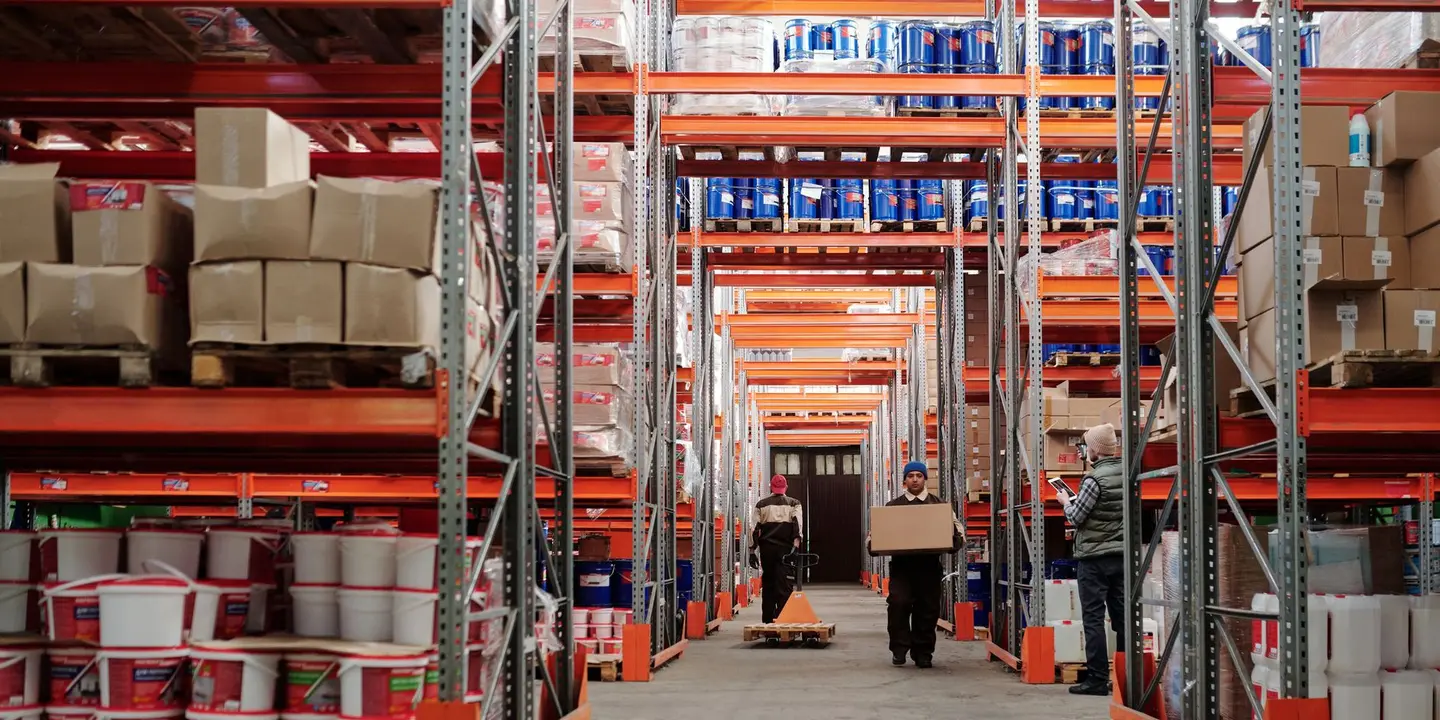
Where AI actually moves the needle inside a Dutch DC
A warehouse P&L is decided by a handful of numbers: lines picked per hour, inventory accuracy, shrink, dock-to-stock time and the labour bill that pays for all of it. None of those improve because you bought a new screen. They improve when the decisions underneath get sharper — which slot a SKU lives in, what sequence a picker walks, how many people you roster for Tuesday's inbound wave, and whether the system trusts its own stock count enough to promise a same-day order. That is the layer where AI for warehousing operators earns its place, and it is the layer most WMS deployments never touch because they digitise the process without improving the decision.
The Netherlands runs one of Europe's densest distribution landscapes — the Port of Rotterdam feeding the Brabant and Venlo logistics belts, Schiphol pulling air-freight volume, and a national network built on the "Gateway to Europe" position. That means full buildings, tight labour and demanding retail and e-commerce service-level agreements. It also means a structural picker and forklift-driver shortage, so the only honest way to lift throughput is to get more out of the hours and the square metres you already have. AI is well suited to exactly this: weighing thousands of constraints at once to find a plan a shift supervisor cannot compute by hand at six in the morning.
Pick-path and slotting: the fastest measurable win
Cut the walking, not the headcount
In a manual or semi-automated DC, pickers spend more time travelling than touching product. Travel is the waste, and it is highly compressible. Pick-path optimisation sequences each pick run so a walker or a forklift covers the shortest sensible route, while batch and zone logic groups orders so one trip serves several at once. Done properly against real aisle geometry and congestion, travel-distance reductions in the 20–30% range are a realistic industry benchmark — and that distance converts straight into lines-per-hour without adding a single person.
Slotting optimisation attacks the same waste from the other side. Fast-movers belong near dispatch and at golden-zone height; slow A-items should not be blocking a prime face. The hard part is that velocity drifts — a SKU that was a runner in Q1 is dead stock by Q3 — so slotting is not a one-off project but a model that re-ranks placements as demand shifts and flags re-slot candidates before the picking inefficiency compounds. We size what a few percentage points of travel reduction is worth to your specific operation in euros before modelling anything; if the number is small, we say so.
Inventory accuracy and shrink: trust the number
Most warehouse pain traces back to one root cause: the system stock figure and the physical stock figure disagree. When inventory accuracy slips, you get phantom availability, short-picks, emergency cycle counts and a full annual stock-take that shuts a zone for a weekend. AI tightens the loop in two ways. First, it turns the blunt annual count into intelligent, risk-weighted cycle counting — the model learns which SKUs and locations drift, and directs counters to the bins most likely to be wrong instead of walking the whole building. Second, it reconciles the data streams — WMS, scans, ASN feeds, ERP — to surface the discrepancies that quietly erode accuracy.
Shrink is the same problem with a sharper edge. Whether the loss is process error, damage or theft, the first defence is knowing it happened and where. Anomaly-detection models watch movement and adjustment patterns to flag the unusual — a location that bleeds units, an adjustment pattern that does not fit, a receiving variance that recurs on one lane. The outcome operators feel: fewer mis-ships, fewer customer claims, a stock figure dependable enough to confidently promise next-day, and a write-off line that stops surprising finance at year-end.
Computer vision on the floor
Eyes that never blink at the dock
A camera that can read does a remarkable amount of warehouse work. Computer vision in the warehouse reads pallet and carton labels, verifies that what is on the dock matches the ASN, counts cases, checks pallet build and stretch-wrap integrity, and catches visible damage on inbound before it is signed for and becomes your liability. Each of those checks today is a person with a clipboard or a hope that the scan was done — vision turns it into a logged, consistent verification that runs at line speed.
The same family of models supports goods-in inspection, returns triage (grading a returned item's condition to decide restock versus refurbish versus scrap), and dimensioning for cartonisation and slotting. The measurable gains are fewer receiving errors propagating downstream, fewer disputes with carriers and suppliers, and damage caught at the point where you can still reject it. The engineering reality — distinguishing a genuine defect from glare, motion blur or a scuffed-but-fine box — is precisely the kind of problem behind our visual-defect detection and image-recognition work, and it sits at the centre of our computer vision service.
Demand forecasting and labour planning
Roster to the wave, not to the average
Inbound and outbound volume is not flat, and staffing to a weekly average is how you end up paying weekend overtime to recover from a Monday surprise. Demand forecasting for a DC predicts the order and receipt profile by day, shift and even hour — learning the seasonality, the promotional lift, the e-commerce peak shape and the day-of-week pattern in your own history. That feeds labour planning that matches pickers, packers and forklift drivers to the actual wave, and a dock scheduling model that spreads inbound appointments so trailers are not stacked up at 09:00 and idle at 14:00.
The outcomes are concrete: less idle paid time, fewer panic temp-agency calls, lower trailer detention and demurrage from smoother yard and dock flow, and a building that hits its dispatch cut-offs without heroics. Forecasting also feeds replenishment so fast-pick faces are topped up before they run dry. The shape of this problem — turning demand signals into a staffable, buyable plan — is exactly what we delivered in our demand forecasting and production planning case study; client details stay confidential, but the pattern is universal across warehouse and supply-chain AI. For conditioned and cold-store DCs, the same monitoring discipline that protects a perishable load appears in our cold-chain monitoring work.
WMS AI, copilots and operational agents
Make the WMS smarter, do not replace it
WMS AI rarely means ripping out Manhattan, Blue Yonder, Körber or your homegrown system. It means wrapping intelligence around it: feeding optimised slotting and pick sequences back in, scoring tasks so the most valuable work surfaces first, and predicting the bottleneck before it forms. The WMS stays the system of record; the AI improves the decisions it executes.
On top of that, a few high-value patterns are landing fast in Dutch DCs:
- AI copilots for floor and office staff. A supervisor or planner asks in plain Dutch or English — "which orders are at risk of missing cut-off?", "where is the nearest open pallet location for this SKU?" — and gets an answer drawn from live WMS data, no report-building required.
- Knowledge bases over SOPs and procedures. A retrieval-augmented assistant (RAG) over your work instructions, dangerous-goods rules, customs and tariff references and equipment manuals means a new picker or a night-shift lead gets the right answer in seconds instead of hunting a binder — built on our generative AI and LLM capabilities.
- Shipment-visibility and track-and-trace assistants. Customer-support automation that answers "where is my order" with a real, current status, deflecting routine tickets so your service desk handles the genuine exceptions.
- Operational AI agents. Multi-step automations that read an inbound ASN, pre-build a putaway plan, raise a dock appointment and flag a discrepancy for a human — handling the routine end-to-end so people focus on the judgement calls.
The data work nobody puts in the brochure
Here is the part the slide decks skip: none of these models work on messy data. WMS, ERP, scan events, ASN feeds, labour-management and yard systems rarely speak to each other cleanly, and a forecast, a slotting recommendation or an accuracy model is only as good as the history feeding it. A large share of any honest warehouse-AI project is data engineering — joining those sources, cleaning the event streams and building the pipeline that keeps fresh data flowing once the model is live. Scan events alone are deceptively dirty: duplicate reads, missing putaways, location codes that drifted when the layout changed. We are upfront about this because pretending otherwise is how AI projects quietly fail six months in. It is also why warehouse AI in the Netherlands succeeds or stalls on integration discipline, not on the cleverness of the algorithm.
Compliance built in, not bolted on
Compliance is the other non-negotiable. A DC's AI touches data regulators care about — camera feeds, worker productivity metrics, customer addresses and decisions that affect people's shifts. Under the EU AI Act some of these use cases carry real obligations, and the AVG/GDPR governs the personal data throughout. We design for it from day one: data minimisation, clear retention, documented decision logic and a human in the loop where it belongs. Productivity models in particular are handled with care — they exist to balance the wave and protect people from crunch, not to surveil individuals. Compliance-first is not a brake on the project; it is what makes a model you can actually deploy and defend.
Why operators choose Crux Digits
Crux Digits is a boutique, senior-led AI consultancy founded in 2022, based at Vlierhoeve 100 in Nieuwegein in the province of Utrecht, serving the Utrecht region and the whole of the Netherlands and Europe. We sit deliberately between two options that fail the typical Dutch logistics operator. The big enterprise consultancies bill heavily, staff your project with juniors and leave you dependent. The weekend-rebranded "AI" web agencies cannot build a production model that survives contact with real WMS and scan data. We are the AI engineering partner in the middle: senior people stay on your project from audit to launch, and you end up owning the solution outright — code, model and pipeline. This page is a spoke of our broader AI for logistics and transport hub, where route, fleet and freight use cases live alongside the warehouse work.
The commercial path is transparent and fixed-step, all prices excluding VAT. An AI Audit & Strategy at EUR 2,500 pinpoints where the money actually leaks — pick travel, accuracy, shrink or labour — and whether AI is the right tool. A Production-ready MVP at EUR 20,000 puts a working model on your own data so you judge it on results, not slides. Production launch starts from EUR 50,000, with day-rate guidance around EUR 150 per hour. You can see the full breakdown on our pricing page, and the breadth behind it across 13 delivered case studies spanning demand forecasting, computer vision, predictive maintenance, NLP and cold-chain monitoring. If lines-per-hour, inventory accuracy, shrink or the labour bill are the numbers keeping you up, those are exactly the numbers we like to attack first — start with a short conversation through our AI consulting team and we will map a realistic path from a single use case to AI running live on your floor.