Home / Choosing a software company
Choosing a supplier

Choosing a software company: five questions that tell you who you are hiring

Every software company will say they are senior, agile and partner-minded. None of that is checkable. These five questions are, and the answers separate the firm that will build your system from the firm that will subcontract it.

By Tom Joseph · Last updated: 27 August 2026

Summarize with AI Prompt copied. Paste it into the chat
Share
In short

Ask to meet the people who will actually write the code, before you sign. That single request settles more than any reference call. In an agency model the people at the pitch are rarely the people on the project, and the gap between them is where budgets go. If the answer is that the team is assigned after signature, you are buying capacity, not expertise, and you should price it accordingly.

Who are you actually hiring?

Five questions, three models

Reference lists say little. What someone answers to five questions says everything.

  1. Two people in conversation at a tableThe questions

    Five questions that reveal

    Who builds, what change costs, what happens on a no, who owns the code, and who is still there in a year.

  2. A contract being read carefully with a magnifierRed flags

    What should make you look up

    A quote without questions back, a demo without your data, and a contract where the source is not yours.

  3. Two freelancers working together on laptopsModels

    Agency, freelancer or own team

    Each model has one strength: speed, price or continuity. The mistake is choosing on rate alone.

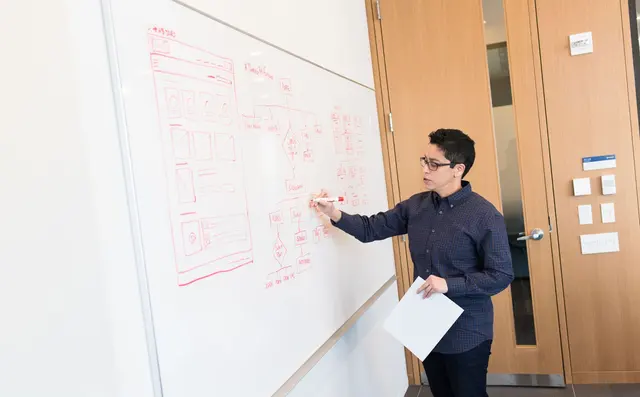
  4. An engineer sketching a system diagram on a whiteboardScoping

    Whoever scopes, builds

    The person who maps your problem should be the person who builds it. Otherwise you are buying a handover.

The questions

Five questions worth more than any reference list

All five are answerable in a first conversation, and the discomfort a question causes is itself information.

Warning signs

What should give you pause

None of these is disqualifying on its own. Two together is a pattern.

Models

Agency, freelancer or in-house: what each is good at

The three routes fail differently, and the failure mode should decide the choice.

A freelancer is the least expensive per hour and the highest concentration of risk: excellent for a defined build, poor for anything that must outlive one person's availability. An in-house team is the right end state for software that is core to the business, and slow to start, since hiring a first engineer takes months and the second is harder. An agency buys speed and breadth, and its weakness is continuity: ask specifically whether the people are yours for the duration.

We are the third of those, and the honest version of our own limitation is that a boutique cannot staff twenty people next month. If that is the requirement, a larger firm is the right answer and we will say so.

Buyer guides

Compare further

FAQ

Frequently asked questions

What should a software company cost?

Dutch rates vary widely and the rate tells you little on its own: a senior at a higher rate who ships in six weeks costs less than a lower-rate team that takes six months. Compare fixed prices against a defined outcome where you can. Ours are published: audit €2,500, proof of concept €20,000, production from €50,000.

Fixed price or hourly?

Fixed price against a clearly defined scope puts the overrun risk on the supplier, which is where it belongs. Hourly is honest for genuinely open-ended research. The problem is hourly billing on work that could have been scoped, because then the incentive runs against you.

How do I check they are any good without being technical?

Ask them to explain a past project to you and see whether the explanation makes you smarter. People who understand a system deeply can describe it simply. Reaching for jargon under a plain question is usually a sign the understanding is not there.

Should the supplier be nearby?

It matters less than it used to, but a shared time zone and language matter for the awkward conversations, and being able to sit in the same room during discovery is worth real money. We work on site in the Utrecht region and remotely across the Netherlands and Europe.

Comparing suppliers right now?

Ask us the five questions on this page. You will meet the engineer who would build your system in the first conversation, not after signature.

Book a conversation