Under the EU AI Act, most AI in a plant is not high-risk. Camera inspection that rejects product and predictive maintenance on a pump are excluded as safety components by a rule the Digital Omnibus added in July 2026. High-risk are AI that carries a machine's safety function, AI that is a safety component in gas, heat or electricity supply, and AI that allocates or monitors workers. AI rules for machinery now arrive through the Machinery Regulation.
This post is for the IT manager, OT manager or compliance lead at a food processor, chemical plant, machine builder or tank terminal of 250 to 5,000 people. Crux Digits builds AI systems such as vision inspection and maintenance models, alongside your ICT partner and machine suppliers; we do not run your OT network or safety PLCs.
What makes an AI system high-risk under the AI Act?
There are two routes: Article 6(1) with Annex I for AI in regulated products, and Article 6(2) with Annex III for listed use cases. Under Article 6(1) of the AI Act, an AI system is high-risk when it is a safety component of a product, or itself a product, covered by Annex I legislation, and that product needs a third-party conformity assessment. Annex III adds use cases; in a plant, point 2 (safety components in the supply of water, gas, heating or electricity) and point 4 (employment and workers' management) matter.
The Digital Omnibus on AI, Regulation (EU) 2026/1744, in force since 27 July 2026, added Article 6(1a): AI used solely for non-safety aspects of user assistance, performance optimisation, service efficiency, automation, convenience or quality control is not a safety component. Article 6(1b) is the counterweight: AI whose failure would endanger health and safety is one. The dates are on our high-risk deadline page: 2 December 2027 for Annex III, 2 August 2028 for Annex I.
Does the Machinery Regulation now govern AI in machines instead of the AI Act?
Largely yes: the Omnibus moved Regulation (EU) 2023/1230 from Section A to Section B of Annex I to the AI Act. For Section B products, the amended Article 2(2) applies only Article 6(1), Article 60a and Articles 102 to 112 of the AI Act, so Chapter III does not apply to machinery directly. Instead, Article 8 of the Machinery Regulation now obliges the Commission to adopt delegated acts adding AI requirements to its Annex III, reflecting Chapter III Section 2 and Articles 17, 19, 72 and 73 of the AI Act, applying by 2 August 2028.
The Machinery Regulation applies from 20 January 2027; a corrigendum replaced the 14 January 2027 in the original text, which is why both dates circulate. Its Annex I Part A lists two AI categories that need a third party: point 5, safety components with fully or partially self-evolving behaviour using machine learning approaches ensuring safety functions, and point 6, machinery with such systems embedded. Article 25(2) then allows modules B and C, H or G. Self-assessment is not an option.
Two laws that chemical plants and tank terminals meet stayed in Section A: ATEX (Directive 2014/34/EU) and pressure equipment (Directive 2014/68/EU). AI that is a safety component of such equipment, where the directive requires a third party, falls under the full AI Act high-risk regime from 2 August 2028.
Are camera quality inspection and predictive maintenance high-risk?
No, in the normal case: Article 6(1a) says AI used solely for quality control, performance optimisation or service efficiency is not a safety component. Example, with assumptions: a vision system on a food packing line checks seal integrity and label print and blows rejects off the belt. Its purpose is product quality, not protecting people at the machine, and quality inspection is not an Annex III use case. Verdict: not high-risk. The Article 4 duty to support AI literacy of its users remains.
Two edges change that. If the camera also detects a hand in the reject zone and stops the ejector, that is a safety function: see the next section. And solely carries weight, because Article 6(1b) catches any AI whose failure would endanger health and safety. Our reading is that foreign-body detection in food is a food safety law question, not a machinery safety function, but the text does not settle it, so record the reasoning. See camera-based quality control and machine vision.
Predictive maintenance follows the same logic. Example: a model reads vibration and temperature from a centrifugal pump, predicts bearing wear and raises a work order in SAP PM or IBM Maximo; a planner decides when to intervene. It does not trip the pump and is not part of the safety instrumented system. Verdict: not high-risk, also in a utility. Wire its output to shut the pump down to prevent a hazardous release, and Article 6(1b) applies. Predictive maintenance covers how such a model is built.
When is AI that controls a machine's stop, guard or speed high-risk?
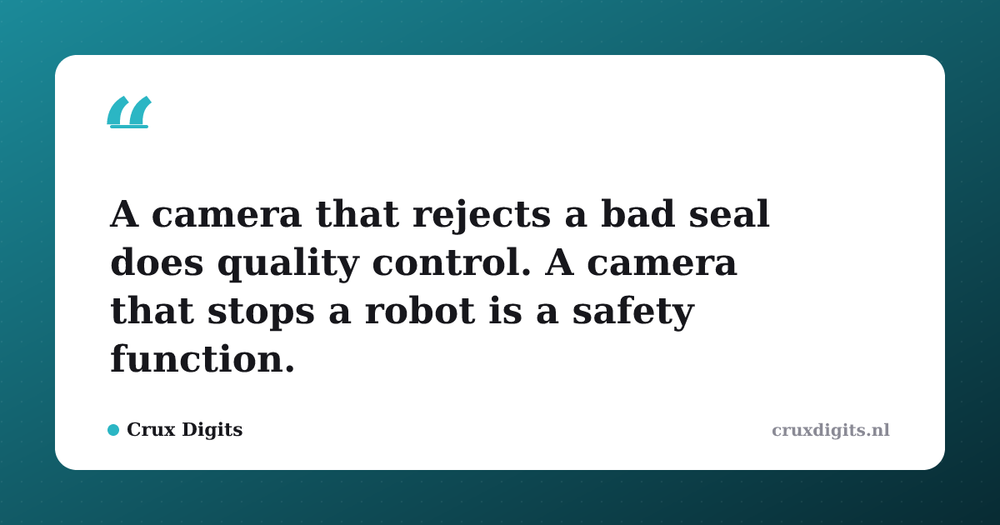
Almost always: a machine learning system that stops, guards or limits a machine's speed fulfils a safety function and needs a notified body. Example: a camera with a neural network detects people near a palletising robot and slows it or triggers a protective stop, alongside or instead of a light curtain. With fully or partially self-evolving behaviour it falls under Machinery Regulation Annex I Part A, needs third-party assessment from 20 January 2027, and counts as high-risk under AI Act Article 6(1). Because machinery is in Section B, its AI requirements come through the Machinery Regulation, and the AI Act's deployer duties in Article 26 do not apply.
One open point: self-evolving is not defined, and recital 55 of the Machinery Regulation excludes software incapable of learning or evolving that only executes programmed functions. Whether a model trained offline and frozen before delivery counts is not settled. Treat it as in scope until your notified body or Commission guidance says otherwise; the Commission's classification guidelines of 19 May 2026 are still a draft.
Is AI for shift scheduling or worker monitoring high-risk?
Worker monitoring is: Annex III point 4(b) lists AI that monitors and evaluates workers' performance and behaviour, from 2 December 2027. Point 4(b) also covers AI that allocates tasks based on individual behaviour or personal traits. Example: a roster tool fills shifts from availability, certificates such as forklift or ATEX zone access, and collective agreement rest times, without scoring anyone. Our reading: outside point 4(b), or a narrow procedural task under Article 6(3)(a); document it. Let the same tool rank operators by output per hour or absence history to hand out preferred shifts, and it profiles people. Article 6(3) says an Annex III system that profiles natural persons is always high-risk.
For a Dutch plant the nearer constraint is the works council. Article 27(1) of the Wet op de ondernemingsraden requires its consent for working and rest time arrangements (point b) and for facilities suitable for checking attendance, behaviour or performance (point l), today. Once the high-risk rules apply, AI Act Article 26(7) adds a duty to inform workers' representatives and affected workers before a high-risk system goes into service.
Is AI in the control of gas, heat or electricity supply high-risk?
Only as a safety component: Annex III point 2 covers AI used as a safety component in the supply of water, gas, heating or electricity. Recital 55 of the AI Act describes these as systems that directly protect the infrastructure or people's health and safety and are not needed for it to function; cybersecurity-only components do not count. Example: a chemical site's combined heat and power unit also feeds a district heating network. A model that schedules it against power prices is optimisation: not high-risk. A model that detects a gas leak and isolates the supply is a safety component: high-risk from 2 December 2027, and Article 6(3) rarely helps. We assumed supply to third parties; whether supply to the own site counts is not settled.
Who is the provider when an OEM sells the AI inside a new machine?
The OEM is: the manufacturer that places a machine with an embedded AI safety system on the market carries its conformity assessment. The compliance risk for the plant sits in two other situations.
Plant-added safety function. You, or a supplier you hired, add an AI camera that stops an existing machine. Article 18 of the Machinery Regulation makes whoever carries out a substantial modification the manufacturer. Article 3(16) defines that as an unforeseen physical or digital change that creates a new hazard or increases a risk and requires, for example, protective devices that change the existing safety control system. An AI stop wired into the safety PLC is a strong candidate. Recital 54 gives one relief: embedding a safety component that was already third-party assessed on its own does not by itself require re-certification.
Plant-added non-safety AI. Under AI Act Article 3(3), a company that has an AI system developed and puts it into service under its own name is the provider. For a quality camera that carries little weight, until someone changes its purpose: Article 25(1)(c) makes a deployer the provider when a modified intended purpose makes the system high-risk. Turning an OEE dashboard into a ranking of individual operators is that move. The amended Article 25(2) then obliges the initial provider to hand over technical documentation, known limitations and failure modes, and technical access for testing, unless it excluded high-risk use. Write that into your purchase contracts.
How does an IT or OT manager check one plant AI system?
Run seven questions per system, in this order, and record each answer with its assumption.
1. Would its failure endanger people or property? If not, and it only does quality control, optimisation or maintenance advice, skip to 5. 2. Which product law covers the protected equipment: the Machinery Regulation, ATEX or pressure equipment? 3. Does that law require a third party, for machinery: self-evolving machine learning ensuring a safety function? 4. Who is the manufacturer: the OEM as delivered, or you after a substantial modification? 5. Does it allocate work or monitor people (Annex III point 4), or protect water, gas, heat or electricity supply (point 2)? 6. Does it profile people? Then it is high-risk. If not, does an Article 6(3) condition fit: a narrow procedural task, improving a completed human activity, detecting deviations without replacing human review, or a preparatory task? 7. Record the verdict, date, owner and re-check trigger: a new model version, data source or purpose.
If you rely on Article 6(3), Article 6(4) requires the provider to document the assessment before the system goes into service, register it under Article 49(2), and supply the documentation on request; the Omnibus slimmed the registration content but kept that duty. No format is prescribed. We suggest: system and version, intended purpose, Annex III point, condition relied on and why, a no-profiling statement, where the human decision sits, signatory and date, and the re-check trigger.
Where Crux Digits fits
Crux Digits designs and builds AI systems for plants, such as vision inspection and maintenance models, with the evidence an auditor asks for: intended purpose, test data and results, the Article 6(3) record where it applies, and code you own. On a machine safety function we work inside the machine builder's or your own conformity process, with your notified body. We do not certify machines or replace your safety engineer, machine supplier or ICT partner. Classify a system first with the EU AI Act risk checker.
If the classification points to a build, AI implementation in the Netherlands shows how a project runs.
Last updated: 26 October 2026.
Our AI Act Check (€950 fixed) gives you your risk classification, obligations and a concrete to-do list within one week — including what you can safely ignore.
See the AI Act Check →A consultant tells you where AI pays off; Crux Digits also builds it. A fixed price per step, one named expert, from Utrecht.
AI consultancy in the Netherlands →