AI can rank a tank terminal's inspections and flag corrosion once drone imagery, ultrasonic thickness readings and past inspection reports sit in one dataset. PGS 29 allows terms up to 20 years under RBI, and the data decides the term.
Yes, once the data sits in one place: drone and crawler imagery, ultrasonic thickness readings per plate, the inspection reports of the last two terms, the tank register and the CMMS work orders. With that set a model ranks which tanks to open first and marks the plates that lost the most steel. It does not replace the inspection; it decides where the inspection goes. This guide says what the data must contain, how it fits PGS 29, EEMUA 159 and API 653, and what it costs.
Last updated: 14 October 2026
AI can prioritise tank inspections and flag corrosion when drone and crawler imagery, ultrasonic thickness readings, past inspection reports and the tank register are joined per tank and per plate; without that join it has nothing to learn from. The inspection regime rewards it: PGS 29:2016 sets a ten-year internal term for non-aggressive products and allows up to 20 years under risk-based inspection, 25 with NL-CBIT approval (PGS 29:2016, vs 3.7.5 and 3.7.8), and a term that long is only defensible on measured corrosion rates. The sector is late to it: 11% of Dutch transport and storage firms with 10 or more employees used AI in 2024, against 22.7% across all sectors (CBS AI Monitor 2024). The data you already collect at every inspection is the asset.
| Data source | What it yields | Where it usually lives |
|---|---|---|
| Drone and crawler imagery (shell, roof, floor, annular plate) | Marked indications: coating breakdown, pitting, seam corrosion, deformation | The inspection contractor's delivery, a file share, an inspection platform |
| Ultrasonic thickness readings (UT grid per plate) | Corrosion rate per plate, remaining life to the minimum thickness | Inspection reports as PDF, contractor spreadsheets |
| Historical inspection reports (NL-CBIT, EEMUA 159, API 653) | The trend over two or three terms, repair history, earlier findings | Document management, often PDF only |
| Tank register and tank data sheet | Design standard (NEN-EN 14015 or API 650), as-built plate thickness, foundation, lining, cathodic protection | Engineering archive, CMMS equipment master |
| CMMS work orders (SAP PM, IBM Maximo, Ultimo) | Repairs, coating jobs, leak reports, cost per tank | The CMMS |
| Product service history | Product class and climate code for the EEMUA 159 term, aggressive or inert service | Terminal management system, tank register |
| Settlement and floor-profile measurements | Differential settlement, floor deformation, edge settlement | Survey reports, inspection reports |
Start from the tank register, not from the model. Per tank it must state the design standard (NEN-EN 14015 for tanks built in Europe since 2005, API 650 for most older ones), the as-built thickness per shell course and per floor plate, the lining, the cathodic protection, the foundation type and the product service. PGS 29 ties the calculation method to that design standard: EEMUA 159 methodology by default, API 653 for tanks designed to API 650 (vs 3.7.9). A model that does not know which standard a tank was built to cannot compute remaining life.
Then three joins. The UT grids of at least two inspections must land on the same plate map, so a reading in 2016 and a reading in 2026 describe the same square metre of steel. The imagery must carry position: which shell course, which plate, which weld. And the inspection reports must be read out of PDF into fields: finding, location, severity, repair, next term. Most of the audit is this extraction, because NL-CBIT reports, contractor spreadsheets and drone deliveries arrive in three formats.
The systems are known. Maintenance runs in a CMMS: Stolthaven standardised maintenance across ten terminals on Ultimo after moving to one system in 2021 and now runs AI functions inside it (IT Brief, March 2026); SAP PM and IBM Maximo are the other two you meet on chemical sites. Inspection data is moving into dedicated platforms: Vopak signed in October 2025 for worldwide deployment of Falcker's tank inspection platform, a site explorer, condition monitoring and a life cycle planner (Tank Storage Magazine), and Evos Hamburg launched DigiTank in January 2025, a three-year IHATEC II research programme combining digital twins, AI and robotics for tank storage (Hydrocarbon Engineering). The AI layer reads from those systems and writes back into them; it is not a fourth place to look.
The regime decides the governance. A Seveso III site (in the Netherlands under the Besluit activiteiten leefomgeving since 1 January 2024, formerly Brzo 2015) must have its inspection terms procedurally secured, PGS 29 requires ultrasonic plate-thickness measurement of wall and floor at every internal inspection, and an RBI term needs an RBI methodology approved by an NL-CBIT (vs 3.7.6). The model's ranking is evidence in that review. The term is still set by the inspection body.
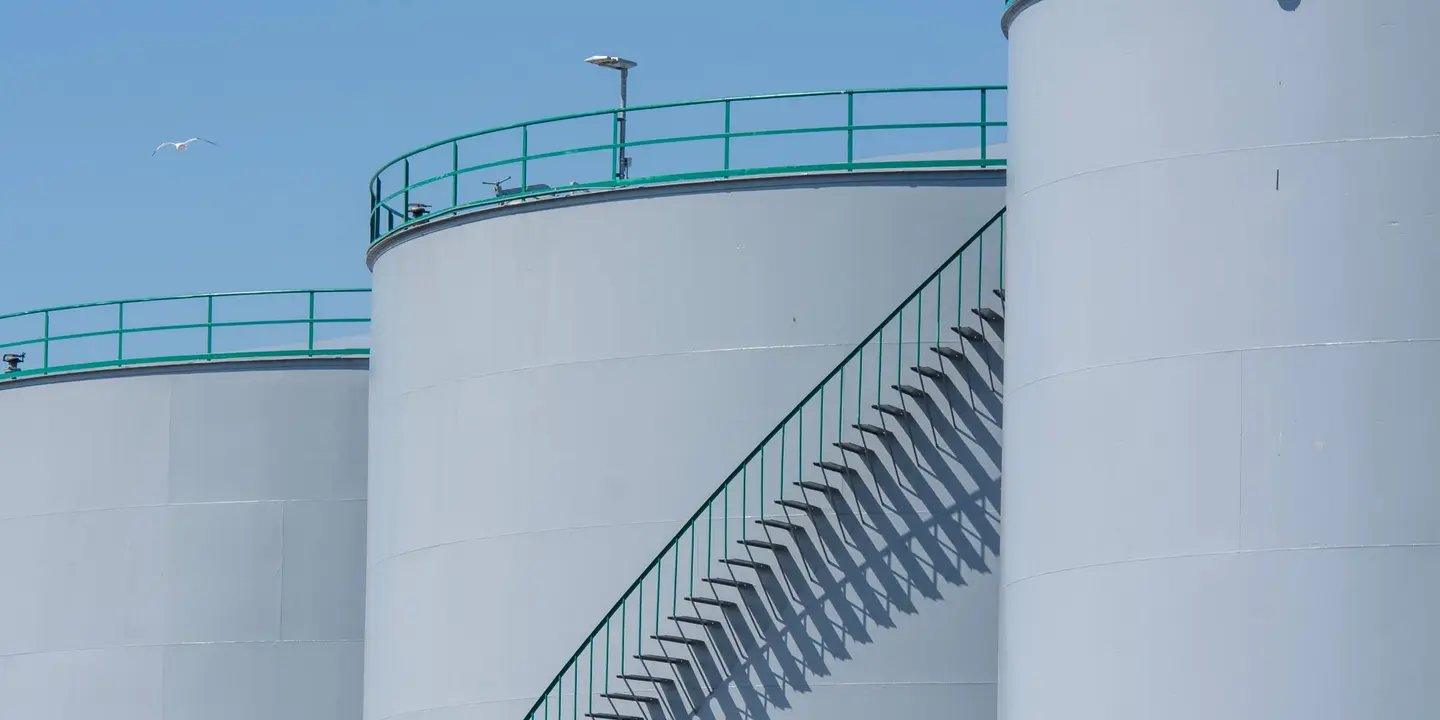
A camera measures surface condition, not metal loss. Imagery tells you where to measure; only the UT reading says how much steel is left. A model trained on imagery alone misses under-coating corrosion and soil-side floor corrosion entirely, which is where the leaks are. Treat the vision model as a triage of frames, never as a thickness measurement.
Two inspections ten years apart with a different UT grid spacing cannot be aligned to a plate, and the corrosion rate is then a guess dressed as a number. The audit checks alignment on five tanks before anyone talks about a model. The same goes for a tank register with the lining, the cathodic protection or the last floor repair missing: those fields move the term under EEMUA 159 table B1 and the model cannot infer them.
It does not change the term and it does not inspect. The out-of-service inspection, with its draining, cleaning, gas-freeing and entry, stays; the point is to open the right tank in the right year and to hold the long term with evidence. A robotics vendor puts the average saving per deferred internal inspection at 400,000 dollars (Square Robot, a vendor figure); treat that as a claim to test on your own cost per outage, not as a result. And Crux Digits builds the data layer and the models alongside your ICT partner and your inspection contractor; the drones, the crawlers and the NL-CBIT remain theirs.
Take a terminal with 60 atmospheric tanks under PGS 29, 45 on a time-based ten-year term and 15 on an RBI term, about six internal inspections a year, UT grids from the last two terms as contractor spreadsheets, inspection reports as PDF, drone imagery of shell and roof for 20 tanks from the last three years, and maintenance in SAP PM. These are assumptions for the illustration, not a client's numbers. The question the integrity manager asks is which six tanks to open next year and whether three of the RBI tanks can hold their term with evidence.
Three fixed steps. The €2,500 AI audit (one to two weeks) inventories the data per tank, tests UT-grid alignment on five tanks and reads one term of reports into fields; you keep the per-tank data inventory and the readiness list, whatever you decide next. The €20,000 Production-ready MVP (four to six weeks) builds the ranking on 20 tanks' back data and the frame triage on the drone imagery, scored against what the inspectors actually found in the last term; you keep the code, the models and the aligned dataset. Production from €50,000 (eight to twelve weeks) connects it to SAP PM and to the inspection contractor's delivery, with the integrity engineer approving every term proposal. All excl. VAT, code and models handed over, and the audit is credited in full if you continue within 60 days. See computer vision, machine learning, data engineering, AI for energy and tank storage and AI implementation in the Netherlands.
Book a free consultation from Utrecht. Bring the tank register and the UT grids of two terms for five tanks, and we will tell you honestly whether they align and what a ranking is worth for your terminal.
Book a free consultation