Five EU member states already meet the Digital Decade target of 75% of enterprises using cloud, AI or data analytics, and on a straight line through the last two Eurostat surveys, 20 of 27 reach it by 2030. The Netherlands is one of the five at 79.7%, Belgium is half a point short and Germany's line crosses 75% in 2029. For AI alone, seven countries are on that line, Belgium and the Netherlands among them.
We checked each business and skills target country by country as a 2027 checkpoint, midway between the 2025 data and 2030. This is written for the IT manager, CIO or informatiemanager at a Dutch or Belgian organisation of 250 to 5,000 people. Crux Digits builds AI systems alongside an organisation's ICT partner.
How was this study built?
We pulled four Eurostat tables on 28 October 2026 and measured them against the Commission's own targets and indicator definitions.
The targets come from Decision (EU) 2022/2481, the Digital Decade Policy Programme. The Commission's DESI 2026 methodological note defines the measures: 75% of enterprises using AI, sophisticated or intermediate cloud, or data analytics, as one combined indicator; more than 90% of SMEs at a basic level of digital intensity, meaning at least 4 of 12 technologies in version III of the index; and 20 million ICT specialists, which the note equates to about 10% of total employment. Annex 1 of the 2026 report also tracks cloud and AI separately against 75%, and so do we.
The tables: isoc_eb_ai for AI and the combined indicator, last updated 15 June 2026; isoc_cicce_use for cloud and isoc_e_dii for SMEs of 10 to 249 persons employed, both updated 27 February 2026; isoc_sks_itspt for ICT specialists, updated 17 April 2026. Values are the share of enterprises with 10 or more persons employed, reference year 2025. All 27 member states have a value for every indicator.
Our pull matches the State of the Digital Decade 2026 report of 17 June 2026: 63.2% combined, 46.7% cloud, 20.0% AI and about 10.5 million ICT specialists. For SMEs the report gives 71.38% and our pull 71.39%.
The projection is ours, a plain linear extrapolation. Slope = (value 2025 minus value 2023) / 2; projected value = value 2025 + slope × (year minus 2025), capped at 100%. On track means the line reaches the target by 2030. The 2027 checkpoint is the value needed in 2027 to sit on a straight path from 2025 to the target: value 2025 + 0.4 × (target minus value 2025). This is arithmetic, not a forecast, and not a finding of Eurostat or the Commission. We use 2023 and 2025 because the combined indicator starts in 2023, when data analytics replaced big data.
Which EU countries are on track for the 2030 business targets?
On our straight line, 20 countries reach the combined target by 2030, 19 the SME target, 7 the AI target and 6 cloud.
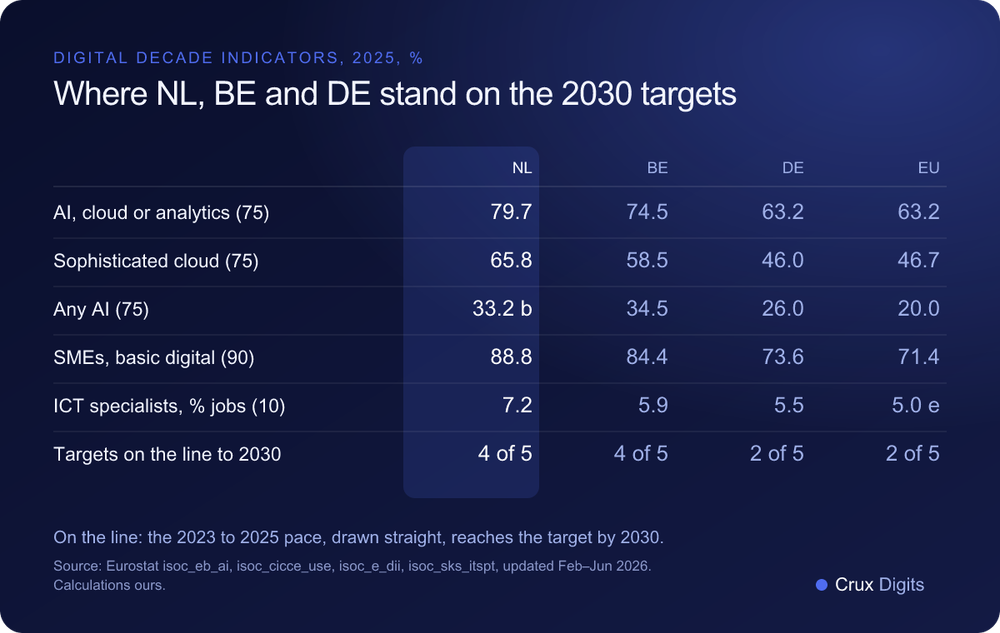
The combined target is closest to done. The EU went from 54.7% in 2023 to 63.2% in 2025, 4.25 points a year, a line that crosses 75% in 2027. The Commission's own baseline, which slows as adoption spreads, gives 71.5% in 2030 and the target in 2033.
Cloud is the slowest. Sophisticated or intermediate cloud, such as hosted ERP, CRM, security software and database hosting, reached 46.7% of EU enterprises in 2025, up 3.9 points a year. Top three: Finland 73.1, Italy 68.1, Denmark and Sweden 67.6. Bottom three: Romania 22.1, Greece 21.3, Bulgaria 15.7. The Netherlands is fifth at 65.8, Belgium eighth at 58.5 and Germany twelfth at 46.0.
Six countries are on a line to 75% cloud by 2030: Italy, the Netherlands, Malta, Ireland, Belgium and Lithuania. Germany adds 3.8 points a year and needs 5.8. Large firms are ahead: in 19 of 27 countries, at least 75% of enterprises with 250 or more staff already use these services.
Which countries lead the combined cloud, AI and data analytics league table?
Denmark leads with 82.3% of enterprises using AI, sophisticated cloud or data analytics in 2025, and Bulgaria is last at 34.6%.
Combined indicator, 2025, % of enterprises: 1. Denmark 82.3 · 2. Finland 81.0 · 3. Netherlands 79.7 · 4. Italy 77.9 · 5. Sweden 76.5 · 6. Estonia 75.0 (74.99) · 7. Belgium 74.5 · 8. Malta 73.3 · 9. Ireland 71.7 · 10. Lithuania 71.4 · 11. Cyprus 64.7 · 12. Luxembourg 64.4 · 13. Germany 63.2 · 14. Spain 62.4 · 15. Czechia 61.0 (b) · 16. Croatia 60.8 · 17. Hungary 59.7 · 18. Portugal 58.5 · 19. Austria 58.1 · 20. France 57.9 · 21. Slovenia 55.3 · 22. Slovakia 55.1 · 23. Poland 52.7 · 24. Latvia 52.2 · 25. Romania 43.6 · 26. Greece 40.8 · 27. Bulgaria 34.6. EU27: 63.2.
Top three: Denmark, Finland and the Netherlands. Bottom three: Romania, Greece and Bulgaria. The Netherlands is 2.6 points behind the leader. Belgium needs 0.5 points, a tenth of the 5.2 a year it has added since 2023. Germany ranks 13th, level with the EU at 63.2%. Romania shows how fast the bottom can move: 7.4 points a year, from 28.7% to 43.6%, enough for a line to 75% by 2030. The seven countries off the line are Portugal, Croatia, Hungary, Poland, Latvia, Greece and Bulgaria.
How far is each country from 75% AI use?
Denmark is closest at 42.0% of enterprises using AI in 2025; the EU stands at 20.0%.
AI league table, 2025, % of enterprises: 1. Denmark 42.0 · 2. Finland 37.8 · 3. Sweden 35.0 · 4. Belgium 34.5 · 5. Luxembourg 33.6 · 6. Netherlands 33.2 (b) · 7. Austria 30.0 · 8. Germany 26.0 · 9. Estonia 23.4 · 10. Slovenia 21.6 · 11. Malta 21.5 · 12. Lithuania 21.3 · 13. Spain 20.3 · 14. Ireland 19.6 · 15. France 18.2 · 16. Slovakia 18.0 · 17. Czechia 17.6 · 18. Italy 16.4 · 19. Croatia 15.2 · 20. Latvia 12.2 · 21. Portugal 11.5 · 22. Hungary 10.4 · 23. Cyprus 9.3 · 24. Greece 8.9 · 25. Bulgaria 8.6 · 26. Poland 8.4 · 27. Romania 5.2. EU27: 20.0.
AI is the fastest-growing of the three technologies: the EU added 5.9 points a year from 2023 to 2025, against 3.9 for cloud. It is also the furthest from target, and in every member state the AI share is below the cloud share. Seven countries add AI fast enough for a straight line to reach 75% by 2030: Denmark, Finland, Sweden, Belgium, Luxembourg, the Netherlands and Austria, each adding 9.5 to 13.5 points a year.
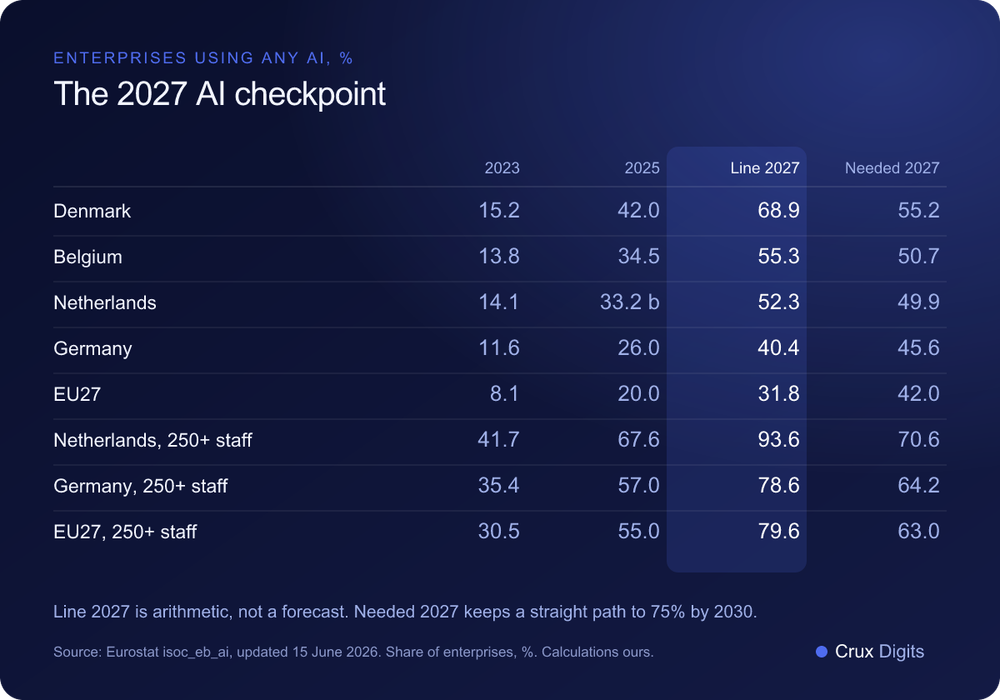
Our rule of thumb works for any country or sector: divide the distance to the target by five for the points a year needed to 2030, and compare that with the points a year added from 2023 to 2025. The Netherlands needs 8.4 and added 9.6. Belgium needs 8.1 and added 10.4. Germany needs 9.8 and added 7.2, so it is 2.6 points a year short and its line reaches 75% in 2031.
The numbers to watch for 2027: a straight path to 75% needs 49.9% AI use in the Netherlands, 50.7% in Belgium, 45.6% in Germany and 42.0% in the EU. Their recent pace, carried forward, gives 52.3%, 55.3%, 40.4% and 31.8%. For the EU our line reaches 49.7% in 2030; the Commission's baseline gives 54.28% and the target not before 2035.
Will 90% of SMEs reach basic digital intensity by 2030?
Yes: the EU's straight line crosses 90% in 2027, and the Commission's baseline puts SMEs at 92.08% in 2030.
The EU share of SMEs rose from 57.9% in 2023 to 71.4% in 2025, 6.7 points a year. Finland (94.0%) and Denmark (92.5%) are past 90%, with the Netherlands third at 88.8%. Bottom three: Greece 56.0, Romania 44.3, Bulgaria 38.3.
The Netherlands is 1.2 points short and adds 3.0 a year, so its line clears 90% before the 2027 reference year. Belgium, fifth at 84.4%, crosses in 2026 and Germany, twelfth at 73.6%, in 2027. Nineteen countries are on the line; Portugal falls just short at 89.8% in 2030.
Can the EU reach 20 million ICT specialists by 2030?
Not at the current pace: the 2023 to 2025 trend reaches 12.2 million in 2030 and 20 million only in 2052.
The EU employed an estimated 10.45 million ICT specialists in 2025, and our line lands exactly on the Commission's own figures. Reaching 20 million by 2030 would need 13.9% growth a year; the fastest country, Portugal, managed 11.2%. Germany is the engine: it added 264,400 ICT specialists in two years, 38% of the EU's increase of 701,300.
Share of total employment, 2025: Sweden 8.9%, Luxembourg 8.7% and Finland 7.8% lead; Italy 3.8% (e), Romania 2.7% (e) and Greece 2.5% trail; EU27 5.0% (e). Only Luxembourg is on a line to 10% by 2030. The Netherlands is fourth at 7.2%, 708,800 people growing 2.6% a year. Belgium is seventh at 5.9%, growing 5.3% a year, and Germany tenth at 5.5%.
What does this mean for an IT manager or CIO at a 250 to 5,000 FTE organisation?
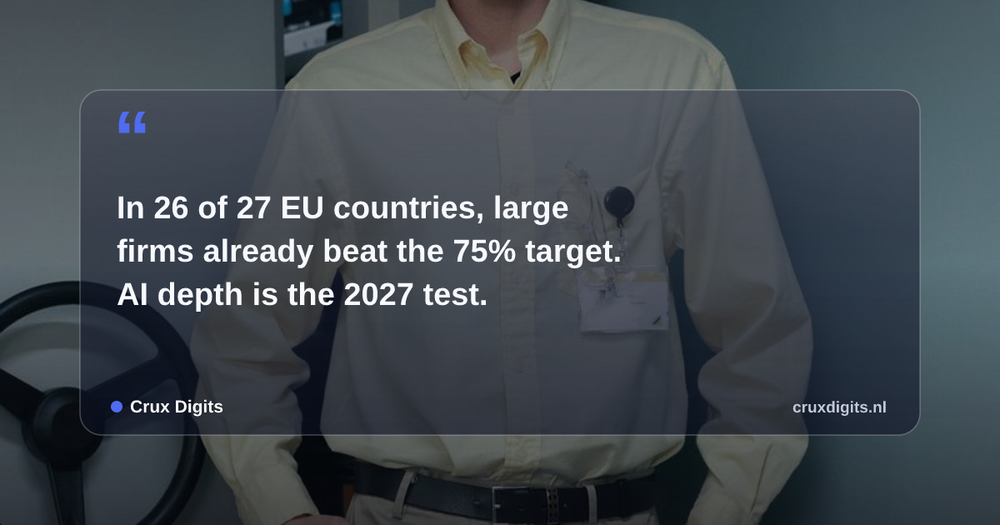
In your size class the combined target is already met: in 26 of 27 member states, at least 75% of large enterprises qualify.
Large Dutch enterprises are at 96.4%, Belgian ones at 98.1% and German ones at 93.4%; only Bulgaria, at 73.1%, is below. In 2025, 76.4% of large Belgian enterprises used AI, second in the EU after Finland at 79.4%. Large Dutch enterprises were seventh at 67.6% and German ones twelfth at 57.0%. On their 2023 to 2025 pace, large firms in 15 member states, including all three, are at or past 75% AI use by the 2027 reference year.
If your organisation does not yet use AI, it is in a group that shrinks every survey: 32.4% of large Dutch enterprises in 2025. That is an opening: peers who moved first now have systems you can learn from. Plan for the people constraint: Dutch ICT specialist employment grew 2.6% a year, so AI work has to fit the ICT partner and IT team you already have. And put the 2027 checkpoint in your board pack, because 75% AI use among large firms is where your peers are heading.
Crux Digits designs and builds AI systems alongside the customer's ICT partner or internal IT team. We are not an ICT partner: we do not run your infrastructure, and we hand over code you own. The national detail is in our studies of AI adoption in the Netherlands and in Belgium. If your 2027 question is how to take one AI system from pilot into a real process, see AI implementation in the Netherlands.
What are the limits of this data?
These are survey shares and two-point lines: treat every projection as arithmetic.
The window matters. With 2021 to 2025 instead, no country reaches 75% AI by 2030, Sweden coming closest at 66.4%, because AI use sped up after 2023. For cloud, six countries stay on the line, but the Netherlands and Belgium drop off and Finland and Poland come on. A straight line also does not slow down near saturation, which is why the Commission's baselines for the combined indicator and cloud sit below ours.
Status flags: break in series (b) for the Netherlands' 2025 AI value and Czechia's 2025 combined value, and for France and Sweden in 2023 on cloud, AI and SME intensity; a different definition (d) for Estonia's 2025 SME value. For ICT specialists the EU aggregate and several countries are estimates (e), France and Spain carry (d) and Denmark a 2023 (b). The ICT share is published to one decimal, so slopes move in steps of 0.05 points a year. The Netherlands' 2024 cloud value, 68.5%, sits above its 2025 value of 65.8%, which a two-point line ignores.
Coverage: enterprises with 10 or more persons employed, without finance, agriculture and mining, each counted once whatever its size. The 10% ICT yardstick is the EU-level equivalent; member states set their own contributions in national roadmaps, which we did not assess.
The short version
1. Five EU countries, the Netherlands among them at 79.7%, already meet the Digital Decade target of 75% of enterprises using cloud, AI or data analytics, and on a straight line from 2023 to 2025, 20 of 27 reach it by 2030.
2. Among enterprises with 250 or more staff, 26 of 27 member states are already above that 75% target; only Bulgaria, at 73.1%, is below.
3. AI grows fastest of the three technologies: seven countries, including Belgium at 34.5% and the Netherlands at 33.2%, add it fast enough to reach 75% by 2030, and Germany is 2.6 points a year short.
4. Large firms in 15 member states, including the Netherlands, Belgium and Germany, are at or past 75% AI use by the 2027 reference year if their 2023 to 2025 pace holds.
5. The EU's SME line crosses the 90% target in 2027, while ICT specialists, at 10.45 million, reach 20 million only in 2052 at the current pace, with Germany supplying 38% of the latest two-year increase.
Last updated: 28 October 2026.
A consultant tells you where AI pays off; Crux Digits also builds it. A fixed price per step, one named expert, from Utrecht.
AI consultancy in the Netherlands →