Every EU member state used more AI in 2025 than in 2021. Across the EU, 19.95% of enterprises with ten or more persons employed used at least one AI technology in 2025, against 7.65% in 2021. Denmark leads at 42.0%. Belgium ranks fourth, the Netherlands sixth and Germany eighth, all three above the EU rate in every size class.
We ranked all 27 member states from Eurostat's published figures, split the ranking by company size and drew a labelled straight line to 2027 and 2030. This is written for the IT manager, CIO or informatiemanager at a Dutch or Belgian organisation of 250 to 5,000 people. Crux Digits builds AI systems alongside an organisation's ICT partner; we are not an ICT partner.
How was this study built?
We ranked Eurostat's own survey figures; nothing in this study comes from a survey of ours.
Source: Eurostat table isoc_eb_ai, Artificial intelligence by size class of enterprise, last updated 15 June 2026, pulled through the Eurostat API on 28 October 2026. Indicator E_AI_TANY: enterprises using at least one AI technology. Unit: percentage of enterprises. Reference years 2021, 2023, 2024 and 2025; the AI questions were not asked in 2022.
Coverage, per Eurostat's survey metadata: enterprises with ten or more employees and self-employed persons in NACE sections C to N, without the financial sector. Government, education and healthcare are outside it. Size classes: 10 to 49, 50 to 249, 250 or more, and all of 10 or more.
All 27 member states have a value for every size class and year, so each ranking covers 27 countries plus the EU27 aggregate. Eurostat flags three breaks in series (b): the Netherlands in 2025 for all firms and for 10 to 49 staff, and France and Sweden in 2023. No value is marked provisional, estimated or of low reliability.
Our own work: ranks, changes in percentage points since 2021, gaps to the leader, size-class ratios and two extrapolations. Line A is the least-squares line y = a + b × year through all four survey years. Line B carries the average yearly gain of 2023 to 2025 forward from 2025: y = y2025 + (y2025 - y2023) / 2 × (year - 2025). Both are capped at 100. They are arithmetic, not forecasts, and not Eurostat findings. We round Eurostat's two decimals half up to one and rank on the two-decimal values.
Which EU countries use AI the most in 2025?
Denmark leads with 42.0% of enterprises using AI, followed by Finland at 37.8% and Sweden at 35.0%; the EU27 rate is 19.95%.
The full league table, all enterprises with ten or more persons employed, 2025, percentage of enterprises: 1. Denmark 42.0 · 2. Finland 37.8 · 3. Sweden 35.0 · 4. Belgium 34.5 · 5. Luxembourg 33.6 · 6. Netherlands 33.2 (b) · 7. Austria 30.0 · 8. Germany 26.0 · 9. Estonia 23.4 · 10. Slovenia 21.6 · 11. Malta 21.5 · 12. Lithuania 21.3 · 13. Spain 20.3 · 14. Ireland 19.6 · 15. France 18.2 · 16. Slovakia 18.0 · 17. Czechia 17.6 · 18. Italy 16.4 · 19. Croatia 15.2 · 20. Latvia 12.2 · 21. Portugal 11.5 · 22. Hungary 10.4 · 23. Cyprus 9.3 · 24. Greece 8.9 · 25. Bulgaria 8.6 · 26. Poland 8.4 · 27. Romania 5.2. EU27: 19.95. (b) marks a break in series.
The bottom three are Bulgaria (8.6%), Poland (8.4%) and Romania (5.2%). Thirteen countries sit above the EU rate. In 2021 only Denmark had more than one in five enterprises using AI; in 2025 thirteen countries did.
The field also tightened. In 2021 the leader used AI at 17.3 times the rate of the last country (Denmark 23.9% against Romania 1.4%); in 2025 the ratio was 8.1.
Which countries climbed the league table since 2021, and which stalled?
Estonia made the biggest climb, from 24th to 9th place, and Sweden made the biggest gain, 25.1 percentage points, moving from 9th to 3rd.
Every one of the 27 countries rose between 2021 and 2025. The largest gains: Sweden +25.1, Belgium +24.2 (7th to 4th), Finland +22.0 (2nd both years) and Austria +21.1 (10th to 7th). Estonia went from 2.8% to 23.4%, 8.4 times its 2021 rate, and Lithuania climbed from 19th to 12th.
Most of the climbing happened late: Sweden gained 24.7 of its 25.1 points between 2023 and 2025. A ranking in this table can move within two survey years.
The countries that lost ground grew more slowly than their neighbours. Croatia fell from 11th to 19th (8.7% to 15.2%). Portugal fell from 14th to 21st, gaining 4.3 points, the second smallest gain after Romania's 3.8. Slovenia fell from 5th to 10th and added 0.7 points between 2024 and 2025. Every country that lost places still grew by a factor of at least 1.6.
The Netherlands shows how fast the field moved: it gained 20.1 points, 1.6 times the EU's 12.3, and still slipped from 3rd to 6th. Germany gained 15.4 points and moved from 6th to 8th.
How does company size change the ranking?
Size moves adoption more than country does: in 2025, 55.0% of large EU enterprises used AI, against 17.0% of small ones.
A rule of thumb follows: in the EU, each step up in size class multiplies AI use by about 1.8. Firms with 10 to 49 staff were at 17.0%, with 50 to 249 at 30.4%, with 250 or more at 55.0%.
Small firms are closing the gap. EU large firms used AI at 4.6 times the small-firm rate in 2021 and 3.2 times in 2025.
Top and bottom three by size class in 2025. 10 to 49 staff: Denmark 37.5, Finland 33.5, Sweden 30.7; at the bottom Bulgaria 7.2, Poland 5.8, Romania 4.1. 50 to 249 staff: Denmark 58.3, Belgium 54.5, Finland 51.4; at the bottom Poland 14.8, Bulgaria 13.3, Romania 7.8. 250 or more: Finland 79.4, Belgium 76.4, Denmark 74.5; at the bottom Cyprus 35.1, Bulgaria 26.2, Romania 20.8.
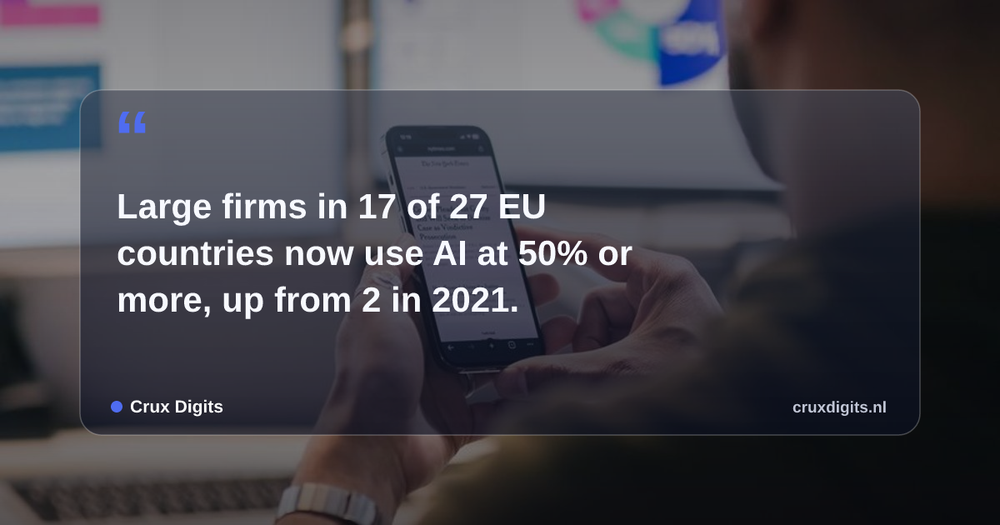
Among large firms, 17 of the 27 countries now reach 50% or more; in 2021 two did, Denmark and Finland. Large firms in Finland (79.4%) and Belgium (76.4%) are already above 75%, the level the EU set for all enterprises for 2030. Austria made the largest large-firm gain (+36.5 points, 9th to 6th). German large firms gained 26.1 points and stayed 12th.
How far are the Netherlands, Belgium and Germany from the leaders?
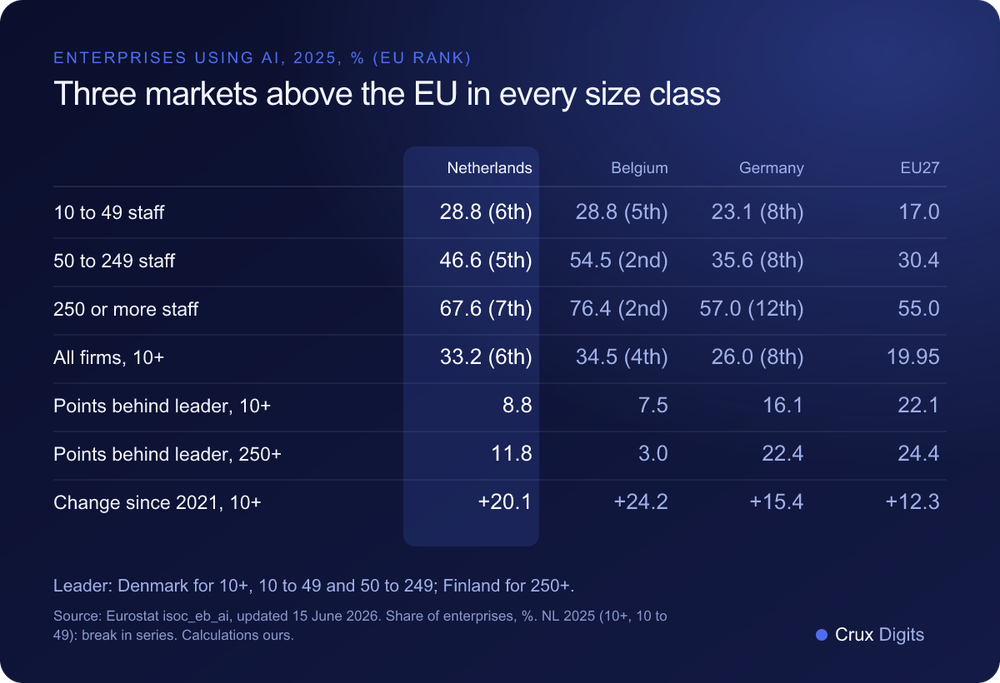
For all enterprises with ten or more staff, Belgium is 7.5 points behind Denmark, the Netherlands 8.8 and Germany 16.1.
Measured in time, the distance is short. Belgian (34.5%) and Dutch firms (33.2%) are already above where Danish firms stood in 2024 (27.6%), and German firms (26.0%) are just below it: roughly one survey year behind the leader.
By size class the three separate. Belgium is 2nd for 50 to 249 staff (3.8 points behind Denmark) and 2nd for 250 or more (3.0 behind Finland). The Netherlands is 5th and 7th, 11.7 and 11.8 points behind. Germany is 8th and 12th, 22.7 and 22.4 behind. Among small firms Belgium and the Netherlands are level at 28.8%.
All three beat the EU rate in every size class; for all firms by 14.6 points (Belgium), 13.3 (the Netherlands) and 6.0 (Germany). The detail is in our studies of AI adoption in the Netherlands and AI adoption in Belgium.
Will the EU reach the 75% Digital Decade target for AI by 2030?
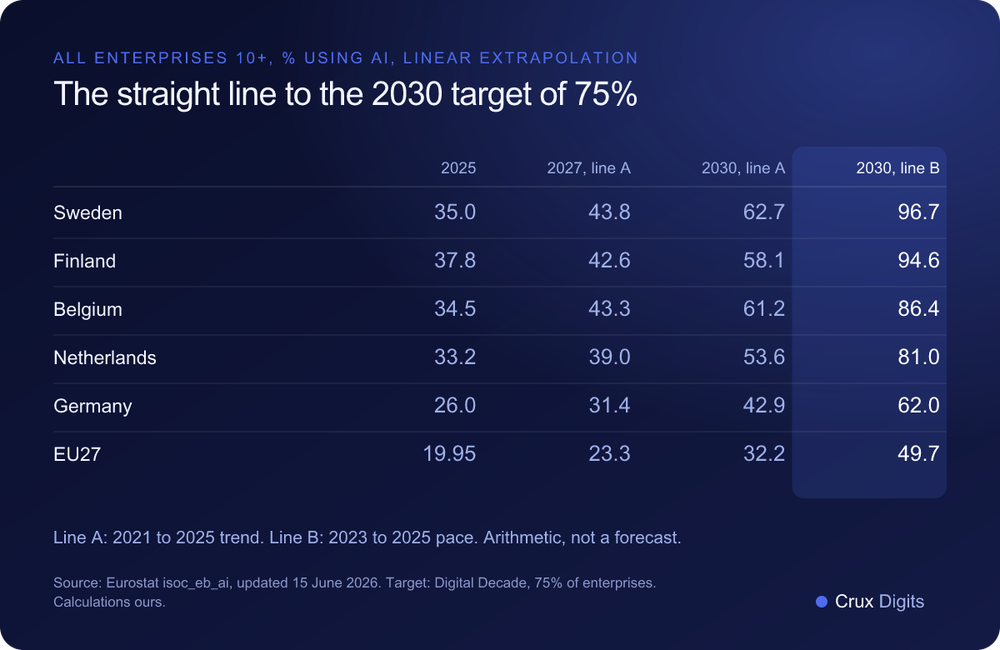
Not on either straight line: line A puts the EU at 32.2% in 2030 and line B at 49.7%, against a target of 75%.
The Digital Decade policy programme, Decision (EU) 2022/2481, sets a 2030 goal for business take-up of cloud, data analytics and AI, and the Commission tracks each against 75% of enterprises. Its State of the Digital Decade 2026 factsheet puts AI take-up at 27% of that target. In its 2025 report, working from 2024 data, the Commission projected 35.9% by 2030 and the target met only in 2042. That projection is the Commission's; the lines below are ours.
Line A gives the EU 23.3% in 2027 and 32.2% in 2030, reaching 75% in 2045. Line B, at 5.9 points a year, gives 31.8% in 2027 and 49.7% in 2030, reaching 75% in 2035. The series accelerated: the EU added 0.4 points from 2021 to 2023 and 11.9 from 2023 to 2025. Line A runs below the latest values; line B assumes the recent pace holds.
At the 2023 to 2025 pace, seven countries pass 75% of all enterprises by 2030: Denmark, Sweden, Finland, Belgium, Luxembourg, the Netherlands and Austria. The Netherlands reaches 52.3% in 2027 and 81.0% in 2030, Belgium 55.3% and 86.4%, Germany 40.4% and 62.0%. On line A no country reaches 75% by 2030; the Netherlands lands at 53.6%, Belgium at 61.2%, Germany at 42.9%.
For large firms the 75% level is within reach even on line A: large firms in 20 of the 27 countries pass it by 2030, and EU large firms reach 81.7%. Dutch large firms cross it in 2027 (75.5%), German large firms in 2029. Denmark's 2023 value (15.2% for all firms) sits below its 2021 value (23.9%) without a break flag, which flattens its line A, so we read nothing into Denmark's extrapolation.
What does this mean for an IT manager or CIO at a 250 to 5,000 FTE organisation?
Benchmark against your own size class in your own country, not the national headline: for a large Dutch organisation the peer rate is 67.6%, not 33.2%.
The peer rates in 2025: for 250 or more staff, 67.6% in the Netherlands, 76.4% in Belgium and 57.0% in Germany; for 50 to 249 staff, 46.6%, 54.5% and 35.6%. An organisation of 250 or more people without AI is now in the minority: 32.4% of large Dutch firms, 23.6% of large Belgian and 43.0% of large German firms.
The opening is in the timing. On line A, Dutch large firms cross 75% in 2027, so a large organisation that puts AI into one production process in the next 12 to 18 months arrives with the majority rather than after it.
Then ask what the AI does. In the same Eurostat table, large Dutch firms gained 34.1 points in text mining and 33.1 in generating text, speech or code from 2021 to 2025, but 5.4 in AI that automates workflows. Organisations that move AI into the process itself still have plenty of room to stand out.
What are the limits of this data?
It is a self-reported yes or no on whether an enterprise uses any AI technology: one tool in one team counts the same as AI in a core process, and nothing measures how well it works.
Coverage is NACE sections C to N without finance, for firms of ten or more. Banks, insurers, hospitals, schools, municipalities and micro-firms are outside it.
Three breaks in series apply: the Netherlands in 2025 (all firms and 10 to 49 staff), France and Sweden in 2023. Line B starts from 2023, so for France and Sweden it starts from a flagged year.
Denmark's 2023 values fall below its 2021 values in every size class without a flag. The data do not state why.
Rates are shares of enterprises, so a country with many small firms scores lower overall than its large firms suggest. Four survey points are a short series; both extrapolations are arithmetic, capped at 100. Applying the 75% level to one size class is our comparison; the target is set for all enterprises.
The short version
1. AI use among EU enterprises with ten or more staff rose 2.6 times in four years, from 7.65% in 2021 to 19.95% in 2025, and it rose in all 27 member states.
2. Denmark leads the 2025 league table at 42.0%; Belgium ranks 4th at 34.5%, the Netherlands 6th at 33.2% and Germany 8th at 26.0%, and all three are above the EU rate in every size class.
3. Estonia made the biggest climb since 2021, from 24th to 9th place, and Sweden the biggest gain, 25.1 percentage points, from 9th to 3rd.
4. Large firms in 17 of the 27 member states now use AI at a rate of 50% or more, up from 2 in 2021, and in Finland (79.4%) and Belgium (76.4%) they already exceed the 75% level the EU set for 2030.
5. At the 2023 to 2025 pace, seven member states, the Netherlands and Belgium among them, pass 75% of all enterprises by 2030, while the EU as a whole reaches 49.7%.
Where Crux Digits fits: we design and build AI systems inside existing processes, alongside your ICT partner or internal IT team. We are not an ICT partner and do not run infrastructure; the code we build is yours. For organisations of 250 people or more, AI use is now the majority position in all three markets; putting it into the processes that matter is where we help.
How we take AI from pilot to production in Dutch organisations: AI implementation in the Netherlands.
Last updated: 28 October 2026.
A consultant tells you where AI pays off; Crux Digits also builds it. A fixed price per step, one named expert, from Utrecht.
AI consultancy in the Netherlands →