In 2025, 37.1% of working people in the Netherlands used a generative AI tool for their job, the highest share in the EU, against 21.8% across the EU27. In every one of the 27 member states, more workers use it for work than there are companies running AI that generates text, speech or code.
This study is for the IT manager, CIO or security officer at a Dutch or Flemish organisation of 250 to 5,000 people who wants to know how far staff have already moved. Crux Digits designs and builds AI systems alongside an organisation's ICT partner. The numbers are Eurostat's; the ranks and gaps are our own calculation.
How was this study built?
We combined two Eurostat surveys from 2025: one asks people about their use of generative AI, the other asks companies about the AI they run.
- People: table isoc_ai_iaiu, Individuals, use of generative AI tools, last updated on 5 June 2026. It covers people aged 16 to 74, about 330,000 of whom were surveyed in 2025 according to Eurostat's survey metadata. Unit: percentage of individuals. Use means use in the last three months.
- Companies: table isoc_eb_ai, Artificial intelligence by size class of enterprise, last updated on 15 June 2026. It covers companies with 10 or more persons employed, excluding agriculture, mining and the financial sector. Unit: percentage of enterprises. We pulled both tables on 28 October 2026.
- Our own work: we ranked all 27 member states on each measure (all 27 have a value) and computed one gap per country: the share of working people (employees, self-employed and family workers) who used generative AI for work, minus the share of companies that use AI generating written or spoken language or programming code (indicator E_AI_TNLG), the company indicator closest to a generative AI tool.
- Flags: the Dutch company figures for 2025 carry b, a break in series. Some breakdowns, such as low formal education in several countries, carry u, low reliability, and we do not rank on them. No headline figure for people is flagged.
How many people in the EU use generative AI, and for what?
One in three: 32.7% of people aged 16 to 74 in the EU used a generative AI tool in the three months before the 2025 survey.
Private use comes first at 25.5%, work second at 15.4% and formal education third at 9.3%. Of everyone who used a generative AI tool, 47.0% used it for work. Among working people, 36.6% used it at all and 21.8% used it for their job.
Private use is ahead of work use in every member state, by 10.1 percentage points across the EU. The Netherlands is the outlier: 28.1% private against 26.6% for work, a difference of 1.5 points, the smallest in the EU. Of all Dutch users, 59.4% use it for work, second only to Malta (63.5%). In most countries generative AI arrived as a personal tool and is moving into work. In the Netherlands it is already there.
Which EU countries lead generative AI use at work?
The Netherlands tops the 2025 table: 37.1% of working people used generative AI for their job, ahead of Malta (37.0%) and Finland (36.9%).
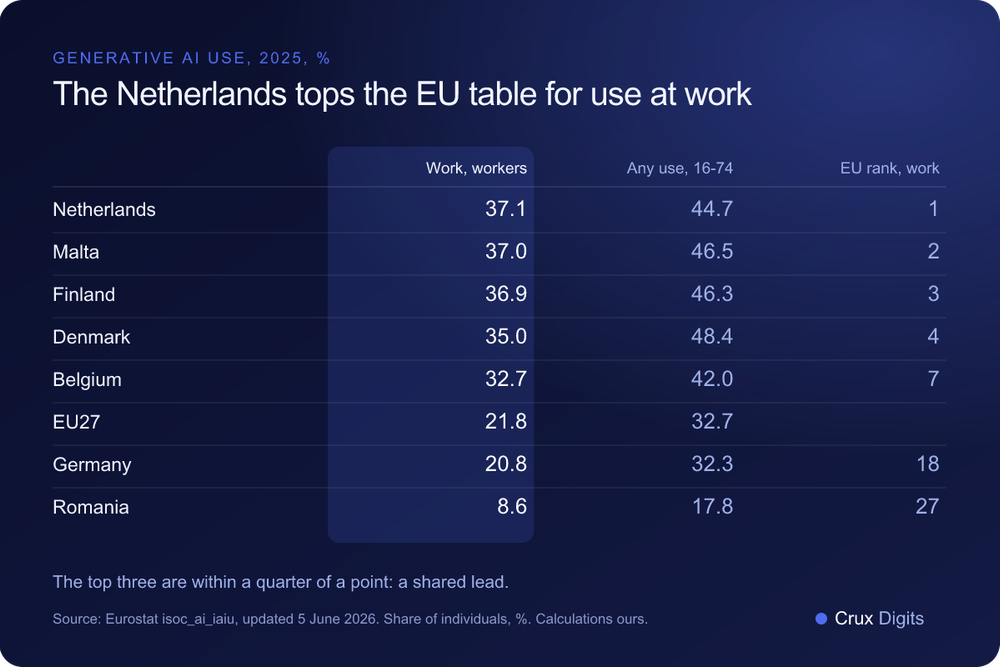
The share of working people who used generative AI for work in the last three months, all 27 member states, in %: 1. Netherlands 37.1 · 2. Malta 37.0 · 3. Finland 36.9 · 4. Denmark 35.0 · 5. Luxembourg 34.8 · 6. Estonia 33.1 · 7. Belgium 32.7 · 8. Cyprus 30.8 · 9. Sweden 29.9 · 10. Austria 28.8 · 11. Ireland 28.6 · 12. Greece 28.1 · 13. Portugal 27.6 · 14. Lithuania 27.1 · 15. Spain 26.1 · 16. France 24.6 · 17. Slovenia 22.9 · 18. Germany 20.8 · 19. Latvia 19.9 · 20. Czechia 19.6 · 21. Hungary 18.3 · 22. Slovakia 16.0 · 23. Bulgaria 14.1 · 24. Croatia 14.0 · 25. Poland 13.3 · 26. Italy 12.5 · 27. Romania 8.6. EU27: 21.8.
The top three sit within a quarter of a point, closer than a sample survey can separate, so read it as a shared lead. Poland, Italy and Romania close the table; the leader's rate is 4.3 times Romania's. Belgium is seventh, 10.9 points above the EU figure, and Germany 18th, 1.0 point below it.
On any use by everyone aged 16 to 74, Denmark leads (48.4%) ahead of Estonia (46.6%) and Malta (46.5%); the Netherlands is sixth (44.7%), Belgium joint tenth with Sweden (42.0%), Germany 20th (32.3%).
A rule of thumb: in the Netherlands more than one in three working people already use generative AI for work, in Belgium one in three, in Germany one in five.
How far is staff use ahead of company adoption, country by country?
In all 27 member states, more working people use generative AI for work than there are companies running text-generating AI: 21.8% against 8.8% across the EU.
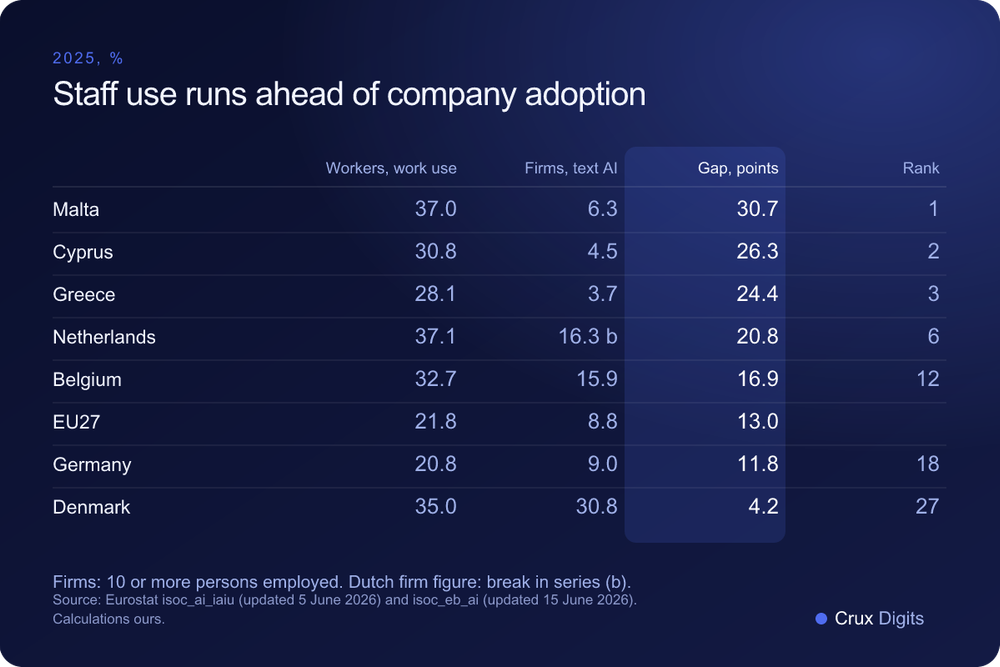
Security teams call use the organisation did not set up shadow AI. This data cannot separate approved from unapproved use. It does show staff 13.0 points ahead of what companies report, and we read that as proven demand: people have shown which tools help them.
The gap in percentage points, workers' share minus companies' share, all 27 member states: 1. Malta 30.7 · 2. Cyprus 26.3 · 3. Greece 24.4 · 4. Portugal 22.4 · 5. Luxembourg 21.0 · 6. Netherlands 20.8 · 7. Lithuania 20.4 · 8. Ireland 19.5 · 9. Estonia 18.0 · 10. Spain 17.2 · 11. Slovenia 16.9 · 12. Belgium 16.9 · 13. France 16.8 · 14. Finland 16.8 · 15. Latvia 15.3 · 16. Hungary 14.2 · 17. Austria 13.5 · 18. Germany 11.8 · 19. Bulgaria 10.8 · 20. Sweden 10.2 · 21. Poland 8.1 · 22. Czechia 6.8 · 23. Slovakia 6.7 · 24. Croatia 6.6 · 25. Italy 6.3 · 26. Romania 5.5 · 27. Denmark 4.2. EU27: 13.0.
Denmark has the smallest gap because Danish companies lead the EU on text-generating AI, at 30.8%: the gap closes from the company side. In the Netherlands it is 20.8 points, 37.1% of workers against 16.3% of companies (flagged b), a ratio of 2.3. Belgium is 12th at 16.9 points (ratio 2.1), Germany 18th at 11.8 (ratio 2.3); the EU ratio is 2.5.
Large companies change the picture. Across the EU, 31.7% of companies with 250 or more persons employed run text-generating AI, above the 21.8% worker rate. Large Belgian companies are at 53.4%, third in the EU after Denmark and Finland, Dutch ones at 41.8%, German ones at 28.6%. Only in nine countries does worker use exceed even that large-company rate: Malta, Cyprus, Greece, Latvia, Lithuania, Luxembourg, Hungary, Bulgaria and Portugal. A large organisation that already runs a governed tool has a head start.
Who uses generative AI at work: which ages and education levels?
Work use peaks at 25 to 34: 27.4% of that age group across the EU used generative AI for work, against 8.8% of people aged 55 to 64.
The youngest group is the largest user overall, 63.8% of 16 to 24 year olds, though only 16.3% use it for work. That is the incoming workforce, already at home with these tools.
Dutch work use is in the EU top three in every age group from 25 to 64: first in the EU at 35 to 44 (39.4%), second at 45 to 54 (33.1%, after Finland) and second at 55 to 64 (18.5%, after Denmark). At 25 to 34, where it is third, the Dutch rate is 42.7%, the Belgian 36.1%, the German 28.0%.
Education separates use far more than age. Across the EU, people aged 25 to 64 with higher education use generative AI at work 8.6 times as often as those with low formal education: 33.7% against 3.9%. The ratio is 4.0 in the Netherlands (49.2% against 12.4%), 6.5 in Germany and 11.0 in Belgium. Dutch people with low formal education use it at work more than three times as often as that group across the EU.
By occupation, ICT professionals lead at 58.3% across the EU, non-manual occupations reach 27.6% and manual occupations 5.3%; in the Netherlands 60.0%, 43.0% and 9.2%. The room to grow sits outside the IT department.
How do the Netherlands, Belgium and Germany compare?
The Netherlands leads on staff use, Belgium on large-company adoption, and in Germany companies are further along than their staff.
- Netherlands: first for work use among working people (37.1%), sixth for any use (44.7%), but only 17th for private use. Companies: 33.2% use any AI (flagged b), and 67.6% of those with 250 or more persons employed.
- Belgium: seventh for work use (32.7%). Companies: 34.5% use any AI, fourth in the EU, and 76.4% of large companies, second. Half of Belgian users (49.6%) use it for work against 59.4% of Dutch users.
- Germany: 18th for work use (20.8%) but eighth for companies using any AI (26.0%). It is one of nine member states where the company rate for any AI is above the worker rate for generative AI at work; Belgium, Denmark, Finland, Sweden, Austria, Italy, Slovakia and Croatia are the others. German 16 to 24 year olds use it for work more often than that age group across the EU (20.5% against 16.3%). Where the tools are in place, training is the lever.
What does this mean for an IT manager or CIO at a 250 to 5,000 FTE organisation?
Plan on the basis that use is already there: at the Dutch rate, about 370 of every 1,000 working people use generative AI for work.
That figure is arithmetic on the national average (37.1% times 1,000), not a measurement of any organisation; your own share will differ by sector, age profile and role mix. Three readings follow.
- Measure your own rate first. Ask staff the Eurostat question: did you use a generative AI tool for work in the last three months? Compare the answer with the tools you license. The difference is your own gap, and it tells you how much demand a governed tool would meet on day one.
- Give the demand a home. A tool that your ICT partner administers and your security officer can review turns use you cannot see into use you can. For answers from your own documents with data kept in a known place, that is what a private AI assistant is for.
- Train by role. The largest unused room sits in manual and frontline roles, among people with lower formal education and among staff over 55. Those groups gain most from structured training and are least likely to teach themselves.
For the company side, see our studies of AI adoption in the Netherlands and AI adoption in Belgium.
What are the limits of this data?
- The gap compares two populations: a share of working people and a share of companies, unweighted by staff. Small firms dominate the company count and use AI less, which widens the gap.
- The worker figure includes the self-employed and people in finance, healthcare, education and government; the company survey leaves out those sectors and firms below 10 persons employed.
- Use is self-reported and binary: one use in three months counts the same as daily use.
- 2025 is the first year of the individuals table. There is no trend, and nothing here is a forecast.
- Close ranks are not real differences. The top three for work use are within a quarter of a point and the table publishes no standard errors, so we treat near-equal values as ties.
- The Dutch company figures for 2025 carry a break in series (b). Low-education cells are flagged u in many countries; we quote them only for the EU, the Netherlands, Belgium and Germany, where they carry no flag.
- The company comparator covers text, speech and code generation. Image, video and audio generation is a separate indicator we did not add, because Eurostat does not publish the overlap.
The short version
- The Netherlands tops the EU on generative AI at work: 37.1% of working people used it for their job in 2025, against 21.8% across the EU.
- In all 27 member states more workers use generative AI for work than there are companies running text-generating AI; across the EU the rates are 21.8% and 8.8%.
- Denmark has the smallest gap between staff use and company adoption in the EU, 4.2 points, because 30.8% of Danish companies already run text-generating AI.
- Dutch people use generative AI for work almost as often as privately, 26.6% against 28.1% of everyone aged 16 to 74, the closest balance in the EU.
- Across the EU, people aged 25 to 64 with higher education use generative AI at work 8.6 times as often as those with low formal education, 33.7% against 3.9%.
Crux Digits designs and builds AI systems and the software around them, alongside your ICT partner or internal IT team. We are not an ICT partner and do not run your tenant or licences. Where staff use has run ahead of the organisation, we turn it into governed systems on your own processes, with code you own. The people side is on our page on AI training for companies.
Last updated: 28 October 2026.
A consultant tells you where AI pays off; Crux Digits also builds it. A fixed price per step, one named expert, from Utrecht.
AI consultancy in the Netherlands →