Hiring ICT specialists in the EU became easier between 2022 and 2024. Among companies with 250 or more staff that recruited ICT specialists, the share reporting hard-to-fill vacancies fell in 22 of the 27 member states, to 68.2% across the EU. In the Netherlands it fell 9.9 points to 69.8%, in Belgium 10.8 points to 75.6%, while Dutch demand for ICT staff kept growing.
This is our own analysis of five Eurostat tables, written for the IT manager, CIO or information manager at a Dutch or Belgian organisation of 250 to 5,000 FTE who has to staff an AI programme. Crux Digits designs and builds AI systems alongside an organisation's ICT partner or internal IT team, and the data shows how common that mixed model has become.
How was this study built?
We pulled five Eurostat tables through the Eurostat API on 28 October 2026 and did all ranking and arithmetic ourselves.
- isoc_sks_itspt: ICT specialists in employment, as a share of total employment and in thousands of persons, 2004 to 2025, last updated 17 April 2026. It is based on the EU Labour Force Survey, with ICT specialists defined by ISCO-08 occupation codes.
- isoc_ske_itrcrs: enterprises that recruited or tried to recruit ICT specialists, hard-to-fill vacancies and the reasons for them, by size class, last updated 15 June 2026.
- isoc_ske_itts (ICT training of staff), isoc_ske_fct (who performs ICT functions) and isoc_ske_itspe (enterprises employing ICT specialists), all last updated 15 June 2026.
- Who is counted in the enterprise tables: companies with ten or more persons employed in NACE sections C to N except finance. We focus on companies with 250 or more staff.
- Years: the enterprise questions on ICT skills were asked in 2022 and 2024, the latest two survey years. The earliest year we compare against is 2014.
- Our own work: EU27 ranks, changes in percentage points, and one ratio we built, the hiring pressure ratio, explained below. Flags from Eurostat are shown in brackets: e = estimated, d = definition differs, b = break in series.
How many ICT specialists does each EU country have?
The Netherlands ranks fourth in the EU: ICT specialists made up 7.2% of Dutch employment in 2025, against an estimated EU average of 5.0%.
That is 708,800 people, 71.0% more than the 414,400 of 2015. That is faster than Belgium (+60.5%), Germany (+58.2%) or the EU (+59.4%). Eurostat flags a break in the Dutch series in 2021, so read the ten-year comparison as indicative.
League table, ICT specialists as % of total employment, 2025, all 27 member states with a value (isoc_sks_itspt):
1. Sweden 8.9 · 2. Luxembourg 8.7 · 3. Finland 7.8 · 4. Netherlands 7.2 · 5. Estonia 6.8 (e) · 6. Ireland 6.2 (e) · 7. Belgium 5.9 · 8. Denmark 5.7 · 9. Lithuania 5.7 · 10. Germany 5.5 · 11. Austria 5.4 · 12. Portugal 5.4 · 13. France 4.9 (d) · 14. Croatia 4.9 (e) · 15. Cyprus 4.9 · 16. Bulgaria 4.8 · 17. Spain 4.8 (d) · 18. Malta 4.8 · 19. Czechia 4.7 · 20. Hungary 4.6 (e) · 21. Latvia 4.5 · 22. Poland 4.5 · 23. Slovenia 4.5 · 24. Slovakia 4.4 (e) · 25. Italy 3.8 (e) · 26. Romania 2.7 (e) · 27. Greece 2.5
The top three are Sweden, Luxembourg and Finland. The bottom three are Italy, Romania and Greece. Belgium is seventh at 5.9% (302,300 people) and Germany tenth at 5.5% (2,319,100 people). Since 2015 the share grew in all 27 member states. Luxembourg (+3.7 points, from a 2015 value with a series break) and Lithuania (+3.6) moved most. The Netherlands added 2.2 points, the EU 1.5.
Where is ICT hiring hardest in the EU?
Malta, Germany and Czechia: in 2024 at least 78% of their large recruiting firms had a hard-to-fill ICT vacancy, against 68.2% EU-wide.
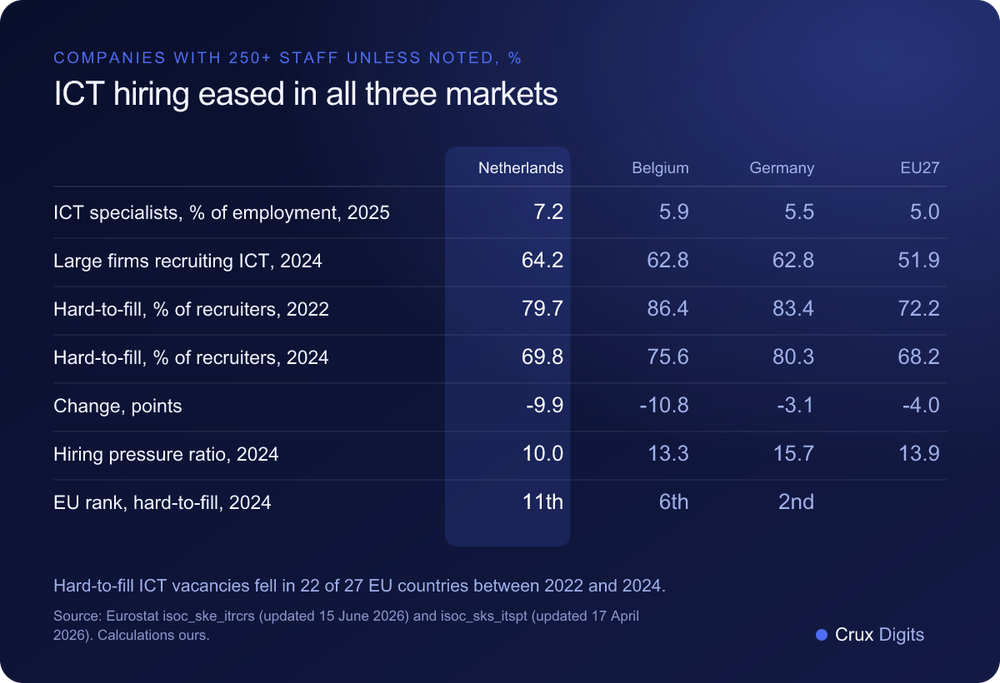
League table, share of recruiting companies with 250+ staff that had hard-to-fill ICT vacancies, %, survey year 2024, all 27 with a value (isoc_ske_itrcrs):
1. Malta 83.9 · 2. Germany 80.3 · 3. Czechia 78.7 · 4. Slovenia 77.6 · 5. Austria 76.4 · 6. Belgium 75.6 · 7. Luxembourg 75.1 · 8. Latvia 73.6 · 9. Hungary 72.0 · 10. Croatia 71.2 · 11. Netherlands 69.8 · 12. Denmark 65.5 · 13. Sweden 65.5 (b) · 14. France 65.0 · 15. Italy 65.0 · 16. Greece 62.5 · 17. Ireland 62.3 · 18. Finland 59.0 · 19. Estonia 58.7 · 20. Slovakia 58.4 · 21. Bulgaria 57.3 · 22. Portugal 56.7 · 23. Spain 55.3 · 24. Cyprus 53.9 · 25. Lithuania 53.8 · 26. Romania 47.1 · 27. Poland 41.2
Bottom three: Lithuania, Romania and Poland. Belgium is sixth at 75.6%. The Netherlands is eleventh at 69.8%, close to the EU's 68.2%.
The direction is good news. Between 2022 and 2024 the share fell in 22 of 27 countries. Belgium dropped 10.8 points (86.4% to 75.6%), the Netherlands 9.9 points (79.7% to 69.8%), Germany 3.1 points and the EU 4.0. Across all companies with ten or more staff it fell in 24 of the 26 countries with a value in both years; France has no published 2024 value.
Demand did not fall with it. 64.2% of large Dutch firms recruited or tried to recruit ICT specialists in 2024, up from 58.3% in 2022 and 34.7% in 2014. Only Malta (67.4%) and Denmark (65.6%) were higher. Belgium (62.8%) and Germany (62.8%) follow. Firms are hiring more and finding it easier than two years ago.
Which countries struggle most relative to their ICT workforce?
Greece, Slovenia and Czechia do: their large firms report the most hiring difficulty per point of ICT employment share.
To compare like with like we built a simple ratio: the share of recruiting large firms with hard-to-fill ICT vacancies, divided by ICT specialists' share of total employment in the same year, 2024. A high number means firms struggle a lot relative to the size of the national ICT workforce. The EU figure is 13.9.
Hiring pressure ratio, 2024, all 27 with a value (our calculation from isoc_ske_itrcrs and isoc_sks_itspt):
1. Greece 25.0 · 2. Slovenia 18.0 · 3. Czechia 17.5 · 4. Romania 16.8 · 5. Italy 16.3 · 6. Hungary 16.0 · 7. Malta 15.8 · 8. Germany 15.7 · 9. Latvia 15.0 · 10. Austria 14.4 · 11. Croatia 14.2 · 12. France 13.5 · 13. Belgium 13.3 · 14. Slovakia 12.7 · 15. Bulgaria 12.5 · 16. Spain 11.8 · 17. Denmark 11.3 · 18. Portugal 10.9 · 19. Cyprus 10.8 · 20. Lithuania 10.1 · 21. Netherlands 10.0 · 22. Ireland 9.9 · 23. Luxembourg 9.4 · 24. Poland 9.1 · 25. Estonia 8.2 · 26. Sweden 7.6 · 27. Finland 7.6
The Netherlands is 21st at 10.0, the lowest of our three markets: a large ICT workforce with average hiring difficulty. Belgium is 13th at 13.3. Germany is 8th at 15.7, where a mid-sized ICT workforce (5.1% of employment in 2024) meets the second-highest hiring difficulty in the EU. Bottom three: Estonia, Sweden and Finland.
The size of a country's ICT workforce says almost nothing about how hard it is to hire: across the 27, the correlation between the two is 0.17. Luxembourg has the second-largest ICT workforce in the EU and the seventh-highest hiring difficulty (75.1%). Poland, at 4.5% of employment, has the lowest difficulty (41.2%). The shortage depends on demand and organisation, not only on supply, so some of the levers sit inside your own organisation.
Why do firms find ICT specialists hard to hire?
In the Netherlands too few applicants is the top reason: 63.5% of large recruiting firms cited a lack of applications in 2024.
Reasons given by Dutch companies with 250 or more staff that recruited ICT specialists, 2024, % of recruiters, more than one answer possible:
- Lack of applications: 63.5%.
- Applicants lack relevant ICT qualifications: 60.2%.
- Applicants lack relevant work experience: 50.2%.
- Salary expectations too high: 45.7%.
Salary is the least cited of the four in the Netherlands. At 45.7% Dutch large firms rank 16th of the 24 countries with a value, against 59.1% in Germany, 52.7% in Belgium and 51.2% across the EU. For Dutch employers the number of qualified people is a bigger constraint than the pay level.
Before that, hiring got harder: since 2014 the share of large Dutch recruiters with hard-to-fill vacancies rose from 54.1% to 69.8%, with a peak of 79.7% in 2022. In the EU it went from 43.7% to 68.2%. The 2024 easing is real, and it starts from a high level.
How do large firms close the gap: hire, train or partner?
They do all three, and the mixed model now dominates: 80.2% of large Dutch firms had ICT functions performed by both their own staff and external suppliers in 2024.
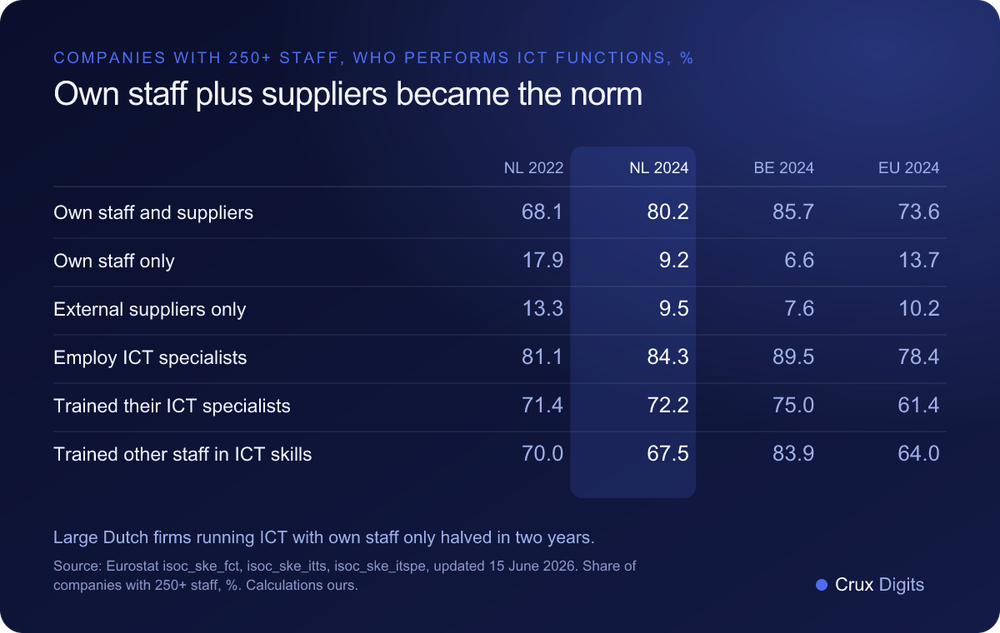
That share was 68.1% in 2022. Over the same two years the share of large Dutch firms that run ICT with only their own employees halved, from 17.9% to 9.2%. In Belgium the mixed share is 85.7% and own staff only is 6.6%, the lowest in the EU. EU averages: 73.6% mixed and 13.7% own staff only. The mixed share is our calculation: firms where own employees perform ICT functions, minus firms where only own employees do.
Training grew too. 67.5% of large Dutch firms trained staff who are not ICT specialists in ICT skills in 2024, nearly double the 34.5% of 2014. Belgium leads the EU on this measure at 83.9%.
What does this mean for staffing an AI programme in the Netherlands or Belgium?
Plan for a mix: own the programme with internal staff, train the business, and source specialist build capacity from a partner while you hire.
Eurostat measures ICT specialists, not AI specialists, so this is an inference. Four readings for an IT manager or CIO:
- Rule of thumb: if you recruit ICT specialists for an AI programme at a Dutch organisation of 250 or more, expect about a seven-in-ten chance (69.8%) of at least one hard-to-fill vacancy. In Belgium it is three in four (75.6%), in Germany four in five (80.3%). Put that in the plan as lead time.
- Keep ownership inside. Product ownership, data ownership and architecture decisions belong to your own people. At 89.3% of large Dutch firms, own employees already perform ICT functions.
- Train the business side early. Large Dutch firms doubled ICT training for non-specialists in ten years. AI literacy for process owners fits in the same budget line and shortens every later project.
- Use a partner for build capacity, with a hand-over written into the contract: repositories, documentation and runbooks your own team and ICT partner can operate. The seat that is hard to fill gets filled now, and the knowledge stays.
Hiring remains worth doing, and the market is better than in 2022. Recruit for the roles you will keep for years, such as the data engineer who runs the system after launch.
Crux Digits is the AI partner that works alongside your ICT partner or internal IT team. We are not an ICT partner: we do not run infrastructure, helpdesk or hosting. We design and build AI systems, document them for audit, and hand over code your organisation owns.
What are the limits of this data?
- ICT specialists are not AI specialists. Eurostat publishes no hiring difficulty for AI roles; we use ICT as the nearest measured group.
- The enterprise survey covers companies with ten or more staff outside finance, public administration, healthcare and education.
- Hard-to-fill is the firm's own judgement in a survey. It says nothing about how long a vacancy stayed open or what it cost.
- The ICT skills questions run every two years. A change between 2022 and 2024 rests on two data points, and some questions refer to the previous calendar year; we use Eurostat's survey-year labels.
- Flags: Sweden's 2024 enterprise data carry a break in series. ICT employment shares for several countries are estimates (e), France and Spain use a different definition (d), and the Dutch employment series has a break in 2021.
- The hiring pressure ratio is our arithmetic, not a Eurostat indicator. It divides a share of large firms by a share of all employment: use it to compare countries only.
The short version
- ICT hiring eased: the share of large recruiting firms with hard-to-fill ICT vacancies fell in 22 of 27 EU countries between 2022 and 2024, to 68.2% EU-wide.
- The Netherlands has the fourth-largest ICT workforce in the EU: 7.2% of employment, or 708,800 people, in 2025, 71.0% more than in 2015.
- Large Dutch firms recruit ICT staff more than almost anyone in the EU (64.2%, third), and 69.8% of them met a hard-to-fill vacancy, down from 79.7% in 2022.
- A bigger ICT workforce does not make hiring easier: across the EU27 the correlation is 0.17, and Luxembourg pairs the second-largest ICT workforce with the seventh-hardest hiring.
- The mixed model won: 80.2% of large Dutch firms combine own ICT staff with external suppliers, up from 68.1% in 2022, while own staff only fell to 9.2%.
For how we scope an AI programme with your own team and your ICT partner, see applied AI and machine learning for mid-sized organisations.
Last updated: 28 October 2026.
A consultant tells you where AI pays off; Crux Digits also builds it. A fixed price per step, one named expert, from Utrecht.
AI consultancy in the Netherlands →


