In 2025, 43.6% of EU companies that buy business software in the cloud and analyse their own data used AI. Among companies with neither of those two foundations, 5.3% did. In 2023 that figure was 23.4%: AI use nearly doubled in the group that had prepared for it. Across the 27 member states, these data foundations explain about half of the differences in AI use, and the Netherlands has the second strongest foundation in the EU.
This study is for the IT manager, CIO or information manager at an organisation of 250 to 5,000 people in the Netherlands or Belgium who wants to know where the organisation stands and what the next step is. Crux Digits builds AI systems on the data and cloud applications an organisation already has, next to its ICT partner.
How was this study built?
We combined three tables from Eurostat's annual survey on ICT use in enterprises, pulled from the Eurostat API on 28 October 2026. Unit: % of enterprises. Reference years 2023 and 2025.
- isoc_cicce_use, cloud computing services, last updated 27 February 2026.
- isoc_eb_das, data analytics, last updated 27 February 2026.
- isoc_eb_ai, artificial intelligence, last updated 15 June 2026.
Who is counted: companies with ten or more persons employed, outside the financial sector, healthcare, education and government.
The data foundation is two things Eurostat measures. Business cloud, which Eurostat calls intermediate or sophisticated: paid finance or accounting software, ERP, CRM, security software, database hosting or a development platform in the cloud. E-mail, office software, file storage and computing power alone count as basic. And data analytics, by own staff or an external provider. A company with both is foundation-ready.
Eurostat publishes the overlap: companies with both foundations that use AI, and those that do not. Our own work: their sum is the foundation-ready share, the first divided by the sum is the conversion rate, and we correlated AI use with each foundation across the 27 member states. Ties at one decimal are ranked on the unrounded value.
Do data foundations explain a country's AI adoption?
Data foundations explain about half of the differences in AI use between EU countries. Across the 27 member states, the foundation-ready share explains 47% of the variation among companies with ten or more staff in 2025 (r² 0.47).
The single cloud services predict more than the combination. The share of companies renting CRM software in the cloud explains 66% of the differences in AI use between countries, and database hosting in the cloud 64%. Computing power follows at 55%, ERP at 53% and finance or accounting software at 52%. Data analytics on its own explains 24%, and generic cloud use (any paid service) 41%.
The link grew stronger: in 2023 the foundation-ready share explained 42%. Among companies with 250 or more staff it explains 54% in 2025, with cloud CRM again the strongest single predictor at 62%.
A rule of thumb from the fitted line: for every 10 points of foundation-ready companies, a country has about 7 points more AI use (slope 0.73 for companies with ten or more staff, 0.77 for 250 or more). It describes 27 countries in one year; it is not a law. It does show where AI lands: where customer and transaction records already sit in systems that can be queried.
Which EU countries have the strongest data foundations for AI?
Denmark leads with 47.7% of companies foundation-ready, followed by the Netherlands at 43.5% and Lithuania at 39.0%. The EU27 figure is 25.4%, up from 18.6% in 2023.
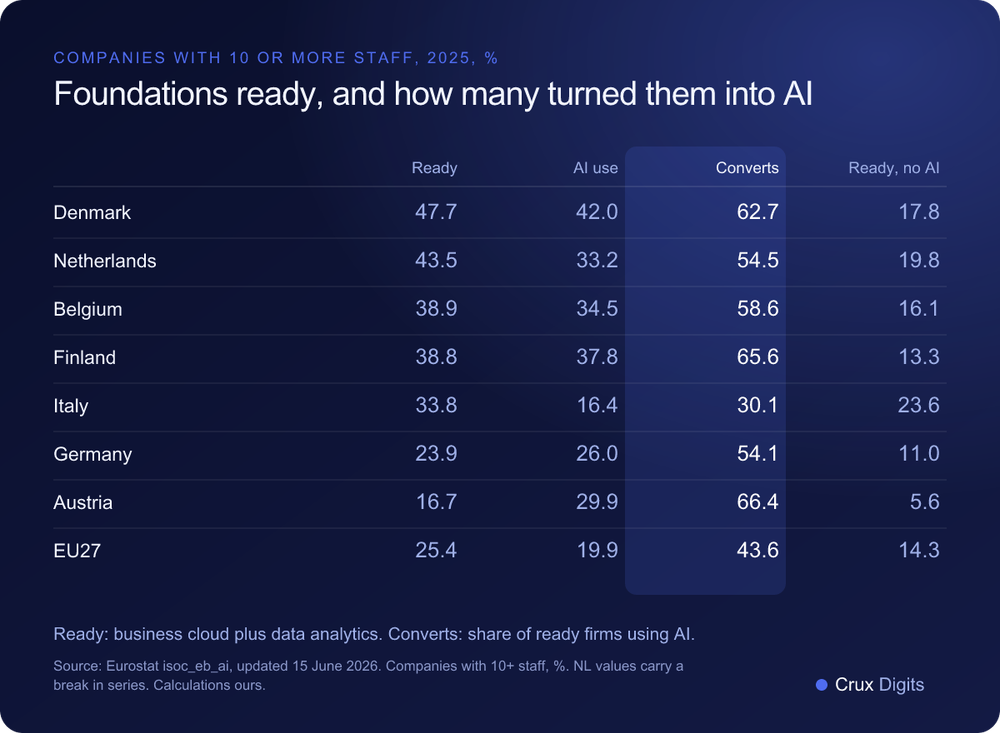
The full league, companies with ten or more staff in 2025, foundation-ready share in %, AI use in brackets, all 27 member states with a value: 1. Denmark 47.7 (42.0) · 2. Netherlands 43.5 (33.2) · 3. Lithuania 39.0 (21.3) · 4. Belgium 38.9 (34.5) · 5. Finland 38.8 (37.8) · 6. Estonia 38.0 (23.4) · 7. Italy 33.8 (16.4) · 8. Ireland 32.9 (19.6) · 9. Malta 32.4 (21.5) · 10. Sweden 32.1 (35.0) · 11. Czechia 27.4 (17.6) · 12. Cyprus 27.3 (9.3) · 13. Croatia 25.6 (15.2) · 14. Spain 25.2 (20.3) · 15. Germany 23.9 (26.0) · 16. Luxembourg 23.7 (33.6) · 17. Hungary 22.7 (10.4) · 18. Latvia 22.7 (12.2) · 19. Portugal 22.2 (11.5) · 20. Slovenia 21.0 (21.6) · 21. France 19.8 (18.2) · 22. Slovakia 19.2 (18.0) · 23. Poland 18.1 (8.4) · 24. Austria 16.7 (29.9) · 25. Romania 14.2 (5.2) · 26. Greece 13.2 (8.9) · 27. Bulgaria 9.7 (8.6). EU27: 25.4 (19.9).
At the bottom are Romania (14.2%), Greece (13.2%) and Bulgaria (9.7%). Belgium is fourth at 38.9% and Germany fifteenth at 23.9%. Every one of the 27 countries increased its foundation-ready share between 2023 and 2025 except Croatia and Hungary, and the share of EU companies with neither foundation fell from 46.3% to 38.8%.
Size dominates: 21.1% of EU companies with 10 to 49 staff are foundation-ready, 42.5% with 50 to 249 and 68.6% with 250 or more.
Which countries adopt AI ahead of their data foundations?
Austria and Luxembourg adopt AI furthest ahead of their data foundations. Austria ranks 24th on foundations at 16.7% and seventh on AI use at 29.9%, about 17 points above what its foundations predict.
Measured as the distance to the fitted line, the countries furthest ahead in 2025 are Austria (+16.7 points), Luxembourg (+15.3), Sweden (+10.6), Finland (+8.5) and Germany (+7.5). Among companies with 250 or more staff, Austria (+20.9) and Luxembourg (+18.7) again lead.
Ahead of the foundation shows up in who the AI users are. In Austria, 22.8% of the companies that use AI have neither business cloud nor data analytics, and in Luxembourg 18.2%. The EU figure is 10.2%, Germany 12.8% and the Netherlands 4.3%, the third lowest. One reading, which the data cannot confirm: ready-to-use AI assistants need no data platform, and companies running ERP and databases on their own servers do not appear as cloud users.
On the other side are the countries whose foundations are furthest ahead of their AI use: Cyprus (−11.7 points), Italy (−9.2), Lithuania (−8.1) and Hungary (−7.2). Italy is seventh on foundations and eighteenth on AI. Lithuania is third on foundations and twelfth on AI. These countries have the largest opening: more foundation than AI use, ready to be converted.
The Netherlands sits almost exactly on the line (+0.5), so its next gains come from converting foundation-ready companies.
How likely is a company to use AI once cloud and analytics are in place?
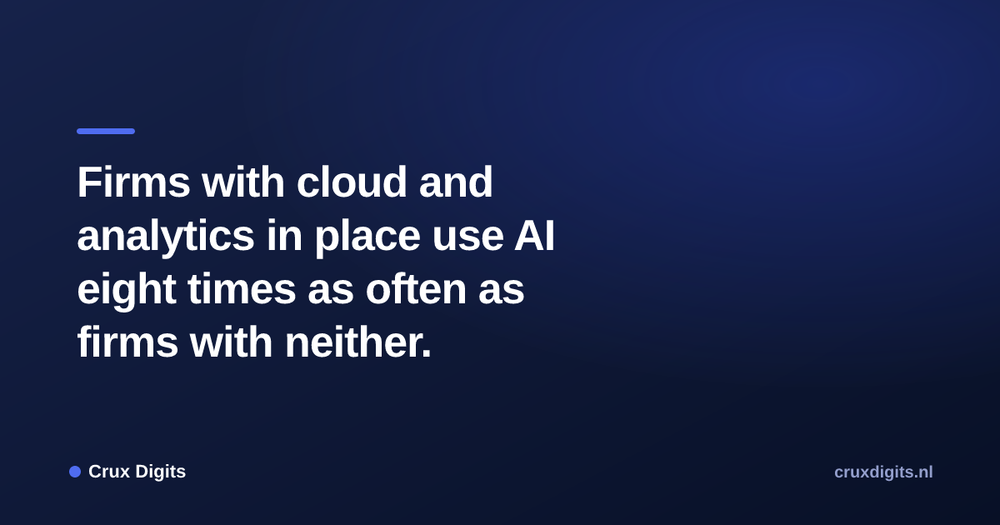
In 2025, 43.6% of foundation-ready EU companies used AI, against 19.1% with only one of the two foundations and 5.3% with neither.
So a company with both foundations is about eight times as likely to use AI as one with neither. Either foundation on its own lifts the rate from 5.3% to 19.1%, and cloud and analytics count equally.
The conversion rate is the fastest-moving number in this study. Among foundation-ready EU companies it went from 23.4% in 2023 to 43.6% in 2025, and among foundation-ready companies with 250 or more staff from 43.6% to 67.4%. Austria (66.4%), Finland (65.6%) and Sweden (64.9%) convert the most of their foundation-ready companies; Romania (19.8%), Cyprus (23.5%) and Hungary (25.1%) the fewest.
Size matters even with equal foundations: a foundation-ready company uses AI at 67.4% with 250 or more staff, 48.2% with 50 to 249 and 39.3% with 10 to 49. A large organisation with its data in order is 1.7 times as likely to use AI as a small one, which makes people, budget and governance the second half of readiness.
What remains is the opening. In 14.3% of EU companies with ten or more staff, about one in seven, both foundations are in place and AI is not in use. That share was 14.2% in 2023: as fast as companies converted to AI, others completed their foundations. Among companies with 250 or more staff the share fell from 31.4% to 22.4%.
Where do the Netherlands, Belgium and Germany stand?
The Netherlands and Belgium are both in the EU top five on foundations and convert them well. Germany uses more AI than its cloud foundations predict.
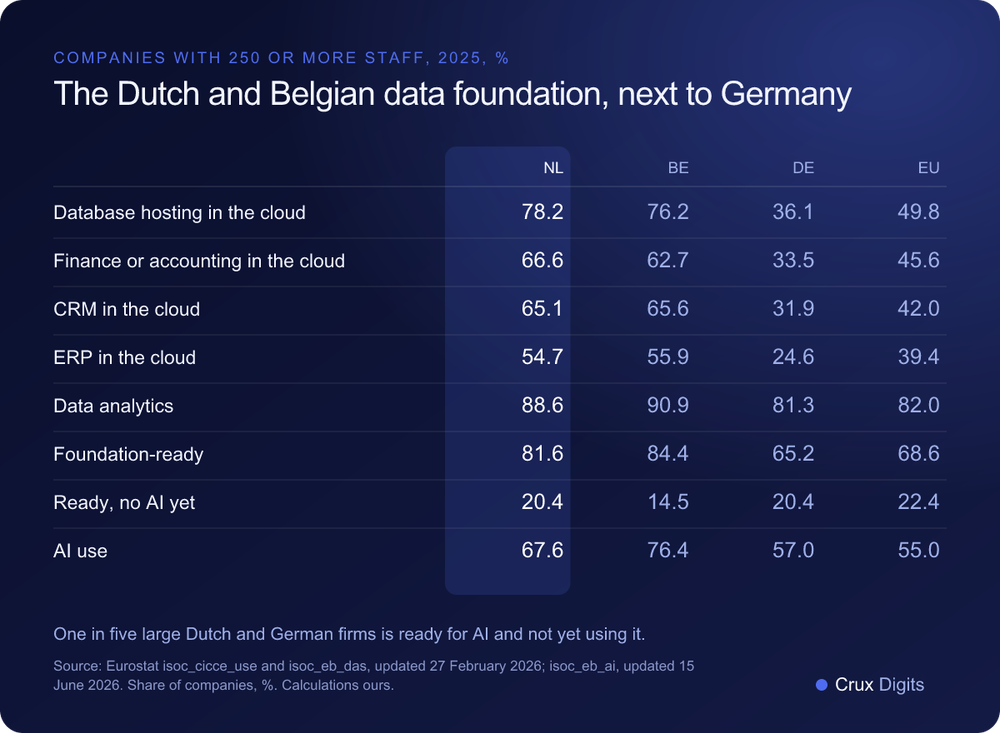
The Netherlands is second on foundations among companies with ten or more staff (43.5%) and fifth at 250 or more (81.6%). Of Dutch AI users, 71.4% have both foundations, the highest share in the EU. Large Dutch companies lead the EU on database hosting in the cloud at 78.2%, and rank third on cloud CRM (65.1%), ERP (54.7%) and finance or accounting software (66.6%). Their conversion rate rose from 48.7% to 75.0%, seventh in the EU. The opening: 20.4% of Dutch companies with 250 or more staff have both foundations and no AI yet, one in five.
Belgium converts best of the three. Among Belgian companies with 250 or more staff, 82.8% of the foundation-ready ones use AI, second in the EU after Finland (85.4%), up from 57.8% in 2023. Belgium leads the EU on cloud ERP for large companies (55.9%) and is second on database hosting (76.2%) and CRM (65.6%). Only 14.5% of large Belgian companies are foundation-ready without AI, 23rd of 27.
Germany adopts AI ahead of its cloud foundations. Large German companies rank 24th on cloud database hosting (36.1%), 22nd on cloud ERP (24.6%) and 18th on overall foundations (65.2%), yet 57.0% use AI, above the EU's 55.0%. Their data analytics share among all companies, 37.7%, is below the EU's 39.9%. With 20.4% of large German companies ready but without AI, the opening matches the Dutch one.
What does this mean for an IT manager or CIO at a 250 to 5,000 FTE organisation?
Find out which of the four groups your organisation is in, then take the step that group needs. Most Dutch and Belgian organisations of this size are already foundation-ready.
- Foundation-ready, no AI in production: you have the shortest route. Choose one process and build on the CRM, ERP and database records already there.
- AI on licences only: assistants run without a data foundation, AI that changes an order, a planning or a claim does not. Make the data for that process reachable.
- Strong analytics, little cloud: common where SAP or databases run on own servers. That is a valid foundation; the question is whether an AI system can reach it through an interface your ICT partner supports.
- Strong cloud, little analytics: start with the analysis. It shows which AI use case the data can carry.
The strongest correlations are with cloud CRM and database hosting, which gives a practical order: start where customer and transaction records sit in a system with an API. And the foundation-ready share grew in 25 of 27 countries in two years, so more competitors can move quickly.
Crux Digits designs and builds AI systems on the cloud applications and data an organisation already has, as the AI partner next to its ICT partner or internal IT team. We are not an ICT partner and do not run infrastructure. Where the foundation is the gap, we do the data work first.
What are the limits of this data?
It is a survey of what companies say they use, not a measurement of how well they use it.
- Nothing here describes a bank, a hospital or a ministry: those sectors are outside the survey.
- Cloud means paid cloud services. A company running ERP or databases on its own servers counts as without cloud, which understates foundations in countries where on-premise systems are common.
- Data analytics is a yes or no. One dashboard and a data platform count the same.
- The foundation-ready share sums two published shares, so rounding can move it by about 0.1 point.
- Correlation across 27 countries is not causation; a third factor such as digital skills may drive both.
- Flags: the Dutch 2025 AI and overlap figures for all companies and small companies carry a break in series (b), so the Dutch all-company foundation-ready share does too; the 250+ figures do not. Czechia's analytics figures carry a b (2025) and a d, definition differs (2023). The 2023 cloud figures for France and Sweden carry a b. All 27 countries have a value in every league here.
- This post contains no projections.
The short version
- AI use nearly doubled among foundation-ready EU companies in two years, from 23.4% in 2023 to 43.6% in 2025.
- A company with both business cloud and data analytics is about eight times as likely to use AI as one with neither (43.6% against 5.3%).
- Cloud CRM and cloud database hosting explain about two thirds of the differences in AI use between EU countries (r² 0.66 and 0.64); data analytics alone explains a quarter (0.24).
- The Netherlands has the second strongest data foundation in the EU (43.5%) and the highest share of AI users with both foundations (71.4%); Belgium converts best of the three, with 82.8% of its foundation-ready large companies using AI, second in the EU.
- One in five Dutch and German companies with 250 or more staff (20.4%) already has cloud and analytics in place and does not use AI yet: the size of the opening.
For the data work that makes a foundation usable for AI, see data analytics in the Netherlands.
Last updated: 28 October 2026.
The AI audit & strategy: in one to two weeks, a ranked list of use cases with a return per opportunity, and a plan you own.
AI audit & strategy →