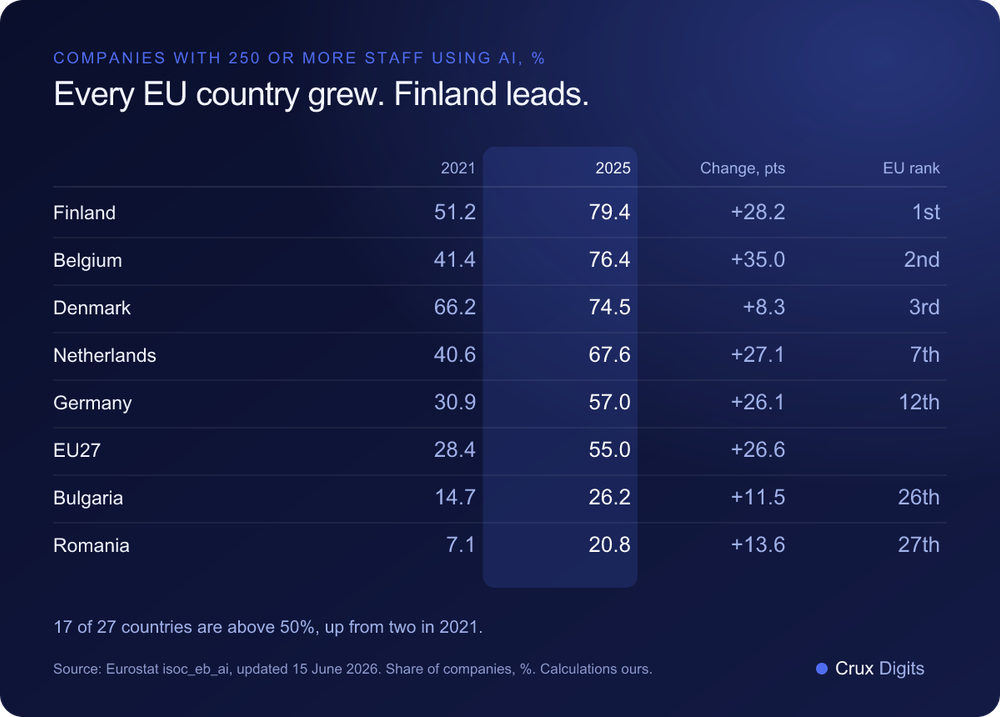
In 2025, 55.0% of companies in the EU with 250 or more persons employed used at least one AI technology, up from 28.4% in 2021. All 27 member states grew, and in 17 of them more than half of the large firms now use AI, against two countries in 2021. Finland leads at 79.4%, Belgium is second at 76.4% and Denmark third at 74.5%.
This study is for the IT manager or CIO at a Dutch or Flemish organisation of 250 to 5,000 people who wants to know where peers of that size stand across Europe, and what AI they run. The numbers are Eurostat's; the ranks and ratios are ours. Crux Digits builds AI systems alongside an organisation's ICT partner or IT team.
How was this study built?
We pulled Eurostat table isoc_eb_ai through the Eurostat API on 28 October 2026, filtered to enterprises with 250 or more persons employed, for the survey years 2021, 2023, 2024 and 2025. The API reports the dataset as last updated on 15 June 2026. You can open the same isoc_eb_ai table in the Eurostat data browser. The AI questions were not asked in 2022.
Unit: percentage of enterprises; the sourcing questions are a percentage of enterprises that use AI. The survey on ICT usage in enterprises covers industry, energy, construction, trade, transport, hospitality, ICT, real estate and business services, not finance, healthcare, education or government.
Our own work: ranks across the 27 member states (equal values share a rank), changes in percentage points since 2021, the gap to the leader, and a language-to-process ratio: the share of large firms using text mining divided by the share using AI to automate workflows or assist decisions. A cross-check with the average of the three language technologies against the average of workflow automation and machine learning gives the same picture at the top.
Status flags: no 2021 or 2025 value we rank carries one. France and Sweden have a break in series (b) in 2023 and some French 2024 values are low reliability (u), so we rank neither year. There is no projection in this study.
Which EU countries' large firms use AI most in 2025?
Finland leads with 79.4% of large firms using AI, ahead of Belgium (76.4%) and Denmark (74.5%); the EU27 figure is 55.0%.
The full league, % of enterprises with 250 or more persons employed using AI in 2025, all 27 countries with a value: 1. Finland 79.4 · 2. Belgium 76.4 · 3. Denmark 74.5 · 4. Sweden 71.9 · 5. Slovenia 71.7 · 6. Austria 68.3 · 7. Netherlands 67.6 · 8. France 58.0 · 9. Luxembourg 58.0 · 10. Spain 57.5 · 11. Ireland 57.3 · 12. Germany 57.0 · 13. Czechia 54.1 · 14. Italy 53.1 · 15. Estonia 52.9 · 16. Lithuania 51.8 · 16. Malta 51.8 · 18. Portugal 49.2 · 19. Latvia 47.1 · 20. Poland 45.8 · 21. Slovakia 43.7 · 22. Hungary 40.0 · 23. Croatia 39.6 · 24. Greece 37.6 · 25. Cyprus 35.1 · 26. Bulgaria 26.2 · 27. Romania 20.8. EU27: 55.0.
The bottom three are Cyprus (35.1%), Bulgaria (26.2%) and Romania (20.8%). The Netherlands is 11.8 points behind Finland, Germany 22.4. The EU figure is weighted towards the large economies, so only 12 of the 27 countries sit above it.
The biggest gains since 2021 came from Austria (+36.5 points, ninth to sixth), Slovenia (+35.3, seventh to fifth) and Belgium (+35.0, third to second). Croatia lost most places, sixteenth to twenty-third, while still adding 18.0 points.
Denmark led in 2021 at 66.2% and added 8.3 points, the smallest gain in the EU, as the field caught up: the median country went from 24.4% to 53.1%. The league moved up together; first and last were 59.1 points apart in 2021 and 58.7 in 2025.
Do large firms use language AI or process AI?
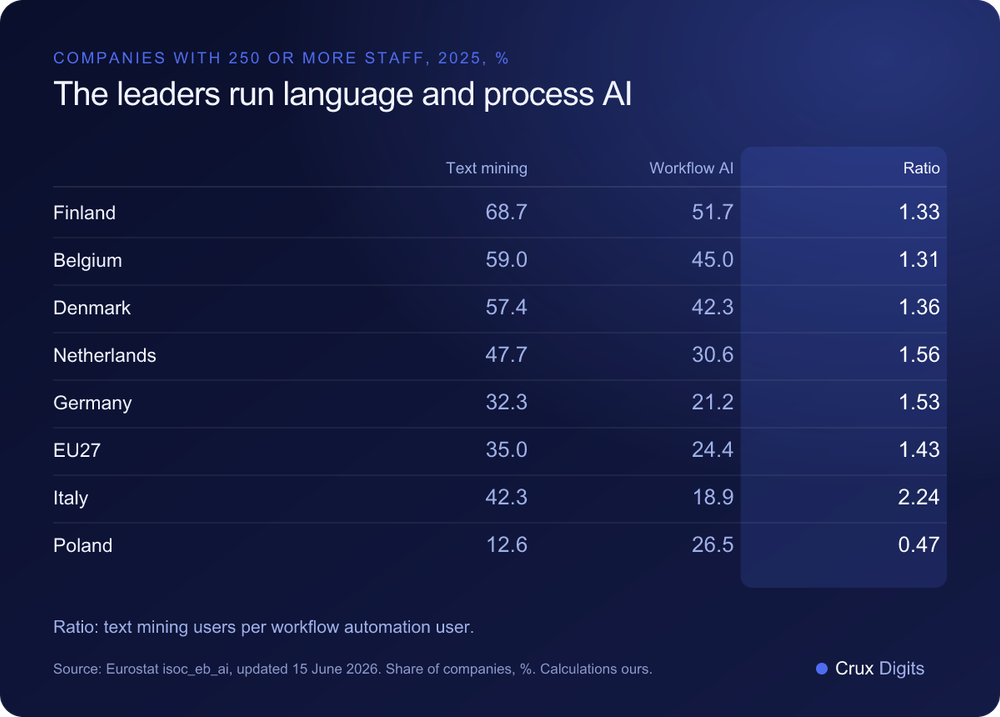
Language AI leads: in 2025 text mining (35.0%) and language generation (31.7%) are the two most used AI technologies in large EU firms, and workflow automation (24.4%) is sixth of eight.
In 2021 the order was the reverse: workflow automation led at 14.6%, then machine learning at 13.1%, with text mining at 9.9% and generating text, speech or code at 5.3%. Language generation grew sixfold in four years.
The switch shows country by country. In 2021 workflow automation was at least as common as text mining among large firms in 24 of 27 countries. In 2025 that holds in five: Poland, Malta, Bulgaria, Hungary and Portugal.
That is good news. Language AI is where adoption is quick: a licence, a browser and a document. Process AI, which puts a decision or a hand-off inside a workflow, is the larger opening: 75.6% of large EU firms do not yet use AI to automate a workflow or support a decision.
The language-to-process ratio sorts the countries. The EU figure is 1.43. Italy (2.24) and Luxembourg (2.17) are highest; Poland (0.47) is lowest. The league leaders sit below the EU ratio: Belgium 1.31, Finland 1.33, Denmark 1.36. They have both kinds at high levels: Finland leads the EU on text mining (68.7%) and on workflow automation (51.7%).
A rule of thumb for your own organisation: count the processes where AI reads or writes text, and those where AI prepares or takes a decision inside a workflow. Above 2, your profile looks like Italy's. Around 1.3, it looks like the EU's leaders.
Workflow automation fell in two countries only: Denmark, from 57.3% to 42.3% while still ranking third, and Luxembourg, by 3.5 points. Belgium gained most, 22.3 points.
Where do the Netherlands, Belgium and Germany stand?
Belgium is second of 27 at 76.4%, the Netherlands seventh at 67.6%, and Germany twelfth at 57.0%, two points above the EU figure.
The national detail is in our study of the Netherlands and our study of Belgium. EU-wide, the three differ in balance and breadth. Belgium's language-to-process ratio is 1.31, the Netherlands' 1.56, Germany's 1.53.
Germany is the result to note. Its large firms use AI at about the EU rate, yet rank fourteenth for text mining, language generation and machine learning and seventeenth for workflow automation (21.2%). They beat the EU figure on two technologies: speech recognition (28.4%) and generating pictures, video or sound (32.5%). Germany was twelfth in 2021 and is twelfth in 2025.
Breadth tells the same story. Of large firms that use AI, the share using three or more AI technologies is 84.8% in Finland, 75.6% in Belgium, 62.6% in the Netherlands, 61.0% in the EU and 56.4% in Germany (our calculation). For German IT teams that is an opening: the firms already use AI, and depth is where the gain sits.
Do large European firms build AI or buy it?
They mostly buy: in all 20 countries with data, more large AI users run ready-to-use commercial AI than AI developed by their own staff.
In 2025 the share running ready-made commercial AI ranges from 48.8% in Croatia, the only country below half, to 88.8% in Cyprus. Firms can name more than one route.
Own development is the more telling line. Share of large AI-using firms whose AI was developed by their own employees, 2025, the 20 countries with a value: 1. Poland 45.8 · 2. Finland 39.1 · 3. Belgium 39.0 · 4. Cyprus 38.8 · 5. Portugal 38.0 · 6. France 37.6 · 7. Bulgaria 36.4 · 8. Sweden 34.6 · 9. Spain 33.5 · 10. Netherlands 30.8 · 11. Greece 29.5 · 12. Slovakia 28.5 · 13. Croatia 28.4 · 14. Lithuania 28.0 · 15. Austria 26.2 · 16. Malta 25.4 · 17. Latvia 23.8 · 18. Luxembourg 21.3 · 19. Hungary 20.6 · 20. Slovenia 16.3.
No 2025 value is published for Czechia, Denmark, Germany, Estonia, Ireland, Italy and Romania, nor an EU27 total. Germany has none in any year, so the build question cannot be answered for Germany.
From 2021 to 2025 ready-made AI rose in 17 of the 19 countries with both years, and own development fell in 11 of 19. The EU27 totals for 2021 and 2024: ready-made 57.8% to 67.2%, own development 35.3% to 34.1%.
Buying made the fast growth possible. Building has not gone away: in the median country 30.2% of large AI users develop with their own people, and in Finland and Belgium, two of the top three in the league, 39.1% and 39.0%. Using an external provider to develop or modify AI is highest in Greece (58.3%) and Belgium (54.6%); the Netherlands is at 44.7%.
Across the 20 countries, in-house development and workflow automation move together only weakly (correlation 0.33, our calculation). Building is no guarantee of process AI, but the leaders do both.
What do large European firms use AI for?
ICT security is the most common purpose: 26.1% of large EU firms use AI for it, ahead of business administration and management (23.9%) and marketing or sales (20.9%).
Then production 18.4%, R&D and innovation 16.3%, finance 15.6% and logistics 8.2%. Of the purposes asked in both 2021 and 2025, marketing and sales grew fastest, from 7.2% to 20.9%; ICT security went from 11.2% to 26.1%, production from 9.3% to 18.4%, logistics from 5.0% to 8.2%.
As a share of the large firms that use AI, marketing rose from 25.3% to 37.9% and ICT security from 39.4% to 47.5%. Production held its share (32.7% to 33.5%), and logistics went from 17.7% to 15.0%. Logistics AI grew, but more slowly than AI as a whole.
For transport, warehousing and wholesale that is the clearest opening in the data: Belgium (18.9%) and Finland (16.8%) show logistics AI at about twice the EU figure.
By country, Slovenia leads on ICT security (54.6%), Belgium on business administration (46.8%) and Finland on marketing (35.8%) and production (32.3%). Germany is above the EU figure on ICT security (27.6%) and marketing (21.8%), below it on production (15.5%) and logistics (6.0%). Human resources was asked in 2021 only.
What does this mean for an IT manager at a 250 to 5,000 FTE organisation?
Your peers already use AI; the gain now sits in putting it into processes, which three in four large EU firms have not yet done.
Benchmark on the right line. Being among the 55.0% says only that AI is in use somewhere. Compare on workflow automation with AI: 24.4% in the EU, 21.2% in Germany, 30.6% in the Netherlands, 45.0% in Belgium, 51.7% in Finland.
Use the ratio from the rule of thumb above. Above 2, AI lives in your documents; the leaders run at about 1.3.
Plan for buying and building. Ready-to-use AI is the majority route everywhere, so supplier management, licence terms and data processing agreements are core work. Where the process sets you apart, the leaders keep developing their own.
What are the limits of this data?
It is a survey of what firms report using, not of how much or how well. One pilot counts the same as a company-wide system.
Nothing here describes a bank, a hospital or a ministry: those sectors are outside the survey.
The 2025 definition of using AI is wider. Generating pictures, video or sound was added to the list of technologies in 2025 (27.9% of large EU firms), so part of the rise from 41.2% in 2024 to 55.0% in 2025 may come from the wider definition. Eurostat does not publish how many firms qualify only through the new item.
The sourcing questions are published for 20 of 27 countries in 2025, with no EU27 total, and never for Germany.
The class 250 or more puts a firm of 300 people and a multinational in one group. The ratios and the correlation are ours; a correlation across 20 countries says nothing about cause.
The short version
1. AI use among large EU firms nearly doubled in four years, from 28.4% in 2021 to 55.0% in 2025, and every one of the 27 member states grew.
2. In 17 EU countries more than half of the large firms now use AI, up from two in 2021; Finland leads at 79.4% and Belgium is second at 76.4%.
3. Workflow automation was the most used AI technology in large EU firms in 2021; in 2025 text mining leads, and 75.6% of large firms have yet to put AI into a workflow.
4. The league's leaders are strong on process AI too: Finland, Belgium and Denmark have about 1.3 large firms using text mining for every one automating a workflow, against 1.43 in the EU and 2.24 in Italy.
5. Large AI users buy first in all 20 countries with data, yet in Finland and Belgium about two in five (39.1% and 39.0%) still build AI with their own staff.
Where Crux Digits fits: we design and build AI systems inside existing processes, working alongside your ICT partner or internal IT team. We are not an ICT partner and do not run your infrastructure. A licence for language AI is a decision you can take yourself; the process line, where Europe's leaders are ahead, is the work we do. What such a build costs is set out on our page on custom AI development cost.
Last updated: 28 October 2026.
A consultant tells you where AI pays off; Crux Digits also builds it. A fixed price per step, one named expert, from Utrecht.
AI consultancy in the Netherlands →