Of the EU companies that considered AI and did not use it in 2025, 70.3% named a lack of relevant expertise as a reason. It is the most cited barrier in 20 of the 21 member states with figures. Since 2023 the barriers that need a budget or a new system have shrunk; the ones that grew are about knowing how and whether you may.
We ranked every member state on seven Eurostat barriers, by company size, with the Netherlands, Belgium and Germany against the EU. This study is written for the IT manager, CIO or security officer at an organisation of 250 to 5,000 people. Crux Digits builds AI systems alongside an organisation's ICT partner; this is our own analysis of official statistics.
How was this study built?
The source is Eurostat table isoc_eb_ai, Artificial intelligence by size class of enterprise, last updated on 15 June 2026 according to the Eurostat API. We pulled it on 28 October 2026.
Who answers: enterprises that do not use AI but ever considered it say why, and may give several reasons. Every barrier figure is a percentage of those enterprises (unit PC_ENT_AI_EC), not of all companies. An eighth reason, "AI is not useful", is asked too.
Coverage, per the survey metadata: enterprises with ten or more persons employed in NACE sections C to N, excluding finance (K). Healthcare, education and government are outside it.
Years: the EU27 aggregate starts in 2023, so EU comparisons run from 2023 to 2025. In 2025, 21 of 27 member states publish barrier figures; Czechia, Estonia, France, Ireland, Lithuania and Romania do not.
Flags: no 2025 value we rank for all enterprises carries one. Sweden's 2023 figures are a break in series (b); several German 2023 figures and Germany's 2025 large-firm figures are low reliability (u) and withheld. Our own work: ranks, point changes, and the gap and ratio between expertise and legal uncertainty.
What stops EU companies that considered AI from using it?
A lack of expertise, named by 70.3% of EU enterprises that considered AI and did not adopt it in 2025. The full order: legal consequences unclear 53.6%, privacy concerns 52.7%, data availability or quality 43.5%, incompatibility with existing systems 41.6%, costs too high 38.4%, ethical considerations 24.6%, and AI not useful 17.8%.
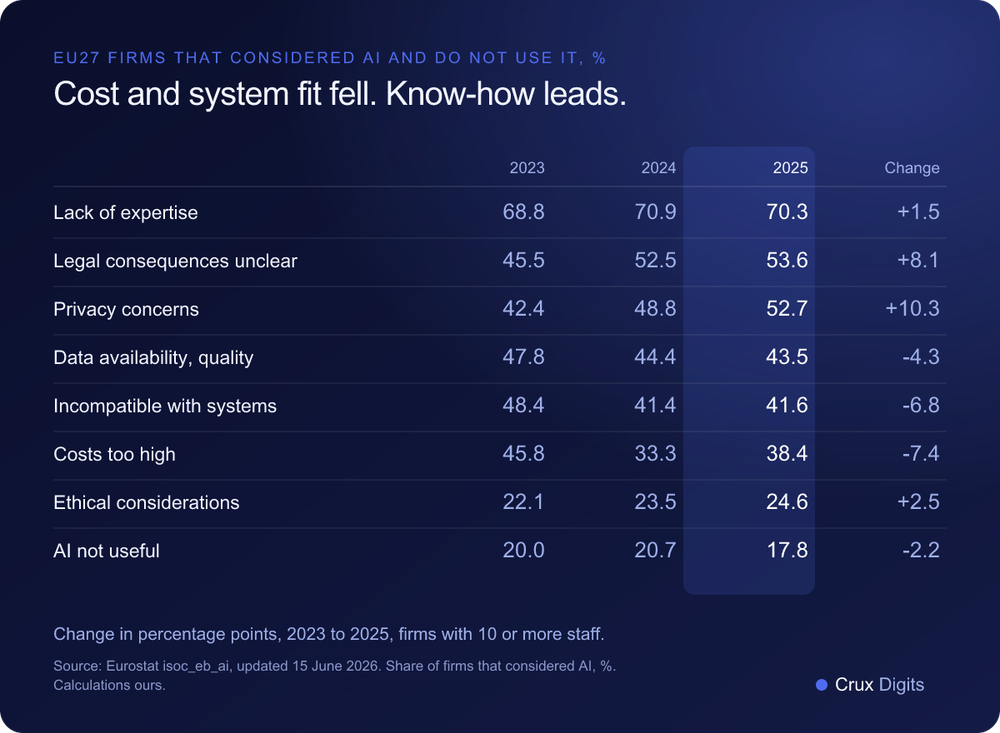
Since 2023, costs fell 7.4 points, from 45.8%. Incompatibility with existing systems fell 6.8 points, from 48.4%. Data availability or quality fell 4.3 points, from 47.8%. Privacy concerns rose 10.3 points, from 42.4%, and legal uncertainty 8.1 points, from 45.5%. Expertise moved 1.5 points.
That is progress. The barriers that need capital or a new system are shrinking. The two that grew are questions of knowledge and rules, answered with people and a process.
The group asking these questions also grew. The share of all EU enterprises that considered AI without using it went from 6.5% in 2023 to 11.1% in 2025, while the share using AI went from 8.1% to 19.9%.
Which EU countries cite each barrier most? The 2025 league table
Lack of expertise tops the list in 20 of the 21 countries with data; only in Croatia is cost named more often, 64.8% against 63.6%. Shares in 2025, high to low:
Lack of expertise (EU27 70.3): 1. Spain 82.3, 2. Denmark 82.1, 3. Netherlands 78.4, 4. Luxembourg 78.0, 5. Sweden 74.7, 6. Belgium 74.5, 7. Portugal 74.4, 8. Bulgaria 72.7, 9. Germany 72.1, 10. Slovenia 68.5, 11. Cyprus 68.3, 12. Austria 67.9, 13. Finland 65.6, 14. Hungary 65.5, 15. Croatia 63.6, 16. Latvia 63.2, 17. Poland 62.5, 18. Greece 61.8, 19. Italy 58.6, 20. Slovakia 57.9, 21. Malta 56.6.
Legal consequences unclear (EU27 53.6): 1. Germany 62.2, 2. Belgium 57.9, 3. Portugal 57.4, 4. Slovenia 56.2, 5. Luxembourg 55.5, 6. Cyprus 54.5, 7. Slovakia 54.2, 8. Poland 52.3, 9. Spain 51.3, 10. Hungary 51.3, 11. Croatia 50.3, 12. Bulgaria 50.3, 13. Latvia 50.2, 14. Austria 50.1, 15. Denmark 47.7, 16. Italy 47.3, 17. Greece 43.4, 18. Finland 42.5, 19. Sweden 39.2, 20. Netherlands 37.9, 21. Malta 31.2.
Privacy concerns (EU27 52.7): 1. Germany 60.0, 2. Latvia 58.0, 3. Portugal 55.4, 4. Luxembourg 54.7, 5. Spain 53.8, 6. Hungary 51.6, 7. Slovakia 51.5, 8. Belgium 50.9, 9. Slovenia 50.3, 10. Austria 50.2, 11. Poland 49.4, 12. Sweden 49.1, 13. Cyprus 48.3, 14. Bulgaria 47.7, 15. Netherlands 47.3, 16. Greece 46.3, 17. Finland 46.1, 18. Denmark 45.5, 19. Italy 43.2, 20. Croatia 35.9, 21. Malta 28.5.
Data availability or quality (EU27 43.5): 1. Croatia 52.7, 2. Portugal 49.2, 3. Cyprus 48.1, 4. Spain 48.0, 5. Slovenia 46.6, 6. Belgium 46.1, 7. Luxembourg 45.6, 8. Latvia 45.3, 9. Italy 45.2, 10. Sweden 44.3, 11. Germany 43.7, 12. Finland 43.5, 13. Slovakia 41.9, 14. Bulgaria 40.9, 15. Austria 40.9, 16. Denmark 38.9, 17. Greece 37.3, 18. Hungary 37.1, 19. Netherlands 36.1, 20. Poland 33.4, 21. Malta 28.9.
Incompatibility with existing systems (EU27 41.6): 1. Croatia 57.9, 2. Bulgaria 51.8, 3. Cyprus 51.2, 4. Slovakia 50.3, 5. Slovenia 49.7, 6. Latvia 48.2, 7. Finland 46.8, 8. Portugal 46.2, 9. Germany 45.4, 10. Greece 43.6, 11. Poland 40.9, 12. Luxembourg 39.3, 13. Malta 39.1, 14. Hungary 38.9, 15. Belgium 38.3, 16. Italy 38.1, 17. Sweden 37.8, 18. Austria 37.0, 19. Spain 35.4, 20. Netherlands 33.7, 21. Denmark 31.3.
Costs too high (EU27 38.4): 1. Croatia 64.8, 2. Portugal 60.4, 3. Bulgaria 55.7, 4. Poland 55.5, 5. Greece 54.3, 6. Slovakia 48.5, 7. Spain 47.4, 8. Hungary 43.2, 9. Italy 43.0, 10. Slovenia 41.8, 11. Latvia 41.8, 12. Cyprus 40.6, 13. Malta 39.9, 14. Luxembourg 39.4, 15. Belgium 35.5, 16. Germany 32.4, 17. Austria 27.6, 18. Finland 26.1, 19. Sweden 25.0, 20. Netherlands 21.6, 21. Denmark 18.0.
Ethical considerations (EU27 24.6): 1. Portugal 36.4, 2. Luxembourg 33.5, 3. Cyprus 32.1, 4. Greece 30.3, 5. Hungary 30.1, 6. Bulgaria 29.0, 7. Denmark 28.6, 8. Latvia 28.5, 9. Slovenia 27.9, 10. Belgium 27.0, 11. Austria 27.0, 12. Poland 26.6, 13. Italy 25.7, 14. Sweden 23.8, 15. Spain 23.4, 16. Germany 22.6, 17. Netherlands 20.6, 18. Slovakia 17.6, 19. Croatia 17.4, 20. Malta 16.9, 21. Finland 15.3.
The second barrier is where countries differ. Legal uncertainty is second in eight (Belgium, Cyprus, Denmark, Germany, Italy, Luxembourg, Slovakia, Slovenia), privacy in six (Austria, Hungary, Latvia, the Netherlands, Spain, Sweden), cost in five (Bulgaria, Greece, Malta, Poland, Portugal) and incompatibility in Finland.
How do lack of expertise and legal uncertainty compare in the Netherlands, Belgium and Germany?
In the Netherlands expertise is named twice as often as legal uncertainty; in Germany the two are close to level.
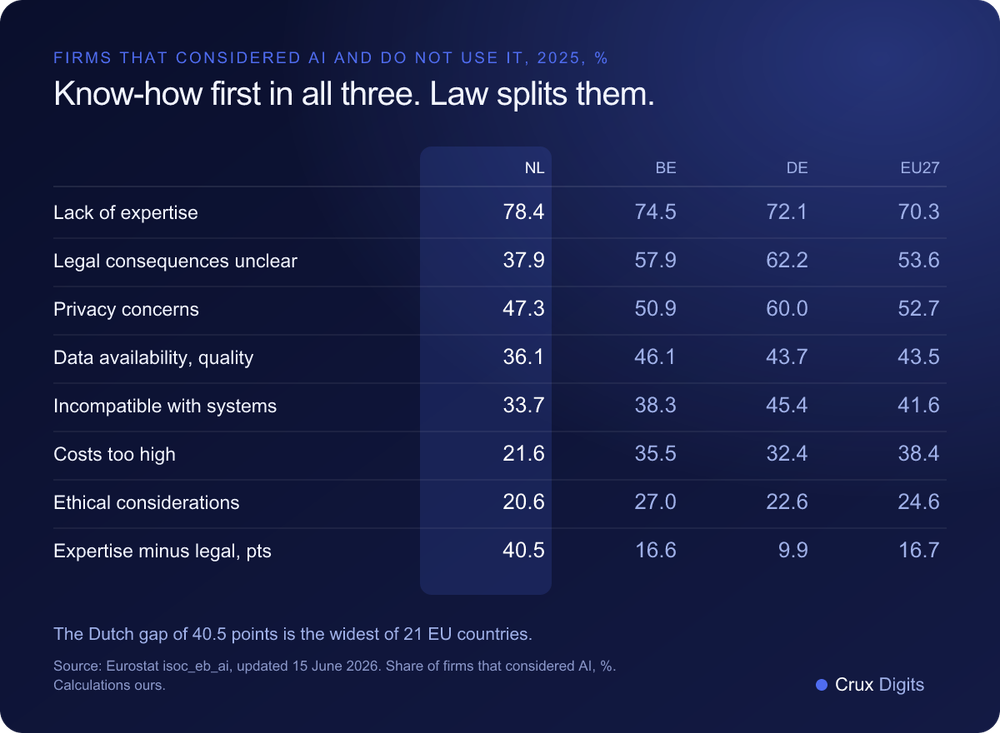
Netherlands: expertise 78.4%, legal 37.9%. Gap 40.5 points, the widest of the 21 countries, ahead of Sweden (35.5) and Denmark (34.4).
Belgium: expertise 74.5%, legal 57.9%. Gap 16.6 points, close to the EU's 16.7 (70.3% against 53.6%).
Germany: expertise 72.1%, legal 62.2%. Gap 9.9 points, the second narrowest after Slovakia (3.7). Germany has the highest share in the EU for both legal uncertainty and privacy concerns (60.0%).
A rule of thumb follows: divide the expertise share by the legal share. The Netherlands scores 2.07, the EU 1.31, Belgium 1.29 and Germany 1.16. Expect a Dutch AI plan to wait on know-how and a German one on legal review.
The Netherlands also has one of the lowest cost barriers in the EU: 21.6%, 20th of 21, with only Denmark lower at 18.0%. Belgium shows the sharpest one-year change: legal uncertainty went from 36.9% in 2024 to 57.9% in 2025, a rise of 21.0 points, the largest one-year move among 19 countries, while Belgian AI use reached 34.5%.
Germany holds the largest opening of the three. Of German firms with 250 or more staff, 22.7% considered AI and do not use it yet, the second highest share in the EU after Lithuania (25.2%). The EU figure is 16.0%, the Netherlands 12.8% and Belgium 8.7%.
Does company size change which barrier matters?
Yes: the larger the firm, the less expertise and cost weigh and the more privacy does. EU27 shares in 2025 for firms with 10 to 49, 50 to 249 and 250 or more staff:
Lack of expertise: 70.9%, 69.2%, 65.1%. Privacy concerns: 52.5%, 52.3%, 58.8%. Costs too high: 38.8%, 37.3%, 34.8%. AI not useful: 19.2%, 13.8%, 9.8%. Legal uncertainty shows no size pattern: 54.8%, 49.4%, 51.2%.
Large firms are half as likely as small ones to call AI not useful: their question is how, not whether.
The Netherlands breaks the EU pattern on law. Dutch legal uncertainty climbs with size: 36.0% at 10 to 49 staff, 41.5% at 50 to 249 and 50.0% at 250 or more, 11th of 20 countries for large firms. The low Dutch headline is a small-firm number. Large Dutch firms also rank third in the EU on privacy concerns (61.4%), behind Finland (68.3%) and Hungary (64.2%).
Adding users and firms that considered AI, 85.1% of large Belgian firms are engaged, fourth of 22 EU countries, behind Finland (91.3%), Denmark (88.7%) and Austria (86.7%). The Netherlands is at 80.4% and Germany at 79.7%, against 71.0% for the EU.
What changed after the AI Act entered into force?
Among large EU firms, legal uncertainty jumped before the AI Act entered into force and stopped rising after it. The AI Act entered into force on 1 August 2024, and its prohibitions and AI literacy duties apply from 2 February 2025, per the European Commission. Eurostat's metadata says firms usually answer in the first half of the year, so the 2024 survey came before entry into force and the 2025 survey after both dates.
Legal consequences unclear, EU27 firms with 250 or more staff: 37.0% in 2023, 51.4% in 2024, 51.2% in 2025. For all firms with ten or more staff: 45.5%, 52.5%, 53.6%. Most of the increase came between the 2023 and 2024 surveys, before the Act entered into force.
Privacy concerns kept rising: 39.1%, 52.2% and 58.8% among large firms. Across countries, legal uncertainty rose between 2024 and 2025 in 13 of 19 and fell in 6. Belgium rose most (+21.0); Malta fell most (-11.0).
The survey does not name the AI Act, so this is timing, not cause. The Digital Omnibus on AI entered into force on 27 July 2026, per the same Commission page; any effect shows first in the 2026 survey. See what the Omnibus changed.
What does this mean for an IT manager or CIO at a 250 to 5,000 FTE organisation?
Treat expertise as the first barrier to remove: it outranks every other reason in 20 of 21 countries.
Benchmark on your size class. The Dutch legal figure is 37.9% overall and 50.0% for large firms. The national number understates what your peers face.
Make the legal question small: answer it per use case, with a risk classification under the AI Act and a data protection impact assessment, not as a verdict on AI as a whole.
Count the opening: one in six large EU firms considered AI and is not using it yet. Closing the expertise gap first puts you ahead of that group.
Crux Digits designs and builds AI systems next to an organisation's ICT partner or IT team and hands over code the organisation owns; we are not an ICT partner. We work on the first barrier in this table: the know-how to scope, build and evidence one process at a time. For the wider picture of Dutch adoption, see our study of AI use in the Netherlands.
What are the limits of this data?
It is a survey of stated reasons, not a measurement. Firms may tick several, and the shares say nothing about which reason weighed most.
The base is small: only firms that considered AI and do not use it, 11.1% of EU enterprises with ten or more staff. Eurostat withholds cells it judges unreliable, which is why German large-firm reasons are missing.
Six member states, France among them, publish no barrier figures for 2025. The EU27 value is Eurostat's own aggregate.
The group of non-users changes as adoption grows. A barrier share can rise because the firms that solved it started using AI and left the group.
The short version
1. Lack of expertise is the top reason EU firms that considered AI do not use it: 70.3% in 2025, first in 20 of the 21 member states with data.
2. Cost is fading as a barrier: it fell from 45.8% to 38.4% of EU firms that considered AI between 2023 and 2025, and stands at 21.6% in the Netherlands, second lowest in the EU.
3. The Netherlands has the EU's widest gap between lack of expertise (78.4%) and legal uncertainty (37.9%): 40.5 points, against 16.6 in Belgium and 9.9 in Germany.
4. Among large EU firms, legal uncertainty rose 14.4 points to 51.4% before the AI Act entered into force and held at 51.2% in the first survey after it.
5. One in six large EU firms (16.0%) has considered AI without using it yet; in Germany it is 22.7%, the second highest share in the EU.
How we work with organisations in the Netherlands: AI consulting in the Netherlands.
Last updated: 28 October 2026.
A consultant tells you where AI pays off; Crux Digits also builds it. A fixed price per step, one named expert, from Utrecht.
AI consultancy in the Netherlands →