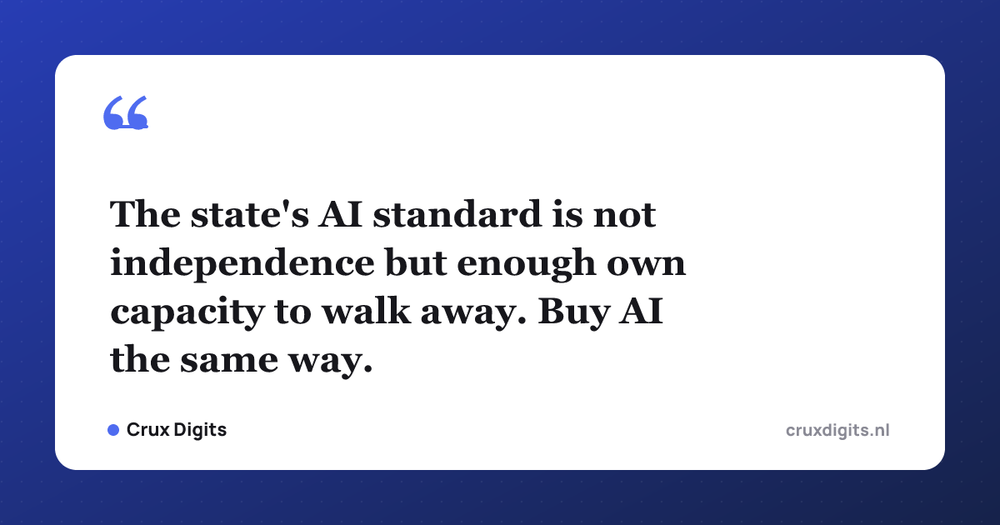
The cabinet vision on AI of 6 November 2026 changes no rule for companies and brings no new money for mid-sized organisations. What it does do is state plainly the standard the cabinet applies to the country's own AI dependencies: enough knowledge and capacity of our own, not independence. That one sentence is worth more to an IT director than every headline about sovereignty.
We read the full 28-page Kamerbrief "Kiezen voor AI voor iedereen" rather than the press release, because the two differ. The release talks about grip and sovereignty. The letter talks about budgets, dates and procurement conditions, and most of those are addressed to the government itself. This post sorts the letter into what is decided, what is announced for later, and what an IT organisation of 250 to 5,000 people can take from it this quarter.
What the vision decides, and what it leaves open
Decided, with a number or a date attached:
- €120 million for Dutch participation in an IPCEI for AI, an Important Project of Common European Interest, to develop AI technology, infrastructure and applications with cross-border consortia. The letter names no year; the money sits in the EZK draft budget for 2027, AIwereld reports, and projects and recipients are not yet chosen.
- A 75 percent target. At least three quarters of SMEs should use advanced digital technology by 2030, with AI, cloud and data analytics counted as one category. For scale: CBS puts AI use in 2025 at 13.8 percent for micro firms, 29.8 percent for firms with 10 to 250 staff and 66.2 percent for 250 staff and more.
- Two letters in Q1 2027. One on AI infrastructure and compute, which also answers the motion on running AI models locally on government systems, and one titled Regie op datacenterontwikkeling, on national direction of datacenter capacity.
- An AI safety institute, studied. An advisory report on a Dutch institute modelled on the UK AI Security Institute is expected in the Tweede Kamer in December 2026. The institute is a study, not a decision.
- For government bodies: uniform procurement conditions for AI, an auditable Algoritmekader, a fuller Algoritmeregister, preparation for the Fundamental Rights Impact Assessment, more joint purchasing and a digital marketplace of validated AI applications and building blocks. Applications named for scaling: Vlam.AI, GemChat, Omgevingschat, HOSAN and GPT-NL within GEM.
Left open: any new obligation for companies beyond the AI Act already in force, any change in who supervises, and any subsidy or voucher for firms above the SME line. The barriers that keep SMEs from using AI are named, but the measures against them are, in the words of Accountancy Vanmorgen the same day, not yet worked out. How much compute the country needs, where it goes and on what power all wait for the Q1 letter.
Open strategic autonomy is a procurement criterion you can copy
The letter defines what it means by sovereignty, and the definition is narrower than the coverage. The EU does not need to be self-sufficient across the whole AI stack. It needs enough basic capacity at a few critical points, among them semiconductor production, high-end compute, trustworthy data storage and cloud, and generic AI models. Everything else may come from partners. The letter names Canada, Japan, Singapore and South Korea as like-minded partners, and says relations with the United States and China must stay stable and predictable, Pax Silica included.
Translate that from a country to a company and you get a supplier test that most IT organisations do not run yet. Not "is this vendor European", but "at which points in our AI stack do we need enough capacity of our own to walk away". Four points, in the order they usually bite:
- The model. Can the application run on a second model from a second provider without a rewrite? That means an abstraction layer, evaluation sets you own, and prompts kept in your repository rather than in a vendor console.
- The data path. Where does a prompt travel, where does the retrieval index live, where are the logs? Our post on data residency for AI walks the four paths a model call can take.
- The weights. For some workloads an open-weight model you host yourself is the exit; for most it is not. The comparison of open-weight and paid models and the cost analysis of self-hosting Mistral Large 4 give the trade-off with numbers.
- The people. Enough knowledge of your own means someone inside who can read an evaluation report and change a provider. That is a role, not a licence, and our post on keeping the evals in-house describes what the state itself learned about it.
The letter also supports the pragmatic buyer. The cabinet writes that it will keep securing access to advanced AI from non-European providers where Europe lacks the capacity, through what it calls AI diplomacy. A company that bans American models in the name of sovereignty is stricter than the state that coined the term. The defensible policy is portability, not purity. Where data genuinely may not leave the building, the right shape is a private AI assistant on your own infrastructure, chosen for that reason and not for a flag.
If you sell to government, or are one
The most concrete part of the letter is about the state's own AI. Uniform procurement conditions, an auditable Algoritmekader, the IAMA human-rights assessment, FRIA preparation, the Algoritmeregister, a marketplace, joint purchasing. For a supplier to a municipality, province, ministry or uitvoeringsorganisatie, that list is the 2027 tender in advance. Expect to be asked for a model card with the training-data provenance you can actually state; a human-oversight design, because the letter says AI may not lead to decisions falling fully outside human oversight or responsibility; logging an auditor can read; documentation ready for the Algoritmeregister; and a reusable building block rather than a one-off, because a marketplace rewards reuse. The clauses themselves are in our post on AI procurement conditions for Dutch buyers.
For a government IT department the same list is the backlog. Our AI audit and strategy work is built around exactly that paperwork: the assessment that comes before the build, written so that an auditor and a procurement officer can both read it.
Compute: do not wait for the Q1 2027 letter
The letter promises to answer three motions early next year: scenarios for the compute the Netherlands needs, an inventory of the government's compute needs for ten years, and the options for running models on government systems. A company does not need the national answer to make its own. Whether to self-host a model is a utilisation question, and the inputs are known today: the hours a GPU would actually run, the headcount to operate it, and the price of the hosted alternative at your volume.
What the letter adds is a route rather than an answer. The national AI factory in Groningen, with the supercomputer planned for 2027 and full operation in early 2028 according to AIwereld, gives companies access to compute hours and expertise through EuroHPC, and the five European Digital Innovation Hubs and seven Dutch AI hubs work alongside it. For an R&D-heavy mid-sized firm that wants to fine-tune rather than rent, that is a channel that did not exist two years ago. It is also one of the few places in the letter where a company can apply for something.
Two things already binding: cyber and literacy
The letter repeats the 24 September statement of the AIVD, MIVD, NCSC, NCTV, CIO Rijk and the police: AI accelerates the cyber threat, and digital security is no longer a matter for the CISO and the IT staff alone. The same day, the minister of Justice sent the action programme Toekomstbestendige Digitale Weerbaarheid to the Kamer. For organisations under NIS2, the Cyberbeveiligingswet puts that accountability on the board; our post on what NIS2 means for your AI supplier lists the questions to put to every vendor in the chain.
Literacy is the other duty that already applies. Article 4 of the AI Act has required AI literacy of every organisation that uses AI since 2 February 2025, and the letter pushes AI skills into mbo, hbo and university education. Our free three-minute AI literacy check shows where a team stands, and the training page is the step after it.
The AI Act dates themselves are unchanged by the vision. After the Digital Omnibus, Regulation (EU) 2026/1744, the high-risk duties of Annex III apply from 2 December 2027 and those of Annex I from 2 August 2028. Two additions to the Article 5 prohibitions apply from 2 December 2026, and the Article 50 transparency duties have applied since 2 August 2026. The letter says the cabinet will keep pressing for rules that are clear, workable and enforceable, which in practice means harmonised standards and a regulatory sandbox at the market surveillance authorities still to be designated, rather than new law.
The calendar to put in your planning
- 13 November 2026: informal European Council under the Irish presidency, where the cabinet hopes AI is discussed at head-of-government level for the first time.
- 2 December 2026: the new Article 5 prohibitions apply.
- December 2026: advisory report on a Dutch AI safety institute to the Tweede Kamer.
- Q1 2027: the Kamerbrief on AI infrastructure and compute, and the Kamerbrief Regie op datacenterontwikkeling.
- 2027: the €120 million IPCEI participation enters the EZK budget, on the reporting so far; citizen dialogues on AI in 2027 and 2028.
- 2 December 2027: Annex III high-risk obligations apply.
What we would do this quarter
- Write the four-point exit test into the next AI request for proposals, and score vendors on it next to price.
- Move prompts, evaluation sets and retrieval configuration into your own repository, so a provider change is a deployment and not a project.
- If you supply government, assemble the FRIA-ready dossier for your existing product now, before a tender asks for it in a three-week window.
- Run the literacy check per team and book Article 4 training where it fails, because that duty is already live.
- Put the Q1 2027 letters in the roadmap as a decision point for self-hosting, not as a reason to wait.
None of this needs a sovereignty programme. It needs an AI implementation that is built to be moved, by a partner who works alongside your ICT partner and leaves the keys with you. That is the standard the cabinet has now set for itself, and it is a reasonable one to hold a supplier to.
A consultant tells you where AI pays off; Crux Digits also builds it. A fixed price per step, one named expert, from Utrecht.
AI consultancy in the Netherlands →