Anthropic released Claude Fable 5.2 on 9 November 2026, together with Claude Mythos 5.2, the same model with fewer safeguards for vetted security and life-sciences organisations. The list price fell to $8 per million input tokens and $40 per million output, from $10 and $50 for Fable 5.1, and Anthropic says output runs up to 30 percent faster. Context stays at 1 million tokens with 128,000 tokens of output. Anthropic's announcement and the Claude pricing page carry those figures.
The launch headline is a proof. Anthropic says 1,000 agents running Fable 5.2 formalised Fermat's Last Theorem in about 30 hours, where its first formalisation took 11 days, and that Opus 5.5 in the same setup finished 26 percent of it in 18 hours. That is a vendor demonstration, not a benchmark you can rerun. The useful questions for an IT team are narrower: where does 5.2 actually lead, what does a task cost, and how close are GPT-6 Astra and the open-weight models.
Anthropic's own table: where Fable 5.2 leads and where it does not
Anthropic compares Fable 5.2 with Fable 5.1, Claude Opus 5.5, GPT-6 Astra and Gemini 4 Carbon, each at its highest available effort unless noted. On most rows Fable 5.2 leads:
- FrontierCode 2.0, agentic coding: 49.1 percent, against 45.5 for Opus 5.5, 42.8 for GPT-6 Astra, 41.1 for Gemini 4 Carbon and 32.4 for Fable 5.1.
- FrontierSWE v2: 69.9 percent, against 65.5 for Astra and 62.3 for Opus 5.5.
- OSWorld 2.1, computer use: 89.3 percent, against 87.2 for Opus 5.5 and 79.5 for Astra.
- Humanity's Last Exam with tools: 74.2 percent, against 67.7 for Opus 5.5 and 57.2 for Astra.
- Remote Labor Index: 41.3 percent, against 21.3 for Opus 5.5 and 20.8 for Astra. One of the largest jumps in the table, roughly double.
Two rows go the other way. On AutomationBench, which tests business workflows across tools, Gemini 4 Carbon scores 53.9 against 51.4 for Fable 5.2. On the AA-Briefcase knowledge-work Elo, Opus 5.5 scores 1,800 against 1,785. If your use case is workflow automation across SaaS tools, the vendor's own table tells you to test more than one model.
What independent tests say
Vendor tables pick their benchmarks. Two independent evaluators had scores within a day of launch.
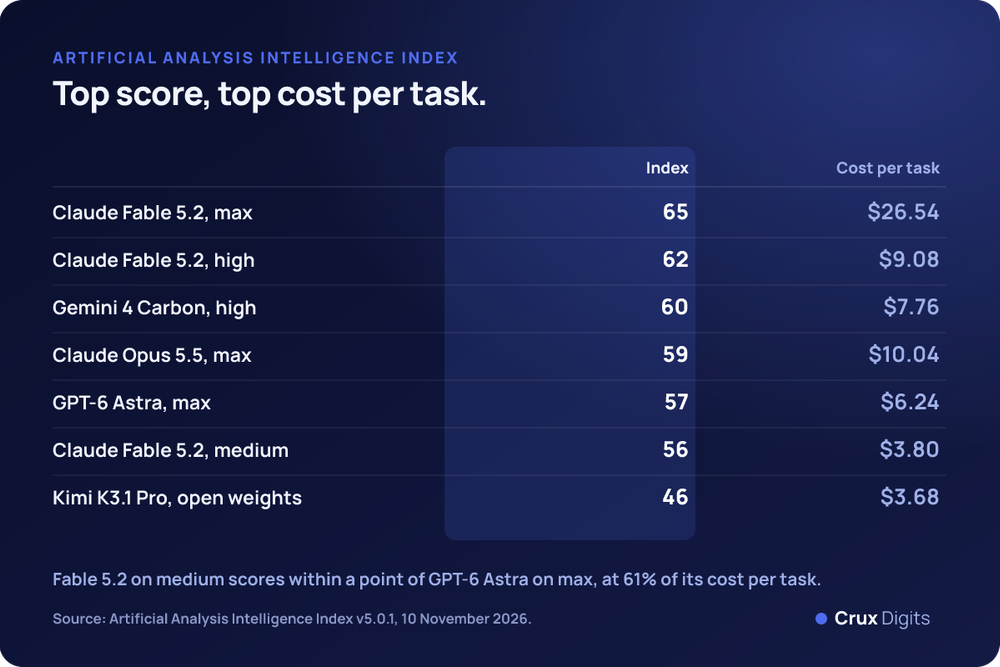
Artificial Analysis puts Fable 5.2 at maximum effort first on its Intelligence Index v5.0.1 with 65. Gemini 4 Carbon at high effort follows with 60, Opus 5.5 at max with 59 and GPT-6 Astra at max with 57. The best open-weight model, Kimi K3.1 Pro, scores 46.
Vals AI ranks Fable 5.2 first of 36 on the Vals Index at 71.31 percent, run at high effort. The next two are the surprise: Claude Sonnet 5.5 at 70.85 and Gemini 4 Carbon at 70.45. Sonnet 5.5 sits less than half a point behind at a quarter of Fable's list price. GPT-6 Astra scores 65.02 and ranks seventh.
The independent results also show where Fable 5.2 does not lead:
- Vals Science Index: GPT-6 Astra 65.09 percent, Fable 5.2 63.74.
- Terminal-Bench-Science on Vals: Astra 62.86 percent, Fable 5.2 55.71. Anthropic's own run of version 0.1 had Fable ahead, 74.6 against 68.1, so the harness changes the winner.
- SWE-bench Multimodal on Vals: Opus 5.5 70.21 percent, Fable 5.2 62.29.
List price against cost per task
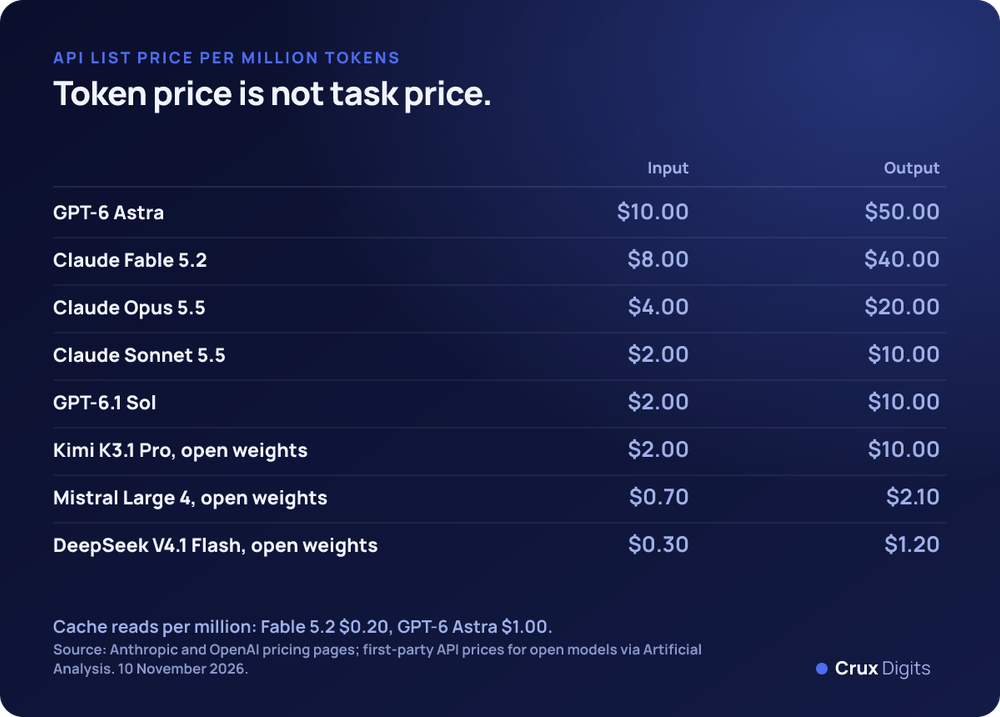
Fable 5.2 is less expensive per token than GPT-6 Astra, which is $10 in and $50 out on OpenAI's pricing page. Per task it is the other way round. Artificial Analysis measured $26.54 per Intelligence Index task for Fable 5.2 at max effort, against $6.24 for Astra at max: 4.3 times as much. The reason is volume. Fable 5.2 produced 275 million output tokens across the index, against a median of 72.8 million for models in its class.
The effort setting is where the money is. The same index across Fable 5.2's effort levels:
- Low: 54, at $3.10 per task.
- Medium: 56, at $3.80.
- High: 62, at $9.08.
- Xhigh: 62, at $14.83.
- Max: 65, at $26.54.
Three readings follow. Medium scores within one point of GPT-6 Astra at max for 61 percent of Astra's cost per task. High scores the same as xhigh for 61 percent of the cost. And high beats Opus 5.5 at max, 62 against 59, for slightly less money. Anthropic makes the same point on its coding benchmark: at high effort Fable 5.2 scores 45.3 percent on FrontierCode, level with Opus 5.5's best, at about half the cost per task. VentureBeat, citing the system card, reports that max effort scored 45.7 percent at $44.70 per task, below xhigh at 49.1 percent and $14.19. More effort is not always a better answer.
For agents, one line on the bill matters more than the headline price: cached input. Fable 5.2 charges $0.20 per million cache-read tokens, GPT-6 Astra $1.00. Take one agent turn with 120,000 tokens of cached context, 2,000 new input tokens and 1,000 output tokens:
- Fable 5.2: $0.024 cache read, $0.016 input and $0.040 output, so $0.080 per turn.
- GPT-6 Astra: $0.120, $0.020 and $0.050, so $0.190 per turn.
- Fable 5.1, for reference: $0.100 per turn.
On identical token counts Astra costs 2.4 times as much per turn. Astra can close that gap only by finishing the job in fewer turns, which is something to measure on your own tasks. We worked the same example for Fable 5.1 in our GPT-6 Astra comparison.
Open-weight models: the gap depends on the test
On the broad index the gap is wide. Kimi K3.1 Pro, from Moonshot and released on 23 October, scores 46 on Artificial Analysis against 65 for Fable 5.2, a gap of 19 points. The other leading open-weight models are further back:
- DeepSeek V4.1 Flash: 33, MIT licence, $0.60 per index task.
- GLM-5.3 from Z.ai: 32.
- Mistral Large 4, from France and released on 29 October: 26, the highest-scoring European open-weight model.
- Qwen3.8 27B: 20, Apache 2.0, a 27-billion-parameter dense model with a 256,000-token context.
On agentic terminal work the gap nearly closes. On the Vals Terminal-Bench 4.0 run Kimi K3.1 Pro scores 63.64 percent against 65.15 for Fable 5.2 and 59.60 for GPT-6 Astra, and Artificial Analysis ranks Kimi first on the same benchmark at 67.2. Kimi costs $2 in and $10 out per million tokens and $3.68 per index task.
Check two things before you treat open weights as the sovereign option. First, the licence. Kimi K3.1 Pro ships under its own licence that allows commercial use with restrictions, and Mistral Large 4 needs a commercial licence for a hosted service. DeepSeek V4.1 Flash (MIT) and Qwen3.8 (Apache 2.0) are the permissive ones. Second, the size. Kimi K3.1 Pro has 2.8 trillion parameters with 104 billion active, so running the strongest open model in your own environment is a GPU cluster project, not a server. We set out that trade-off in open-weight versus paid models.
Which model for which workload
No single model wins every row, so pick per workload and keep the choice configurable:
- Long autonomous coding and agent runs where a failed run is expensive: Fable 5.2 at high effort. Move to xhigh only where your own tests show a gain.
- Business workflow automation across SaaS tools: test Gemini 4 Carbon alongside Fable 5.2, because it leads AutomationBench.
- High-volume, well-defined tasks: Claude Sonnet 5.5, within half a point on the Vals Index at a quarter of the price, or GPT-6.1 Sol, which scores 55 on Artificial Analysis at $1.27 per task.
- Scientific and analytical work: include GPT-6 Astra, which leads the Vals Science Index.
- Data that may not leave your environment: an open-weight model, DeepSeek V4.1 Flash for a permissive licence or Kimi K3.1 Pro where its licence terms fit.
Then test on your own work. Fifty to a hundred real tasks from your tickets, documents or repositories, scored the way your team would score them, tell you more than any table in this article. Log the model ID and effort level with every call, because effort labels are not comparable across vendors. We wrote down how to set up that routing in choosing a model per agent workload. Crux Digits in Utrecht builds that evaluation set from a client's own material before a model is chosen, so the next release becomes a configuration change rather than a rebuild.
How to read these numbers
Every figure here comes with a caveat worth knowing:
- Effort settings differ. Anthropic reports each model at its highest available effort, Artificial Analysis headlines Fable 5.2 at max and Vals ran it at high.
- The model is one day old. Fable 5.2 is not yet in the top ten of Arena's agent leaderboard, and independent scores will move as more runs come in.
- Benchmark versions matter. Vals has archived SWE-bench Verified as saturated, so older coding scores are not comparable with FrontierCode or Terminal-Bench 4.0.
- The per-task costs quoted from VentureBeat come from Anthropic's system card as VentureBeat reports it.
Figures as published on 10 November 2026.
We build custom AI and LLM systems that run in production: a clickable MVP by the second call, fixed steps, and you own the code.
AI agency in the Netherlands →