The model race moved three times in November. Anthropic released Claude Fable 5.2 on 9 November. Google followed with three Gemini 4 models in eight days: Carbon on 10 November, Hydrogen on 12 November and Neon on 18 November. OpenAI released GPT-6.2 Astra and GPT-6.2 Sol on 17 November. In Europe, Mistral had published the weights of Mistral Large 4 on 29 October.
We read every public leaderboard we could on 25 November 2026. The picture is clearer than the launch posts suggest: Google leads on human preference, Anthropic leads the broad capability index, OpenAI has lost its automatic place at the top, and Europe's best model is well behind on capability but ahead on terms that matter to European buyers. Below are the numbers, where they come from, and what they mean for an IT team choosing models.
Who is number one depends on the board
No single model leads every ranking, so a headline that says one model is "the best" cannot be defended. Here is each board as we read it on 25 November:
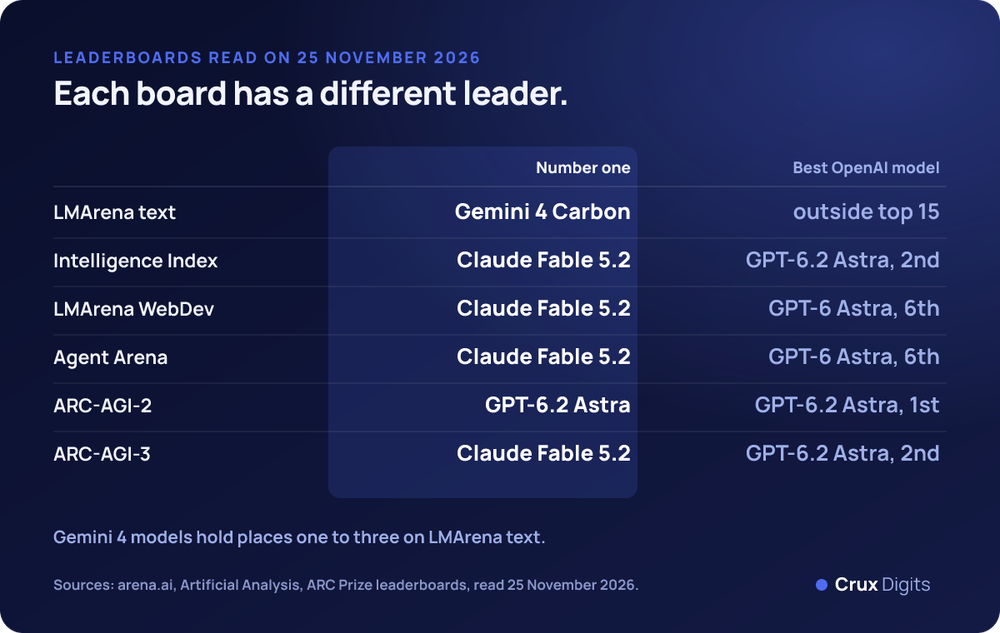
- LMArena text (now called Arena; blind human votes, updated 22 November): Gemini 4 Carbon 1,527, Gemini 4 Argon 1,520 and Gemini 4 Neon 1,512 hold the top three places. The best non-Google models are Meta's Muse Wonder at 1,512 and Claude Opus 5.5 at 1,507. No OpenAI model is in the top 15.
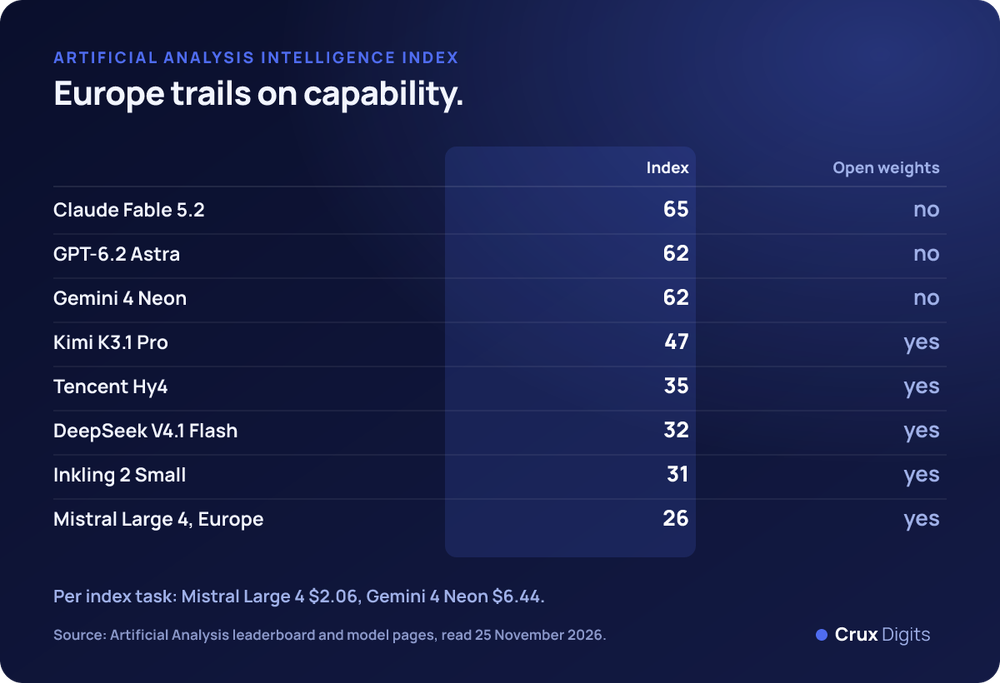
- Artificial Analysis Intelligence Index (a composite of independent evaluations): Claude Fable 5.2 65, GPT-6.2 Astra 62, Gemini 4 Neon 62, Gemini 4 Carbon 60, Claude Opus 5.5 59.
- LMArena WebDev (building working web apps): Claude Fable 5.2 1,822, Claude Opus 5.5 1,820. The best Gemini is Carbon in fourth place, the best OpenAI model GPT-6 Astra in sixth.
- Agent Arena: Claude Fable 5.2 1,449, well clear of Claude Opus 5.5 at 1,342 and Gemini 4 Neon at 1,331. GPT-6 Astra is sixth.
- ARC-AGI-2 (abstract reasoning puzzles): GPT-6.2 Astra 95.8 percent, GPT-6 Astra 95.0, Gemini 4 Carbon 94.2. The test is close to saturated: the top ten sit within five points.
- ARC-AGI-3 Standard, its harder successor: Claude Fable 5.2 81.2 percent, GPT-6.2 Astra 70.3, Gemini 4 Carbon 65.1.
The pattern is consistent. People asked to pick the better answer pick Gemini. Long agentic and coding tasks go to Claude. OpenAI wins the reasoning puzzle and is close on the broad index, but has dropped down the human-preference boards it used to lead.
Where Gemini 4 outperforms
Google's advantage is not one benchmark. It is the combination of human preference, cost per task and a range of model sizes released in a single month.
- Human preference: the three Gemini 4 models above hold the top three text places on LMArena, a board built from blind comparisons, not from tests a lab can train for.
- Cost per task: on ARC-AGI-3, Gemini 4 Carbon scored 65.1 percent at a cost of $7.2K, against $21.9K for Claude Fable 5.2 and $24.2K for GPT-6.2 Astra. Artificial Analysis puts Gemini 4 Neon at 62 on its index for $6.44 per index task.
- Range: Neon ($3 per million input tokens, $15 output) sits between Carbon for the hardest long tasks and Hydrogen ($1.50 and $7.50) for fast everyday work. Carbon is on an introductory $2 and $10 until 30 November and moves to $4 and $20 after that, according to Google's announcement.
- Reach: Alphabet reported more than 1 billion monthly users of the Gemini app on 28 October. Gemini's share of generative AI web visits rose from 13.6 percent in October 2025 to 24.7 percent in October 2026, according to Similarweb data, although it has slipped four months in a row since its April peak.
Read Google's own numbers next to the independent ones. In its Neon announcement Google reports 71.3 percent on Humanity's Last Exam (Diamond subset); Scale's SEAL leaderboard measured 65.3 percent. For Carbon, Google claims first place on CursorBench 4.0 and two other agent tests without publishing the scores. Both may still hold up, but the independent figure is the one to plan with.
For Dutch and Belgian organisations the practical point is residency. On Google Cloud, Gemini 4 Neon is generally available in the EU multi-region endpoint with data residency, customer-managed encryption keys and VPC Service Controls, for verified enterprise customers. That is the contract line to ask for; the consumer Gemini app is a different service.
Is OpenAI falling behind?
In part, and the evidence should be read precisely. OpenAI is not losing on every measure, but it no longer leads by default.
The signs of lost ground:
- On LMArena text no OpenAI model is in the top 15, and its best vision model, GPT-6.1 Sol, is thirteenth. On WebDev and Agent Arena its best model is sixth.
- GPT-6.2 had a difficult launch. Several well-known power users criticised it in public; Matt Shumer called it "essentially unusable", VentureBeat reported. Others were positive. At launch the new models were available in ChatGPT Work and Codex, not in the regular chat.
- The Financial Times and the Wall Street Journal reported that OpenAI cut the target of its new funding round from $30 billion to $20 billion, with about $11 billion committed, as TechCrunch summarised. OpenAI did not comment.
Where OpenAI still leads or is close:
- GPT-6.2 Astra is first on ARC-AGI-2, second on ARC-AGI-3 and joint second on the Artificial Analysis index at 62, three points behind the leader.
- ChatGPT still takes 56.6 percent of generative AI web visits, more than twice Gemini.
- In Menlo Ventures' survey of about 400 US enterprise buyers, OpenAI's share of enterprise API spend rose from 27 to 31 percent over the year, the firm reported. Anthropic's rose from 40 to 55 percent and Google's fell from 21 to 9. Menlo is an investor in Anthropic, and these are survey estimates, not revenue.
The fair summary: OpenAI has lost the clear lead it once had, not the race. For a buyer that changes one thing. ChatGPT or the OpenAI API is no longer the safe default that needs no comparison.
European models: behind on capability, ahead on other terms
Start with the honest number. Mistral Large 4, the strongest European model, scores 26 on the Artificial Analysis index, against 65 for the leader. It sits 31st among scored models. The best open-weight models are Chinese: Kimi K3.1 Pro at 47, Tencent Hy4 at 35 and DeepSeek V4.1 Flash at 32. Even among Western open models, Thinking Machines' Inkling 2 Small (31) is now ahead. Mistral reports 41 percent on Terminal-Bench 4.0; Artificial Analysis measured 24.7. Europe is not winning the benchmark race, and the gap is not closing this quarter.
Europe is winning on other terms, and they are the ones European procurement teams are asked about:
- Open weights at frontier scale. Mistral Large 4 has about 1 trillion parameters with 52 billion active and a 1 million token context, and Mistral says it trained the model from scratch in its own European data centres. You can run it on your own hardware. Read the licence first: it is a modified MIT licence, and offering the model as a hosted service to others needs a separate commercial licence.
- Price. Through Mistral's API Large 4 costs $0.70 per million input tokens and $2.10 output, and Artificial Analysis puts it at $2.06 per index task, about a third of Gemini 4 Neon.
- Contracts. France's armed forces ministry signed a framework agreement with Mistral in January, with its tools running on French infrastructure. Mistral names ASML, ABN AMRO, Belfius, ENISA, the European Space Agency, CrowdStrike and Cisco among Large 4 users and partners.
- Capital. Mistral raised €3 billion at a valuation above €21 billion in September, led by Samsung, with ASML and Belfius among the existing investors who joined. Mistral calls it the largest equity round ever completed by a European technology company.
- Rules. Mistral, Aleph Alpha, Black Forest Labs, Pleias and the Amsterdam company Dweve are among the 22 signatories of the EU code of practice for general-purpose AI. Meta is not on the list.
The rest of the field is specialised rather than general. Black Forest Labs makes the FLUX image models, DeepL released its voice translation model Aure on 11 November, and Kyutai and H Company work on voice and computer-use agents; on 16 November H Company announced that its agents run on the AWS European Sovereign Cloud. Cohere and Aleph Alpha agreed to merge in September; we found no confirmation that the deal has closed. The EU-funded OpenEuroLLM has its first model due on 31 December 2026.
What it means in the Netherlands and Belgium
Sovereignty is a policy aim here, but it does not decide purchases on its own.
- The cabinet presented its AI vision on 6 November. It does not aim for full independence; a plan for Dutch AI infrastructure and compute is due in early 2027, BP Nieuws reported.
- The government's own chatbot for civil servants, VLAM-chat, runs on European open-source models in a government data centre, for a starting group of about 26,500 civil servants.
- UWV moved its chatbot pilot from Mistral's Le Chat to Microsoft Copilot Chat, which led to written questions in parliament. A European model is not chosen by default when the alternative is already in the Microsoft licence.
- GPT-NL, built by TNO, SURF and NFI, is available to launching customers only, with version 1 targeted for this autumn.
- Neither the Netherlands nor Belgium is among the 18 member states in the joint procurement for the EU's AI gigafactories, for which the call closed on 12 November.
- The EU AI Act timeline after the 2026 omnibus brings two dates close: from 2 December 2026 generative systems already on the market must mark their output as AI-generated, and the high-risk rules for Annex III systems follow on 2 December 2027.
How to choose a model now
The rankings changed three times in one month. A model choice that is written into code, contracts and training is the bigger risk than picking the second-best model.
- Choose per workload, not per vendor. On today's numbers: Claude Fable 5.2 for long agentic and coding work, Gemini 4 Neon or Carbon where cost per task and long context matter, GPT-6.2 Astra worth testing for structured reasoning, and Mistral Large 4 where data must stay on European or your own infrastructure and the task is extraction, classification or summarising rather than frontier reasoning.
- Test on your own work. Fifty to a hundred real tasks from your tickets, documents and code tell you more than any of the boards above. We explained the method in our Claude Fable 5.2 benchmark analysis.
- Keep the model configurable. Route calls through one layer that records model, version and cost per call, so a switch is a setting and not a project. Our post on model router architecture shows the pattern, and a model-independent AI strategy covers the contract side.
- Put residency in writing. Region, encryption keys, retention and sub-processors belong in the agreement, whichever vendor you choose. For self-hosting, our Mistral Large 4 cost analysis and the comparison of open-weight and paid models cover hardware and licences.
- Re-read the boards monthly. Leaderboard positions are a snapshot; the figures in this post were read on 25 November 2026.
We build custom AI and LLM systems that run in production: a clickable MVP by the second call, fixed steps, and you own the code.
AI agency in the Netherlands →